
Through the Flaming Sword
February 14, 2026 § Leave a comment
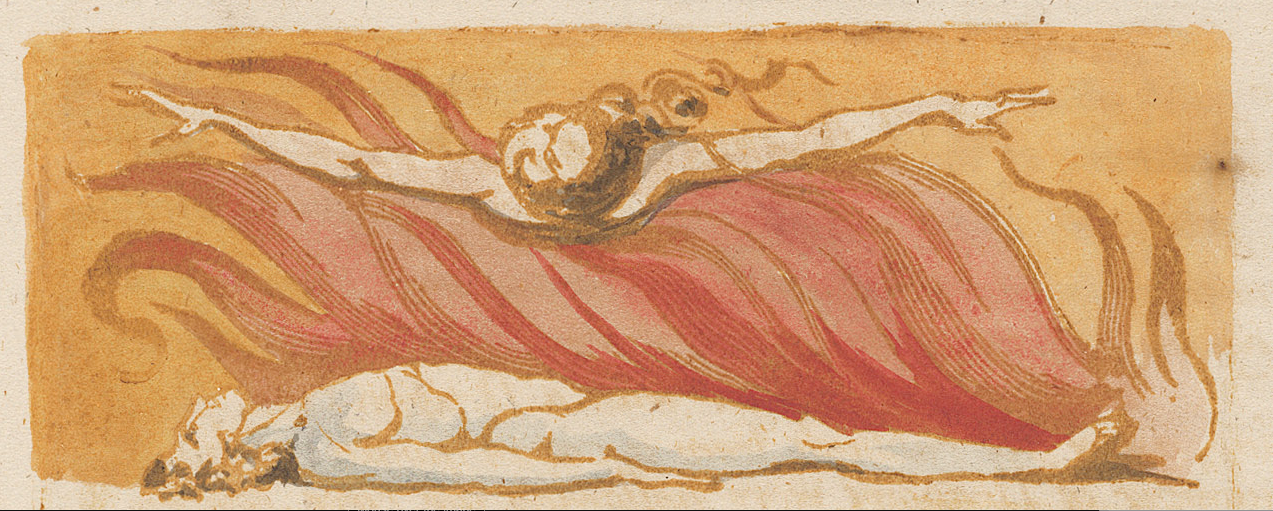
This painting by the poet William Blake is the image I use as the banner image for this blog. The “flaming sword” comes from the story of “the Fall” in Genesis three, which I’ll quote below; I’ll also quote from Blake and from George Fox.
The image
But Blake’s painting is hardly directly representational, as we’ll see from the Genesis passage.
- There are flames but no sword or gate into Paradise.
- The cherub is oddly presented and is human, or at least humanoid, in form, whereas cherubim are variously described in the Bible and other ancient mythologies, but always in some composite and mostly animal form. The cherubim that sit atop the ark of the covenant at least have wings.
- The human, presumably Adam, is supine, laid out almost as though he is dead. He has fallen.
Genesis 3:22–24:
And Yahweh God said, Behold, the man is become as one of us, to know good and evil; and now, lest he put forth his hand, and take also of the tree of life, and eat, and live forever:
Therefore Yahweh God sent him forth from the garden of Eden, to till the ground from whence he was taken.
So he drove out the man, and he placed at the east of the garden of Eden Cherubim, and a flaming sword which turned every way, to keep the way of the tree of life.
Comment
So the cherubim’s charge is to keep humans from reentering Paradise, eating from the tree of life, and becoming immortal. Yahweh and his angelic court (the “us” in the quote) are worried that humans will become like them. And we are already halfway there, having learned good and evil.
Blake’s blanket of flames and the outstretched arms of the cherub block the laid out Adam from rising.
Blake’s text
This image accompanies a page in Blake’s “The Marriage of Heaven and Hell”, one of his prophetic books, which is mostly text as captions for a series of paintings with a poem prologue. The poet presents himself as having descending into Hell and come back with prophecy that will reconcile heaven and hell. Here’s the text on that page. Note that Blake has given us here a significant phrase.
The ancient tradition that the world will be consumed in fire at the end of six thousand years is true, as I have heard from Hell.
For the cherub with his flaming sword is hereby commanded to leave his guard at tree of life; and when he does, the whole creation will be consumed and appear infinite and holy, whereas it now appears finite & corrupt.
This will come to pass by an improvement of sensual enjoyment.
But first the notion that man has a body distinct from his soul is to be expunged; this I shall do by printing in the infernal method, by corrosives, which in Hell are salutary and medicinal, melting apparent surfaces away, and displaying the infinite which was hid.
If the doors of perception were cleansed every thing would appear to man as it is, infinite.
For man has closed himself up, till he sees all things thro’ narrow chinks of his cavern.
George Fox
This image, these texts, together build an astonishing set of figures, both visual and theological, a kind of theological koan, a reality that seeks to transcend our either/or. But I used the image as a banner for my blog because of George Fox’s account of one of his visions. Here’s that passage from his journal:
Now I was come up in spirit through the flaming sword into the paradise of God. All things were new, and all the creation gave another smell unto me than before, beyond what words can utter. I knew nothing but pureness, and innocency, and righteousness, being renewed up into the image of God by Christ Jesus, so that I say I was come up to the state of Adam which he was in before he fell. The creation was opened to me, and it was showed me how all things had their names given them according to their nature and virtue. And I was at a stand in my mind whether I should practice physic [medicine] for the good of mankind, seeing the nature and virtues of the creatures were so opened to me by the Lord. But I was immediately taken up in spirit, to see into another or more steadfast state than Adam’s in innocency, even into a state in Christ Jesus, that should never fall. And the Lord showed me that such as were faithful to him in the power and light of Christ, should come into that state in which Adam was before he fell, in which the admirable works of the creation, and the virtues thereof, may be known, through the openings of that divine Word of wisdom and power by which they were made. [John 1:3] Great things did the Lord lead me into, and wonderful depths were opened unto me, beyond what can by words be declared; but as people come into subjection to the spirit of God, and grow up in the image and power of the Almighty, they may receive the Word of wisdom, that opens all things, and come to know the hidden unity in the Eternal Being. [Journal, Nickalls edition, page 27–28]
Fox claims to have made it past the guardian cherubim and the flaming sword back into Paradise. He says he came “up in spirit through the flaming sword.” He ascended through the flames into Paradise, just as the supine Adam in Blake’s painting would have to do. And the first thing that happens to him is Blake’s “improvement of sensual enjoyment”: Fox’s sense of smell became transcendentally acute.
And he was “renewed up into the image of God”. He was restored to the condition of Adam before the Fall, including the wisdom with which Adam named all the animals from mystical insight into their true nature—the doors of his perception were cleansed. [Check out Bob Dylan’s wonderful song Man Gave Names To All The Animals.] And Fox ate of the tree of life, though he does not describe it this way—through Christ he attained eternal life.
Hellenistic Religion
November 16, 2025 § Leave a comment
I’ve been reading Hellenistic Religions: The Age of Syncretism, edited by Frederick C. Grant and published in 1953. It’s a collection of primary sources from the time of Alexander the Great’s conquest of Persia in 331 BCE until Octavian’s defeat of Antony and Cleopatra in 31 BCE, and then through the early Roman empire, which he calls the Hellenistic-Roman period. We tend to forget that Christianity is, then, also a Hellenistic religion, especially as Paul was a Hellenistic figure himself and the ultimate syncretist.
Grant offers brief introductions to his categorizations of these sources and to the individual texts themselves. These are personal accounts of encounters with gods, instructions from a donor patron for the establishment and maintenance of a new shrine, accounts of and instructions on how to petition an oracle, and so on.
They reveal that pagans were having experiences and talking about the gods in ways that are quite similar to our own experience and language in some ways, and especially to those of their Christian contemporaries. Here’s an example, the account of a healing told by a man named Philadelphus by the god Asclepius written by Aelius Aristides, a Greek author and orator, 117–181 CE:
“This is what Philadelphus dreamed. ‘What happened to me was as follows: I dreamed that I stood in the entrance to the sanctuary, where also some other people were gathered, as at the time of the sacrifice for purification; they wore white garments and were otherwise festively garbed. Then I spoke about the god and named him, among other things, Distributor of Destiny, since he assigns to men their fate. The expression came to me out of my own personal experience. Then I told about the potion of wormwood, which had somehow been revealed to me [in a previous account in Aristides’s work cited by Grant]. The revelation was unquestionable, just as in a thousand other instances the epiphany of the god was felt with absolute certainty. You have a sense of contact with him, and are aware of his arrival in a state of mind intermediate between sleep and waking; you try to look up and are afraid to, lest before you see him he shall have vanished; you sharpen your ears and listen, half in dream and half awake; your hair stands up, tears of joy roll down, a proud kind of modesty fills your breast. How can anyone really describe this experience in words? If one belongs to the initiated, he will know about it and recognize it.’”
This account is so vivid, so personal. I have felt exactly like this myself. One can imagine Paul feeling like this in his visions, too. Or Jesus himself.
Aristides’s account goes on to describe how this wormwood treatment (wormwood is a poison) worked for Philadelphus, as did other odd cultic instructions later involving mud and running. One thinks of Jesus spitting into dirt and putting it on a blind man’s eyes.
“That of God”—Again
October 17, 2025 § 6 Comments
For decades, I have complained about Friends claiming that “that of God in everyone” is our central tenet of faith and that it’s to be understood as a divine spark of some kind, something inherent in the human that partakes somehow of God’s being or nature. I’ve heard Friends equate it with the “image of God” in which Genesis one says we were created.
For all these years, I have accepted Lewis Benson’s argument that this usage of the phrase was introduced by Rufus Jones and is a misunderstanding of Fox’s use of the phrase. Benson claims that Fox used the phrase almost always in the pastoral sense implied in the quote that we use as our source for it in an epistle which he includes in his journal, that Fox did not use the phrase in the doctrinal sense that is common among us nowadays, usually stated as “there is that of God in everyone.
Then, in Michael Langford’s Becoming fully human: Writings on Quakers and Christian thought, I find this quote from Fox:
None that is upon the earth shall ever come to God but as they come to that of God in them, the light that God has enlightened them with; and that is it which must guide everyone’s mind up to God, and to wait upon to receive the spirit from God. . . . That which is of God within everyone is that which brings them together to wait upon God, which brings them into unity, which joins their hearts together up to God (Doctrinals, Works, Vol. 4, pp. 131–132; page 117 in Becoming fully human)
This quote demonstrates how complex and fluid Fox’s thinking was, how hard it is to pin down what he actually means, or at least what kind of coherent theology we might reconstruct from his truly prolific output. Fox is edging right up to Jones here. Or to put it in chrono-theological order, you can see how Jones might see in this passage some foundation for his own understanding. And there it is in one of Fox’s doctrinal works.
However, Fox is still giving “that of God in everyone” a pastoral role; that is, it brings us to God. And he equates “that of God” with the light of John 1:9, “the true light, which enlightens everyone,” which is the Word, which is Christ. So it looks like this is an Inward Light, because God has given it/him to us for our enlightenment. It’s not inherently in-dwelling; it was given to us.
On the other hand, however, “that which is of God within us”—that looks more like an Inner Light, an indwelling light that might in fact be inherent, since it is within us and everyone has it. It looks like Fox is having it both ways.
My sense from reading Jones’s books on mysticism is that he was some kind of neo-neoplatonist, in the sense that neoplatonism believes that a universal divine spark is what brings us to God, just as Fox is saying here. God’s spark seeks to return to its origin-home in God; this is the source of the religious/mystical impulse. Likewise, God reaches us inwardly by reaching this God-seeking God’s-self within us, and that divine spark recognizes and receives God when God comes. In mystical union, the divine spark has finally come home. This is the dynamic of mystical union experience.
Jones believed that this universally possible God-to-God’s spark connection is what lies behind all mystical experience, whatever the mystical tradition. And Jones is the one who taught us to think of Quakerism as “practical mysticism”. All of this is very close to what Fox seems to be saying in this quote.
Fox’s sublime innovation is to equate all this—the pastoral “bringing” to God, the doctrinal dwelling “within” us—with the light of Christ, the enlightening Word. “God” in this dynamic is Christ speaking to our condition, penetrating the sheath of sin and ignorance around our soul with the Light, seeking to reach that of God within us, which yearns for him.
“That of God” yearns for God, Fox implies in the quote we always use for this phrase. In that epistle, once we have done the inner work of our own transformation in the light of Christ ourselves, then we can answer that of God in others. That of God within us is calling out in the darkness, and the Light answers with the Word.
The Spirit of the Christ and Vocal Ministry
December 3, 2024 § Leave a comment
When we strive to be Spirit-led in our vocal ministry, what do we mean by that? What, or who, is the Spirit by which we hope to be led?
For centuries, the Quaker answer to that question has been pretty straightforward: it is Jesus Christ who gathers us in worship and who leads us in vocal ministry.
But in our liberal branch of the Quaker movement, since roughly the middle of the last century, we have become increasingly less Christ-centered in our understanding of that Spirit.
But even Jesus as the Christ was led by the Spirit.
As the gospel of Luke tells it, at his baptism a Spirit descended on Jesus, conferring upon him spiritual gifts of vision and mission. He then spent some time in the desert during which his vision was tested. And when he was clear in his discernment regarding his role in the kingdom of God, he went back home to Nazareth.
There, on the sabbath, the local rabbi invited him to read from the prophets. We can imagine that the rabbi was aware of Jesus’ claim to prophetic status, and wanted him to explain himself, to choose a passage that might provide a foundation for his claims, and some time to expound on the passage and explain why and how he was the messiah.
Jesus chose Isaiah 61, verses one and part of two: “The spirit of Yahweh God is upon me, because God has anointed me; he has sent me to bring good news to the poor . . .” Isaiah, and Jesus in this passage in Luke, go on to unpack what good news to the poor meant. Then Jesus declared that Isaiah’s prophecy was fulfilled in him.
The spirit of God has anointed me, he proclaimed. The word “anointed” in Greek is the word “christ”; the word anointed in Hebrew is “messiah”. Jesus is saying, I have been anointed by God’s spirit, I have been christ-ed, I have been messiah-ed, by God’s spirit.
Several years later, shortly after his death, the same spirit of the christ anointed the disciples at the Pentecost, and led them into Spirit-led vocal ministry, jump-starting the post-crucifixion Christian movement.
And the spirit of the christing continued to anoint prophets and mystics for centuries after: Hildegard of Bingen, Julian of Norwich, Teresa of Avila, Meister Eckhart, Jacob Boehme . . . George Fox.
When George Fox preached to the Seekers on Firbank Fell in 1652, he was anointed by the same spirit of the christ, and they were convinced, they were themselves anointed, christ-ed, in the Spirit, in a second Pentecost, and that anointing jump-started the Quaker movement.
And the spirit of the christing has been anointing us ever since: John Woolman, Lucretia Mott, Elizabeth Fry, Alice Paul, Sandra Cronk, Patricia Loring, Bill Taber.
And when we rise to speak, we too pray that we will be anointed by the same spirit that anointed Jesus and all these other prophets, mystics, and saints, one Spirit leading the faithful into vision and mission.
Integrating mystical experience with Quaker community
October 27, 2017 § 16 Comments
My formative “mystical” experience was triggered by a sweat lodge ceremony more than thirty years ago, during a time when I was deeply involved in the study of the First Nations of Turtle Island (North America). This was before I became a Quaker.
Because this life-changing experience had come from outside the Quaker tradition, I struggled for a long time about whether I really could be a Quaker. Nor was this the only spiritual experience that I brought in from outside the Quaker tradition. I had also been a serious practitioner of yoga as a spiritual path, not to mention my psychedelic experiences. I was only convinced it was okay to join Friends when a very close f/Friend—a neo-pagan priestess—convinced me it was okay because it had worked for her.
I’m still not sure she was right, sometimes, since I have come to feel quite strongly that the Quaker tradition is a Christian tradition, and the Christian tradition makes little room for neo-pagan or neo-indigenous experience. But here I am. This dissonance between my past experience and my current tradition prompts me now to consider myself a guest in the house that Christ built and to give the master of the house the respect I believe he’s due.
Meanwhile, since having this experience (in 1984), I have immersed myself in the Quaker way at least as passionately as I immersed myself in indigenous spirit ways, and in yoga before that. Since then, I’ve also had “mystical” experiences that have come directly from my Quaker practice and that fit comfortably within our tradition. They have been less profound than that sweat lodge experience, which is still a rock upon which I build my spiritual life, but they are important to me and defining for me nonetheless.
Thus I have always had within me these ties to experience, faith, and practice that are not at all Quaker, standing alongside my Quaker “mystical” experiences. This is a defining condition of many Friends in the liberal Quaker tradition. Most of us are convinced Friends and many of us come to Friends already mature to a degree in some other spiritual path or experience. It is one of the gifts of the liberal Quaker tradition that it allows us as individuals to accommodate or even incorporate these other experiences and spiritual identities in our personal pursuit of the Quaker way.
This leaves open the question, however, of how this eclectic dynamic in liberal Quakerism affects our collective faith and practice of the Quaker way. I suspect it’s both a strength and a weakness. A strength because it gives (some of us) both grounding and faith—we know the life of the spirit is real and important to us. We know that there is a there there. Meetings need Friends who are thusly grounded in their own experience.
But it’s also a weakness because it seems to encourage some Friends to think that anything goes in Quakerism, that we don’t actually have a coherent or clearly defined tradition anymore. About that I profoundly disagree.
Furthermore, a lot of disparate but powerful experiences in a meeting might make cohesive community and collective experience more difficult to achieve. Perhaps; but maybe not.
I’ve been reading Rufus Jones’s Studies in Mysticism, seeking to track how he redefined liberal Quakerism as a mystical religion, which was a significant innovation in the history of our tradition. He’s the one who gave us “that of God in every person” as a divine spark—not George Fox. It’s clear that he was a neo-Platonist of a kind, that he did believe in some version the divine spark as the vehicle by which humans had mystical experiences. He finds versions of this belief in many of the mystical movements he discusses in that book, and he came to believe that this was the universal element in mystical experience, if not in religion itself.
Thus liberal Friends get from Rufus Jones the current form of our universalism, the notion that there is truth in all religions, and that something universally true lies behind the distinctive beliefs and practices of each religion. I’m not so sure he’s right about that, myself. It sounds nice, but I think it might be wishful thinking.
Jones also felt, it seems, that mystical experience lies at the root of the religious impulse itself. Modern liberal Quakers do not necessarily share this view.
A survey of Friends conducted by Britain Yearly Meeting to understand what draws people to Friends identified three types of experience or temperament in their newcomers. The survey called them mystics, activists, and refugees. This latter would be better labeled community-oriented Friends, people who seek religious community; some portion of these folks are indeed refugees from other traditions, but not all.
Of course, most of us have all three of these temperaments to some degree, but in my experience, most of us “specialize” in one or the other. (What is your experience and your primary focus?) My point is that the activists and the community-oriented Friends have not necessarily had transcendental experiences and often aren’t particularly interested. The mystics are often less inclined toward witness. And community-oriented Friends, which seem to me to be the majority, seem less interested in either than in having a settled religious identity, a shared fellowship, and a place to belong.
I suspect that this diversity of religious temperament is at least as responsible for whatever weakness or shallowness we have in our meetings’ collective spiritual life as is the diversity of our past transcendental experiences, since the majority of us may not have had profound transcendental experiences in the first place.
I am profoundly grateful that I can bring my experience with me into the Quaker fold. In return, I try to respect the tradition I’ve joined.
In this, Rufus Jones has become my model. He was raised an Orthodox Friend and he, along with John Wilhelm Rowntree and the rest of the cohort of young adult Friends who were the midwives of the liberal Quaker movement—they were all devout followers of Christ. To our modern liberal ears they even sound rather evangelical, though many of their innovations were actually reactions to the evangelicalism of their time. They were Christians with a vision of a new kind of Quakerism that was active in the world, that embraced science, and that held a mystical and universalist view of religion.
I’m not sure what they would have thought about my sweat lodge experience. But I would like to think they would have asked, what are the fruits? Hast thou known the Light, by whatever means thee has found it? And has it awakened love—of God and of thy neighbor?
Mystical Experience
October 27, 2017 § 1 Comment
I wonder how open Friends are to mystical experience? How many of us have had a mystical experience? How do we treat those of us who have had mystical experiences? How equipped are our meetings to minister to members or attenders who’ve had such an experience?
Maybe “mystical” isn’t the best word. Mystical in its traditional usage implies union with the divine, a la Jacob Boehme or Theresa of Avila. “Transcendental” might be a better word. By transcendental, I mean experiences that transcend normal consciousness, that transcend our understanding, that transcend the senses. But I also mean experiences that are positively inwardly transforming, that deepen your faith, make you a better person, inspire compassion, empathy and love, give you direction, and awaken greater spiritual awareness.
That’s not to say that mystical experiences aren’t disruptive. When an experience changes your life, it disrupts your life, and sometimes the lives of others, of people who are attached, or at least used to, the old you.
Mystical experiences fall along a spectrum of intensity and affect on a person. I suspect that many Friends have had “milder” versions of “mystical” experience, and may not even think of them as such. But what about those of us for whom the experience has been earth-shaking, truly transforming—and therefore disruptive?
We are fewer in number, I suspect. Maybe one person in a medium-sized meeting? Or maybe not even one. I know of at least one other in my meeting, which has roughly 60 worshippers on a given Sunday. But I bet there are others. My point is that we are not likely to know.
We don’t share these experiences lightly, or with just anyone. It’s too precious, we feel too vulnerable, and we have had some bad responses. I know I have. Some people can’t imagine such an experience and feel somehow threatened by it. Many people just don’t understand it and are mystified and feel awkward. Some will think you’re deranged or somehow delusional. Sometimes our passion and self-consciousness makes us talk about it with a combination of avid intensity and nervous withholding, especially early on when we haven’t finished processing what’s happened to us, so we do come off as a little deranged.
What would happen if someone came to your meeting with such an experience? Would your pastoral care committee or worship and ministry committee be equipped to provide some help and support? Would you know of any other mystics in the meeting to whom you could turn, who might be able to serve as an elder to this person?
I was lucky that, when I had my formative experience in a sweat lodge at the first North American Bioregional Congress, I knew a fellow there who had studied with an Aboriginal medicine man for a while. He was able to elder me, to help me understand what had happened to me in the experience’s own terms. That is, he gave me an indigenous spiritual understanding for an experience that had presented itself through an indigenous spiritual technology, the sweat lodge, and that was rife with the symbolic elements of indigenous spirit-ways. And I already had some background in that worldview and I had had transcendental experiences before, so I wasn’t totally freaked out.
But some of us have to work out the meaning of a mystical experience on our own. In fact, you still have to even if you have an elder, like I did. But at least I had some psychic, spiritual, and intellectual tools to work with and a little help.
My message here is that our meetings should try to create an environment that is open to mystical experience. We should somehow encourage those who have had transcendental experiences of any intensity and import to share those experiences with the rest of us, or more likely, to feel comfortable at least seeking support privately, either through a committee or an individual. We should be ready to listen with open hearts and minds.
And if the experience comes from outside the Quaker tradition, as it is very likely to have done, we should help the Friend integrate the experience with their Quaker faith and practice, if that’s what they want. Or be ready to point them in some other direction for support, if that seems appropriate, or if we’re not equipped to be of service.
I might share more about this last point in a subsequent post.
 Through the Flaming Sword