
Through the Flaming Sword
February 14, 2026 § Leave a comment
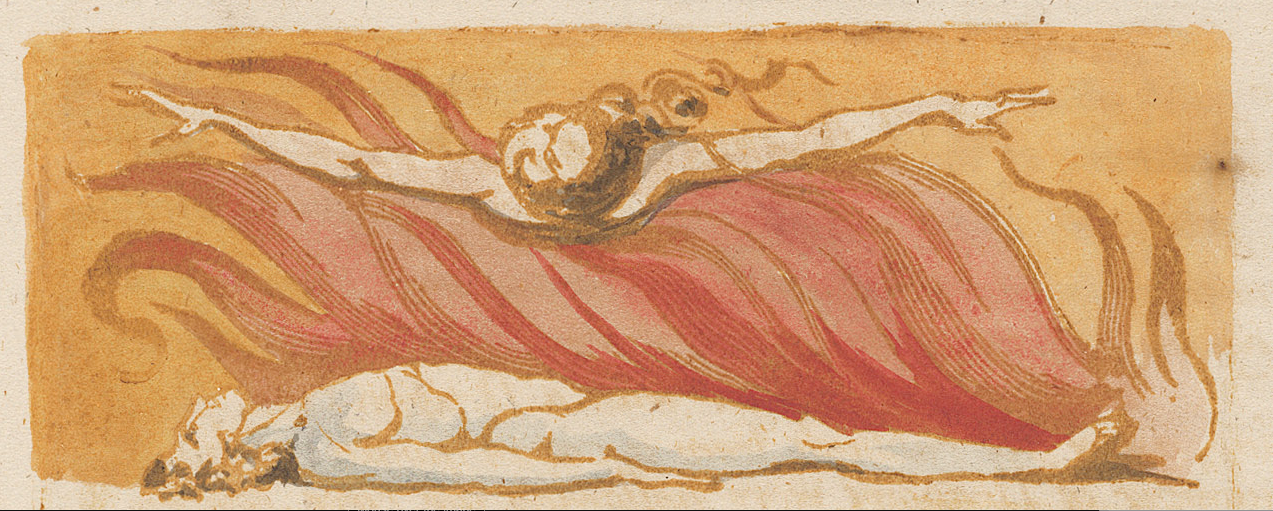
This painting by the poet William Blake is the image I use as the banner image for this blog. The “flaming sword” comes from the story of “the Fall” in Genesis three, which I’ll quote below; I’ll also quote from Blake and from George Fox.
The image
But Blake’s painting is hardly directly representational, as we’ll see from the Genesis passage.
- There are flames but no sword or gate into Paradise.
- The cherub is oddly presented and is human, or at least humanoid, in form, whereas cherubim are variously described in the Bible and other ancient mythologies, but always in some composite and mostly animal form. The cherubim that sit atop the ark of the covenant at least have wings.
- The human, presumably Adam, is supine, laid out almost as though he is dead. He has fallen.
Genesis 3:22–24:
And Yahweh God said, Behold, the man is become as one of us, to know good and evil; and now, lest he put forth his hand, and take also of the tree of life, and eat, and live forever:
Therefore Yahweh God sent him forth from the garden of Eden, to till the ground from whence he was taken.
So he drove out the man, and he placed at the east of the garden of Eden Cherubim, and a flaming sword which turned every way, to keep the way of the tree of life.
Comment
So the cherubim’s charge is to keep humans from reentering Paradise, eating from the tree of life, and becoming immortal. Yahweh and his angelic court (the “us” in the quote) are worried that humans will become like them. And we are already halfway there, having learned good and evil.
Blake’s blanket of flames and the outstretched arms of the cherub block the laid out Adam from rising.
Blake’s text
This image accompanies a page in Blake’s “The Marriage of Heaven and Hell”, one of his prophetic books, which is mostly text as captions for a series of paintings with a poem prologue. The poet presents himself as having descending into Hell and come back with prophecy that will reconcile heaven and hell. Here’s the text on that page. Note that Blake has given us here a significant phrase.
The ancient tradition that the world will be consumed in fire at the end of six thousand years is true, as I have heard from Hell.
For the cherub with his flaming sword is hereby commanded to leave his guard at tree of life; and when he does, the whole creation will be consumed and appear infinite and holy, whereas it now appears finite & corrupt.
This will come to pass by an improvement of sensual enjoyment.
But first the notion that man has a body distinct from his soul is to be expunged; this I shall do by printing in the infernal method, by corrosives, which in Hell are salutary and medicinal, melting apparent surfaces away, and displaying the infinite which was hid.
If the doors of perception were cleansed every thing would appear to man as it is, infinite.
For man has closed himself up, till he sees all things thro’ narrow chinks of his cavern.
George Fox
This image, these texts, together build an astonishing set of figures, both visual and theological, a kind of theological koan, a reality that seeks to transcend our either/or. But I used the image as a banner for my blog because of George Fox’s account of one of his visions. Here’s that passage from his journal:
Now I was come up in spirit through the flaming sword into the paradise of God. All things were new, and all the creation gave another smell unto me than before, beyond what words can utter. I knew nothing but pureness, and innocency, and righteousness, being renewed up into the image of God by Christ Jesus, so that I say I was come up to the state of Adam which he was in before he fell. The creation was opened to me, and it was showed me how all things had their names given them according to their nature and virtue. And I was at a stand in my mind whether I should practice physic [medicine] for the good of mankind, seeing the nature and virtues of the creatures were so opened to me by the Lord. But I was immediately taken up in spirit, to see into another or more steadfast state than Adam’s in innocency, even into a state in Christ Jesus, that should never fall. And the Lord showed me that such as were faithful to him in the power and light of Christ, should come into that state in which Adam was before he fell, in which the admirable works of the creation, and the virtues thereof, may be known, through the openings of that divine Word of wisdom and power by which they were made. [John 1:3] Great things did the Lord lead me into, and wonderful depths were opened unto me, beyond what can by words be declared; but as people come into subjection to the spirit of God, and grow up in the image and power of the Almighty, they may receive the Word of wisdom, that opens all things, and come to know the hidden unity in the Eternal Being. [Journal, Nickalls edition, page 27–28]
Fox claims to have made it past the guardian cherubim and the flaming sword back into Paradise. He says he came “up in spirit through the flaming sword.” He ascended through the flames into Paradise, just as the supine Adam in Blake’s painting would have to do. And the first thing that happens to him is Blake’s “improvement of sensual enjoyment”: Fox’s sense of smell became transcendentally acute.
And he was “renewed up into the image of God”. He was restored to the condition of Adam before the Fall, including the wisdom with which Adam named all the animals from mystical insight into their true nature—the doors of his perception were cleansed. [Check out Bob Dylan’s wonderful song Man Gave Names To All The Animals.] And Fox ate of the tree of life, though he does not describe it this way—through Christ he attained eternal life.
“That of God in everyone” – Again, Again
November 2, 2025 § Leave a comment
“Can we not say a little more?”
Here is another quote from Brian Drayton’s Messages to Meetings, this one about the phrase “that of God in everyone”, which my regular readers know is a regular theme of mine; I posted about it just two weeks ago. This is from letter 20 in Brian’s book: “That of God in every one : Can we not say a little more?”
The whole letter is worth reading and speaks my mind, but it is too long to quote in full here. But I do want to share its first few paragraphs. I quote Brian (pages 74–75):
Friends meetings, in making statements on a variety of social issues, often found their rationale upon the assertion that the divine Light is accessible to everyone, typically citing as our core belief that “there is that of God in every one.” This article of faith is so widely cited that it is rare for us to question its use or what we actually mean by it. In what follows, I do not suggest that we stop using it! However, in this yearly meeting season, with minutes and epistles being crafted and circulated, I’d like to encourage Friends to examine what this phrase actually means for them and to also suggest that we can’t rely on this alone as the theological basis for our social witness. Can’t we say a little more?
“That of God”—what can it mean?
It sometimes seems that when Friends say “there is that of God in every one,” it is really meant as the equivalent for a statement that “each individual is of value and has inalienable rights.” This is a valuable thing to say, and I have no objection to it, as far as it goes. I would claim, however, that if it means this and no more, then it is really not a theological statement at all, that is, it is not a statement that reflects in any obvious way our experience of the living God. It is a sentiment that is well suited to a pluralistic democracy or as a universal statement on human rights. To claim that individuals must be treated with equal respect before the law and have equitable access to the necessities of life (including those that make culture and society possible) is a liberal and just sentiment.
But do we Friends bring God into our statements out of habit? If so, then this invocation of the Deity seems more like other conventional references to God that decorate political documents and public expressions than an indication of some imperative that drives us, that is rooted in our spiritual life.
I am not comfortable to remain at that level when using the phrase. Perhaps a further exploration of what we intend by the phrase might help bring other meanings of it to the surface, and these might in turn enhance the richness of our witness and our search.
“That of God”—Again
October 17, 2025 § 6 Comments
For decades, I have complained about Friends claiming that “that of God in everyone” is our central tenet of faith and that it’s to be understood as a divine spark of some kind, something inherent in the human that partakes somehow of God’s being or nature. I’ve heard Friends equate it with the “image of God” in which Genesis one says we were created.
For all these years, I have accepted Lewis Benson’s argument that this usage of the phrase was introduced by Rufus Jones and is a misunderstanding of Fox’s use of the phrase. Benson claims that Fox used the phrase almost always in the pastoral sense implied in the quote that we use as our source for it in an epistle which he includes in his journal, that Fox did not use the phrase in the doctrinal sense that is common among us nowadays, usually stated as “there is that of God in everyone.
Then, in Michael Langford’s Becoming fully human: Writings on Quakers and Christian thought, I find this quote from Fox:
None that is upon the earth shall ever come to God but as they come to that of God in them, the light that God has enlightened them with; and that is it which must guide everyone’s mind up to God, and to wait upon to receive the spirit from God. . . . That which is of God within everyone is that which brings them together to wait upon God, which brings them into unity, which joins their hearts together up to God (Doctrinals, Works, Vol. 4, pp. 131–132; page 117 in Becoming fully human)
This quote demonstrates how complex and fluid Fox’s thinking was, how hard it is to pin down what he actually means, or at least what kind of coherent theology we might reconstruct from his truly prolific output. Fox is edging right up to Jones here. Or to put it in chrono-theological order, you can see how Jones might see in this passage some foundation for his own understanding. And there it is in one of Fox’s doctrinal works.
However, Fox is still giving “that of God in everyone” a pastoral role; that is, it brings us to God. And he equates “that of God” with the light of John 1:9, “the true light, which enlightens everyone,” which is the Word, which is Christ. So it looks like this is an Inward Light, because God has given it/him to us for our enlightenment. It’s not inherently in-dwelling; it was given to us.
On the other hand, however, “that which is of God within us”—that looks more like an Inner Light, an indwelling light that might in fact be inherent, since it is within us and everyone has it. It looks like Fox is having it both ways.
My sense from reading Jones’s books on mysticism is that he was some kind of neo-neoplatonist, in the sense that neoplatonism believes that a universal divine spark is what brings us to God, just as Fox is saying here. God’s spark seeks to return to its origin-home in God; this is the source of the religious/mystical impulse. Likewise, God reaches us inwardly by reaching this God-seeking God’s-self within us, and that divine spark recognizes and receives God when God comes. In mystical union, the divine spark has finally come home. This is the dynamic of mystical union experience.
Jones believed that this universally possible God-to-God’s spark connection is what lies behind all mystical experience, whatever the mystical tradition. And Jones is the one who taught us to think of Quakerism as “practical mysticism”. All of this is very close to what Fox seems to be saying in this quote.
Fox’s sublime innovation is to equate all this—the pastoral “bringing” to God, the doctrinal dwelling “within” us—with the light of Christ, the enlightening Word. “God” in this dynamic is Christ speaking to our condition, penetrating the sheath of sin and ignorance around our soul with the Light, seeking to reach that of God within us, which yearns for him.
“That of God” yearns for God, Fox implies in the quote we always use for this phrase. In that epistle, once we have done the inner work of our own transformation in the light of Christ ourselves, then we can answer that of God in others. That of God within us is calling out in the darkness, and the Light answers with the Word.
Liberal Theology—A Definition
June 30, 2025 § 2 Comments
I’ve just finished reading The Foundations of Liberal Quakerism, by Stephen W. Angell, the 45th Annual Walton Lecture presented at the Annual Southeastern Yearly Meeting Gathering of Friends in 2008 and published as a pamphlet available from SEYM. It describes the historical precursors of liberal Quakerism, especially the writings of William Penn, progressive Friends in the Midwest, and Lucretia Mott and the Progressive Friends movement (see also Chuck Fager’s books on this movement). I highly recommend Stephen Angell’s pamphlet.
Stephen Angell starts with some definitions and he quotes Garry Dorrien, a historian of liberal Christian theology, with this definition, which I found useful:
“liberal theology is defined by its openness to the verdicts of modern intellectual inquiry, especially the natural and social sciences; its commitment to the authority of individual reason and experience; its conception of Christianity as an ethical way of life; its favoring of moral concepts of atonement; and its commitment to make Christianity credible and socially relevant to modern people.”
According to my own studies, this very aptly describes the priorities of the young adults who gave birth to liberal Quakerism in the late 19th century, whose new sensibilities emerged fairly decisively with the Manchester Conference in Britain in 1895. The most famous of these young Friends were John Stephenson Rowntree and Rufus Jones.
The sciences. These young Friends embraced Darwin’s theory of evolution and the critical study of the Bible that had begun in Germany earlier in the century. These two advances, one in the natural sciences and the other in the social sciences, were directly related to each other in their influence, since the theory of evolution required an all-new look at the creation story in Genesis and by extension a new kind of relationship to the Bible’s authority and role in religious life.
Individual reason and experience. Those young Friends were desperate for a place in a Quaker culture of eldership that had become ossified and restrictive; they wanted their voices heard and they wanted a theology that matched their religious experience, and vice versa.
Ethics. They revolutionized how Christian moral principles should be applied to society’s problems. In the evangelical view that had dominated Quaker culture for roughly a century, social problems derived from sin, and so the solution to these problems was evangelism: bring people to Christ and they will act more righteously, and society will follow. But social science was just then realizing that social ills had structural elements that both constrained and transcended individual moral choice. The signature development along these lines was Seebohm Rowntree’s book Poverty: A Study in Town Life, which proved scientifically that poverty in the city of York was not due to the poor’s moral failures—sex (too many children), drink, gambling, and other vices—but simply because they were not being paid enough. Capitalism was the problem, though he didn’t put it that way.
Atonement. Friends had always emphasized the transformation of the soul by the immediate and inward work of Christ over the theology of blood atonement on the cross, at least until the evangelical revolution in Quakerism that began around 1800. These young liberals reclaimed the earlier emphasis on God’s direct moral guidance.
Credibility and relevance. And they wanted their faith to be relevant, they wanted to be able to stand on their faith as a foundation and in their faith as a frame for their message and work to make the world a better place. And for that, they needed a theology that spoke to their time.
Quakers and Theology
June 10, 2025 § 1 Comment
I’ve been editing a submission to Pendle Hill Pamphlets on the faith behind the gathered meeting. It would be sequel to my earlier pamphlet The Gathered Meeting, which focused more on the experience, the history, and the practice of the gathered meeting, and on what might foster the gathered meeting. This new essay is more about the faith side of the faith and practice duo regarding the gathered meeting.
It’s about what’s going on when we are gathered in the Spirit, and how we talk about what’s going on. It’s a theology of the gathered meeting.
Theology—yikes. Let’s not talk about that. I suspect that many Friends in the “liberal” branch of the movement will react negatively to this topic, perhaps quite viscerally. Haven’t we fought each other enough over theology? But I’m here to make a case for theology, for doctrine, for what we have to say.
Not dogma! Not something you have to believe to save your soul or to be one of “us” on the inside of an exclusionary religious community. I’m talking about what we think and how we think about our Quaker history, practice, and experience. I’m talking about what we have to say, to seekers, to those folks checking us out to see if we’re their spiritual home, what we have say to our kids, to each other—to ourselves.
So I am an unapologetic Quaker theologian. But what do I mean by that? What is a Quaker theologian?
For me, it’s trying to think of the best questions I can ask about my religion’s faith and practice, its history and experience. About my own Quaker religious experience, the spiritual experiences I’ve had in the context of meeting for worship and as I practice the Quaker way understood more broadly. Being a Quaker theologian is trying to ask the best questions about my community, its history and tradition and future prospects. And then I try to answer them, with integrity and creativity, while trying to remain grounded in experience.
Why? Why ask these questions; why pursue such answers?
Because what we think and how we think about these things do affect our religious experience. What we think and how we think about our practice, our history and traditions affect the course of our religious movement. Mindset, worldview, frameworks of thought—these do matter. They’re not the most important thing; no, actual experience remains paramount—“What canst thou say?”
But experience takes place in context, and part of that context is mindset, worldview, frameworks for understanding. They help to shape our experience, and experience helps to shape our understanding. It’s a feedback system: faith and practice, in dynamic relationship with each other over time, evolving and emerging in real time, sometimes, right before our eyes, as the promise of continuing revelation continues to be fulfilled. For revelation has content.
One more pushback against a certain kind of resistance to “theology”. I have been eldered for being in my head, which is a condition presumed to be at the expense of my heart and my spirit. Isn’t that just like a man, that person said, in so many words. And ain’t I a man, to coopt Sojourner Truth.
As if the very many transcendental experiences I’ve had in this blessed life could not have happened to someone who’s too much in his head, like me. As if the life of the mind and the life of the heart and soul could ever be separated. As if a spiritual path, let alone a religious path, with its history and traditions and testimonies and distinctive practices, could not be one holistic, holy whole in someone’s life. And as if gender necessarily defined one’s spiritual and religious potential.
But to be fair, one can get out of balance. I do get out of balance. We all do. But the heart is arguably better than the mind at unbalancing a person. Or perhaps I should say the unconscious mind, which often has the heart in its secret capture.
That’s where Quaker discernment comes in. With her or his mind, someone asks some questions and then offers some possible answers. Continuing revelation is now on the table. Time for the community to test these ideas and see if they stand in truth and beauty and usefulness. Is it from the Light, or not?
That’s the role of the Quaker theologian: to be a servant of continuing revelation, at the prompting of and accountable to, the Holy Spirit in discernment.
Britain Yearly Meeting Minute on Gaza
June 3, 2025 § 2 Comments
At their annual gathering recently, Quakers in Britain became the first British church to state their belief that the Israeli government is committing genocide in Gaza. (Download a pdf of the minute here.) I happen to agree with their discernment and pray that their minute was approved in a truly gathered meeting.
However, I really don’t like the minute itself. Like almost all of the minutes of conscience I’ve seen approved by meetings in the “liberal” branch of Quakerism, most of this minute reads as though it were written by a secular social change nonprofit. (But at least these minutes are being drafted and approved; we almost never hear from the evangelicals.)
Here’s a synopsis: The minute mentions previous action by their Meeting for Sufferings (without explaining to non-Quaker readers what that is). It describes collective horror at the actions of the Israeli government in Gaza. It reviews the problems with a declaration of genocide. It offers two tenets of Quakerism as rationale for their stand. And it makes some appeals to action.
Here are those statements of Quaker faith given as rationale:
Central to Quakerism is the experience that there is that of God in everyone. From this belief – that all people are unique, precious, children of God – all others follow. We therefore abhor racism, including antisemitism, in all its forms.
. . .
It is also a tenet of Quakerism that violence can never be the answer. That the means are just as important as the ends. This is our peace testimony that has led us for more than 350 years to eschew all war and all violence at all times.
That’s 87 “religious” words out of a total of 944, less than ten percent of the minute.
I have problems not with its message, but with how it represents the Religious Society of Friends and our testimonies and with the weakness of its moral argument.
Integrity and misrepresentation
Central to Quakerism
The minute presents “the experience that there is that of God in everyone” as the foundation from which all our other beliefs follow. This simply is not true. it is not central to Quakerism. It might be central to a lot of Quakers in the so-called liberal branch of the movement, but it certainly is not central to the much larger evangelical branches, or to Conservative Friends. We shouldn’t be speaking of “Quakerism” with such a broad brush.
Nor is it central even to “liberal” Quakerism, except as a kind of unreflective doctrinal drift. We’ve been saying this kind of thing for decades now without any meaningful corporate discernment. It’s been slipping into our books of faith and practice and getting approved, much like a sly amendment to a massive legislative bill that most representatives haven’t noticed. Meanwhile, no meeting has actually carefully unpacked and considered the meaning or standing of this phrase “that of God in everyone” on its own. We think George Fox said it so now we can say it, too; meanwhile, George Fox never actually did say it.
Moreover, there are still quite a few of us “liberal” Friends who do know that Fox never said it that way and wouldn’t have ever said it, and we would never say that it’s the foundation of our religious faith and experience as stated. We might be in the minority in a lot of meetings, but if a meaningful discernment process actually took place in our yearly meeting’s revision of their faith and practice, we would stand in the way. Well, I would, anyway.
That of God in everyone
And anyway, what does “that of God in everyone” mean? The minute does not explain. What do we mean by “that of”? What or who do we mean by “God”? And what does “that of God” mean? And how do we experience it, or say we do, in “everyone”? We can say we believe it’s in everyone, but can we experience it in everyone? I can’t.
I suppose this statement tries to express what I agree is perhaps the central experience of Friends, that we humans can commune directly with God (however we experience the Divine), personally, inwardly, immediately. But why and how would this experience lead us to “abhor racism”? Because, in that experience, God’s anointing Spirit, the spirit of the christ, awakens and guides us to love and compassion, to truth and service. That’s the real message here: we are led into love and compassion by the Spirit, whatever each of us might mean by that, not by the “experience” of some abstract notion about our nature as humans.
What’s missing
This is what’s missing in this minute—religious and moral appeal, especially to love and compassion. I suppose it’s worth something to be the first church in Britain to call Israeli action in Gaza genocide; it will get attention. But I’m not sure it’s the most powerful thing we can say. The unique and powerful thing we as Quakers have to offer is our religious and moral message and appeal and our guidance from the Spirit. The secular activists are not going to talk like that, or appeal to the people for whom religious and moral appeal might be appealing.
That means speaking from our religious tradition. Specifically, we should use the prophetic voice of Hebrew and Christian scripture, because it’s a powerful voice and a powerful message, and it might appeal to the hearts and souls of people who are inured to political polemic, especially those who at least claim to be people of faith. And I would use queries, not declarations.
For instance: With their horrific actions and policies, are you the Israeli government and your military loving God with all your hearts and souls and strength, as God demanded in Deuteronomy? Are you loving your neighbors as yourselves, as God demanded in Leviticus?
Or: You want to be a “Christian nation”, you American Christian conservatives in government and other institutions of power who support and supply these atrocities? What about Jesus’ commandment of love? Is American military support loving one another even as we have been loved? Is helping to slaughter and starve children, who are “the least of these”, not re-crucifying Christ all over again? Is killing them inviting these “little children” to come unto him?
Well, now I’ve slipped into an American focus. This minute comes from Britain Yearly Meeting. I’m not sure whether Britain has a comparable Christian nationalist element, like we do here. But Britain does still have a national church. If I were a British Friend, I would be in challenging dialogue with the Church of England about this situation—unless they are already in unity with a Prince of Peace message. Then I would join with our religious fellow travelers.
I would be moral and religious, prophetic and traditional, in both voice and message.
Early Quaker Christology and Blasphemy
January 12, 2025 § 1 Comment
I’ve been reading “Accusations of Blasphemy in English Anti-Quaker Polemic, c. 1660–1701,” by David Manning, from Quaker Studies 14/1 (2009) [27–56]. The article focuses on polemical charges of blasphemy against early Quakers based primarily on early Friends’ theology of the light within as anti-Trinitarian and on a claim that Quakers were identifying themselves with God.
Before sharing some of the article, it’s worth noting that George Fox was charged with blasphemy three times, tried twice, and convicted once and got jail time. There probably would have been more trials, but his magistrate for the second trial happened to be none other than Judge Fell, Margaret’s first husband. Fox and Fell met before the trial and uncovered a loophole in the law and Fox got off on a technicality. Judge Fell was such a senior and respected jurist that the third charge never went to trial because they knew they would lose, and it probably kept other prosecutors from bringing charges. And then, of course, there was James Naylor.
Pamphlet wars about these claims raged between Quakers and anti-Quakers throughout this period, to which William Penn was a major contributor. Part of the problem was that early Friends were inconsistent about their theology in this period, so it was hard to pin them down. Manning draws on the work of Leo Damrosch and Ted Underwood*, writing: “. . . no definitive account of early Quaker theology can be written because early Quakers regularly equivocated about their beliefs and that their early theology was, quite understandably, somewhat fluid and contestable precisely because it was a new and developing belief system**.” Which hasn’t stopped most of us from offering “definitive accounts” of early Quaker theology anyway.
But as to the theological claims that gave rise to charges of blasphemy, Manning writes:
The terms Christ, God, and Holy Spirit were not denied, but appeared to have been used interchangeably to describe the Light, rather than to acknowledge the existence of distinct divine persons. Early Quakers most commonly identified the Light with Christ, professing that the pre-incarnate and the incarnate Christ were the same. Christ on earth was, therefore, not manifest in human form, but a celestial being in the vessel of a human body. [emphasis mine] Thus, from this position, Christ was wholly supernatural and provided a uniquely spiritual soteriology [salvation theology]. . . .
The Quakers’ type of non-Trinitarianism meant that they rejected the traditional tenets of Christian belief: faith was not a bridge between human and divine, and mortals did not receive the grace of God, but experienced him immediately (i.e. without mediation). For the Quakers, the language of ‘inwardness’ was effectively a euphemism for the only true way to form a relationship with Christ; for his celestial being had no cause, or means, to mediate with humans, but dwelt within them. . . . one can appreciate the thrust of [Richard Bailey’s] argument that Quaker conviction hinged upon a Christo-present, rather than Christo-centric belief system***.
I read Bailey’s book (New Light on George Fox and Early Quakerism: The Making and Unmaking of a God) some time ago and found it both fascinating and challenging. Here’s a quote from it along similar lines as above taken from Fox’s The Great Mystery of the Great Whore. This is Fox speaking:
God’s Christ is not distinct from his saints, nor their bodies, for he is within them, nor distinct from their spirits, for their spirits witness him . . . he is in the saints, and they eat his flesh, and sit within him in heavenly places.”
This is weird stuff. It is truly unorthodox, and it is much more radical thinking than later Quaker Christology, which has, it seems to me, been retrojected onto Fox and early Friends in apparent embarrassment, or maybe just through incredulity and misunderstanding. Assuming that Damrosch, Underwood, Manning, and Bailey are not the ones who misunderstand. Moreover, these quotes echo ideas in Glen D. Reynolds’s Was George Fox a Gnostic? An Examination of Foxian Theology from a Valentinian Gnostic Perspective, and some of the insights of Rosemary Moore in The Light in their Consciences..
Those anti-Quakers might have been right, from the orthodox point of view.
Leo Damrosch, The Sorrows of the Quaker Jesus: James Naylor and the Puritan Crackdown on the Free Spirit. Ted Underwood, Primitivism, Radicalism, and the Lamb’s War: The Baptist-Quaker Conflict in Seventeenth Century England.
Richard Bailey, New Light on George Fox and Early Quakerism: The Making and Unmaking of a God.
Are We A Chosen People?
June 9, 2024 § 2 Comments
In the elder days, Friends would sometimes refer to themselves as a “peculiar people.” By “peculiar” they did not mean that they were odd, though they were odd, and I think they knew they were odd. Rather, they meant that they were a a distinct people, a chosen people; they had been gathered by Christ as a people of God for a purpose.
This identity as a chosen people appears in the passage in the gospel of John from which we get our name as the Religious Society of Friends:
“This is my commandment, that you love one another as I have loved you. No one has greater love than this, to lay down one’s life for one’s friends. You are my friends if you do what I command you. I do not call you servants any longer, because the servant does not know what the master is doing, but I have called you friends, because I have made known to you everything that I have heard from my Father. You did not choose me, but I chose you. And I appointed you to go and bear fruit, fruit that will last, so that the Father will give you whatever you ask him in my name. I am giving you these commands so that you may love one another. (John 15:12–17)
Integral to the identity that we claim with our name from this passage are five things:
- The commandment of love—“Love one another.”
- Direct and intimate communion with the spirit of the Christ—“You are my friends.”
- The promise of (continuing) revelation—“I have made known to you everything . . .” And
- Being chosen—“I chose you.”
- For a purpose: a mission as a called people of God—“Go and bear fruit.”
Pondering this passage today in meeting for worship raised some queries:
- Do we see ourselves as a chosen/called people of God?
- If so, what is our mission?
- Are we bearing fruit that will last?
 Through the Flaming Sword