
Through the Flaming Sword
February 14, 2026 § Leave a comment
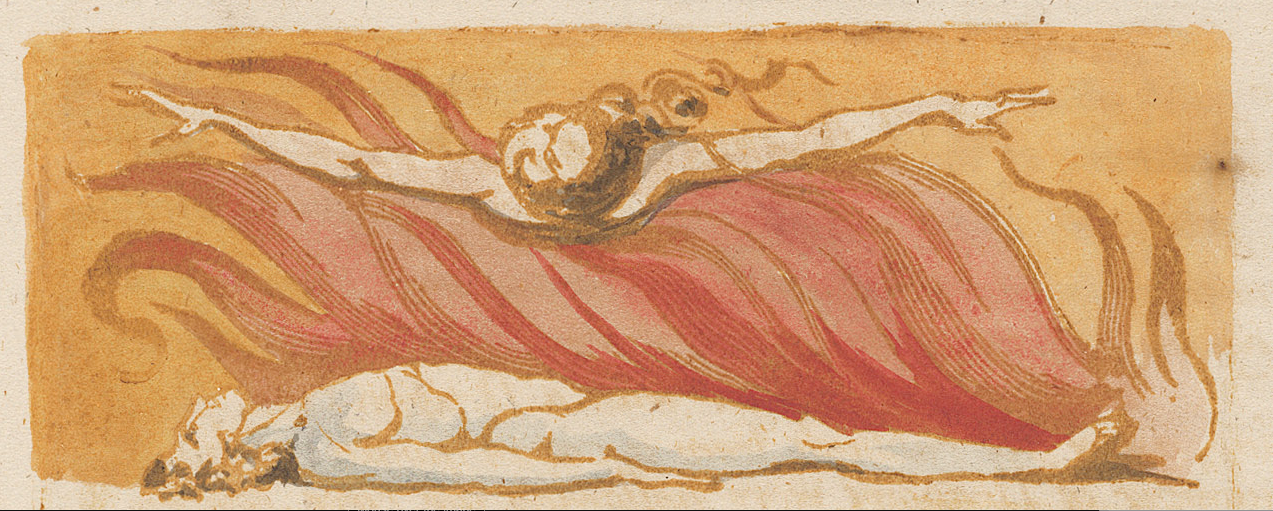
This painting by the poet William Blake is the image I use as the banner image for this blog. The “flaming sword” comes from the story of “the Fall” in Genesis three, which I’ll quote below; I’ll also quote from Blake and from George Fox.
The image
But Blake’s painting is hardly directly representational, as we’ll see from the Genesis passage.
- There are flames but no sword or gate into Paradise.
- The cherub is oddly presented and is human, or at least humanoid, in form, whereas cherubim are variously described in the Bible and other ancient mythologies, but always in some composite and mostly animal form. The cherubim that sit atop the ark of the covenant at least have wings.
- The human, presumably Adam, is supine, laid out almost as though he is dead. He has fallen.
Genesis 3:22–24:
And Yahweh God said, Behold, the man is become as one of us, to know good and evil; and now, lest he put forth his hand, and take also of the tree of life, and eat, and live forever:
Therefore Yahweh God sent him forth from the garden of Eden, to till the ground from whence he was taken.
So he drove out the man, and he placed at the east of the garden of Eden Cherubim, and a flaming sword which turned every way, to keep the way of the tree of life.
Comment
So the cherubim’s charge is to keep humans from reentering Paradise, eating from the tree of life, and becoming immortal. Yahweh and his angelic court (the “us” in the quote) are worried that humans will become like them. And we are already halfway there, having learned good and evil.
Blake’s blanket of flames and the outstretched arms of the cherub block the laid out Adam from rising.
Blake’s text
This image accompanies a page in Blake’s “The Marriage of Heaven and Hell”, one of his prophetic books, which is mostly text as captions for a series of paintings with a poem prologue. The poet presents himself as having descending into Hell and come back with prophecy that will reconcile heaven and hell. Here’s the text on that page. Note that Blake has given us here a significant phrase.
The ancient tradition that the world will be consumed in fire at the end of six thousand years is true, as I have heard from Hell.
For the cherub with his flaming sword is hereby commanded to leave his guard at tree of life; and when he does, the whole creation will be consumed and appear infinite and holy, whereas it now appears finite & corrupt.
This will come to pass by an improvement of sensual enjoyment.
But first the notion that man has a body distinct from his soul is to be expunged; this I shall do by printing in the infernal method, by corrosives, which in Hell are salutary and medicinal, melting apparent surfaces away, and displaying the infinite which was hid.
If the doors of perception were cleansed every thing would appear to man as it is, infinite.
For man has closed himself up, till he sees all things thro’ narrow chinks of his cavern.
George Fox
This image, these texts, together build an astonishing set of figures, both visual and theological, a kind of theological koan, a reality that seeks to transcend our either/or. But I used the image as a banner for my blog because of George Fox’s account of one of his visions. Here’s that passage from his journal:
Now I was come up in spirit through the flaming sword into the paradise of God. All things were new, and all the creation gave another smell unto me than before, beyond what words can utter. I knew nothing but pureness, and innocency, and righteousness, being renewed up into the image of God by Christ Jesus, so that I say I was come up to the state of Adam which he was in before he fell. The creation was opened to me, and it was showed me how all things had their names given them according to their nature and virtue. And I was at a stand in my mind whether I should practice physic [medicine] for the good of mankind, seeing the nature and virtues of the creatures were so opened to me by the Lord. But I was immediately taken up in spirit, to see into another or more steadfast state than Adam’s in innocency, even into a state in Christ Jesus, that should never fall. And the Lord showed me that such as were faithful to him in the power and light of Christ, should come into that state in which Adam was before he fell, in which the admirable works of the creation, and the virtues thereof, may be known, through the openings of that divine Word of wisdom and power by which they were made. [John 1:3] Great things did the Lord lead me into, and wonderful depths were opened unto me, beyond what can by words be declared; but as people come into subjection to the spirit of God, and grow up in the image and power of the Almighty, they may receive the Word of wisdom, that opens all things, and come to know the hidden unity in the Eternal Being. [Journal, Nickalls edition, page 27–28]
Fox claims to have made it past the guardian cherubim and the flaming sword back into Paradise. He says he came “up in spirit through the flaming sword.” He ascended through the flames into Paradise, just as the supine Adam in Blake’s painting would have to do. And the first thing that happens to him is Blake’s “improvement of sensual enjoyment”: Fox’s sense of smell became transcendentally acute.
And he was “renewed up into the image of God”. He was restored to the condition of Adam before the Fall, including the wisdom with which Adam named all the animals from mystical insight into their true nature—the doors of his perception were cleansed. [Check out Bob Dylan’s wonderful song Man Gave Names To All The Animals.] And Fox ate of the tree of life, though he does not describe it this way—through Christ he attained eternal life.
“That of God”—Again
October 17, 2025 § 6 Comments
For decades, I have complained about Friends claiming that “that of God in everyone” is our central tenet of faith and that it’s to be understood as a divine spark of some kind, something inherent in the human that partakes somehow of God’s being or nature. I’ve heard Friends equate it with the “image of God” in which Genesis one says we were created.
For all these years, I have accepted Lewis Benson’s argument that this usage of the phrase was introduced by Rufus Jones and is a misunderstanding of Fox’s use of the phrase. Benson claims that Fox used the phrase almost always in the pastoral sense implied in the quote that we use as our source for it in an epistle which he includes in his journal, that Fox did not use the phrase in the doctrinal sense that is common among us nowadays, usually stated as “there is that of God in everyone.
Then, in Michael Langford’s Becoming fully human: Writings on Quakers and Christian thought, I find this quote from Fox:
None that is upon the earth shall ever come to God but as they come to that of God in them, the light that God has enlightened them with; and that is it which must guide everyone’s mind up to God, and to wait upon to receive the spirit from God. . . . That which is of God within everyone is that which brings them together to wait upon God, which brings them into unity, which joins their hearts together up to God (Doctrinals, Works, Vol. 4, pp. 131–132; page 117 in Becoming fully human)
This quote demonstrates how complex and fluid Fox’s thinking was, how hard it is to pin down what he actually means, or at least what kind of coherent theology we might reconstruct from his truly prolific output. Fox is edging right up to Jones here. Or to put it in chrono-theological order, you can see how Jones might see in this passage some foundation for his own understanding. And there it is in one of Fox’s doctrinal works.
However, Fox is still giving “that of God in everyone” a pastoral role; that is, it brings us to God. And he equates “that of God” with the light of John 1:9, “the true light, which enlightens everyone,” which is the Word, which is Christ. So it looks like this is an Inward Light, because God has given it/him to us for our enlightenment. It’s not inherently in-dwelling; it was given to us.
On the other hand, however, “that which is of God within us”—that looks more like an Inner Light, an indwelling light that might in fact be inherent, since it is within us and everyone has it. It looks like Fox is having it both ways.
My sense from reading Jones’s books on mysticism is that he was some kind of neo-neoplatonist, in the sense that neoplatonism believes that a universal divine spark is what brings us to God, just as Fox is saying here. God’s spark seeks to return to its origin-home in God; this is the source of the religious/mystical impulse. Likewise, God reaches us inwardly by reaching this God-seeking God’s-self within us, and that divine spark recognizes and receives God when God comes. In mystical union, the divine spark has finally come home. This is the dynamic of mystical union experience.
Jones believed that this universally possible God-to-God’s spark connection is what lies behind all mystical experience, whatever the mystical tradition. And Jones is the one who taught us to think of Quakerism as “practical mysticism”. All of this is very close to what Fox seems to be saying in this quote.
Fox’s sublime innovation is to equate all this—the pastoral “bringing” to God, the doctrinal dwelling “within” us—with the light of Christ, the enlightening Word. “God” in this dynamic is Christ speaking to our condition, penetrating the sheath of sin and ignorance around our soul with the Light, seeking to reach that of God within us, which yearns for him.
“That of God” yearns for God, Fox implies in the quote we always use for this phrase. In that epistle, once we have done the inner work of our own transformation in the light of Christ ourselves, then we can answer that of God in others. That of God within us is calling out in the darkness, and the Light answers with the Word.
Worship in Spirit and Truth
October 3, 2025 § 2 Comments
In the weekly Bible study that I moderate (Thursdays, 3:30, via Zoom), we’ve been looking at the wonderful story of Jesus and the Samaritan woman at the well in John chapter four. It includes a passage that is one of the scriptural foundations for worship in the manner of Friends, John 4:23–24, and, as very often happens, our exploration brought to me some openings. Here is that passage:
The hour is coming, and is now here, when the true worshippers will worship the Father in spirit and truth, for the Father seeks such as these to worship him. God is spirit, and those who worship him must worship in spirit and truth.
The structure of this saying suggests to me an identity or deep correspondence between spirit and truth. And I think a key to that relationship can be found in the word for truth in Greek, and also in another passage in John, John 14:15–17.
“Truth” in New Testament Greek is aletheia, in which the “a-“ is a prefix which we might render in English as “un-“. Lanthano, the Greek root word for aletheia means to hide. So “truth” is an un-covering, a revealing. Truth is revelation. A revelation of the Spirit of Truth, our Advocate, as in John 14:15–17:
If you love me, you will keep my commandments. And I will ask the Father, and he will give you another Advocate, to be with you forever. This is the Spirit of Truth, whom the world cannot receive, because it neither sees him nor knows him. You know him, because he abides with you, and he will be in you [or among you].
So to “worship in spirit and truth” is to worship in the Spirit-Advocate whom God sends to us for revelation—continuing revelation, because that spirit is “forever”. The vehicle for revelation in our worship is our vocal ministry. So true worship is manifest in truly Spirit-led ministry.
This Spirit of Revelation is within us, and it is among us. It arises from within us as love, as vocal ministry, and as our presence in worship. It arises among us as it brings us into the Presence in our midst in worship that is gathered and covered by the Spirit. True worship is the gathered meeting.
To “worship in spirit and truth” is also to follow Jesus’s commandments, and “This is my commandment, that you love one another as I have loved you.” (John 15:12) So true fellowship in the Spirit is also a form of worship. It is worship in action, worship that continues after we have left the meeting room at close of formal worship, a continuing revealing of divine love.
Meetings and Ministry, Part 2: My Story
July 28, 2025 § Leave a comment
A Leading Leads to Frustration, and to New Leading
In 1990, Buffalo Meeting in New York asked New York Yearly Meeting’s Friends in Unity with Nature Task Group to bring them an earthcare program on the twentieth anniversary of Earth Day. A f/Friend and I answered their call.
On Saturday night before the program on Sunday, I was sitting up praying over my notes for the following morning when an opening came to me that pushed its way in front of my preparations. It came out of nowhere—well, as it turns out, it came out of Spirit-where—and it would not go away. It was this: If Christ was the Word “through whom were all things were made and without whom nothing was made that was made,” as John 1:3 puts it, then destroying creation is re-crucifying Christ.
Now this was what Friends in the elder days called a cross to the will: my will and my intentions and expectations were being crucified. Because I was in those days actively hostile to Christ, Christianity, and the Bible.
But I had been raised in a pretty pious and active evangelical Lutheran family and I knew the Bible pretty well. And the more I thought about it, the more important this new idea seemed, and the more it ramified—the more I remembered and discovered that I could say to Buffalo Meeting. But I did not want to say it. And I was pretty sure that Buffalo Meeting wouldn’t want to hear it.
But the Holy Spirit had seized me by the scruff of the neck and would not let me go. I had to scrap my original notes and go with this crazy new thing. So I gave Buffalo Meeting a little Bible-based sermon and, as I remember it, they did in fact give it a rather cool reception.
It was weird. Or wyrd, in the Old Norse sense of the origins of the word, a situation that was so important the gods were involved. God was involved. And it didn’t stop there.
Over the next few weeks, the original opening expanded and ramified and it dug in. Eventually, I felt I was called to write a book of Bible-based earth stewardship theology—another cross to the will. I did not want to do this. First of all, I knew it meant probably years of research; I didn’t know nearly enough. I had read none of the earth stewardship theology that had been written up to that time, and I didn’t know the Bible well enough to treat it properly. But more importantly, I still felt hostile to Christianity and the Bible.
So I brought my leading to my meeting. I asked for an oversight committee. I knew that my prejudices threatened to thwart or distort my faithfulness and I wanted my meeting to help me stay faithful.
In my first meeting with ministry and counsel, they did not understand what I was asking for, even though some weighty and seasoned Friends served on that committee. I went away frustrated. But I still felt it was important to get some support. So I went back to them. This time, some of them understood just enough to actually misunderstand in a new way.
“We can’t tell you what to think,” they said. I didn’t want them to tell me what to think, I wanted them to tell me if I was going off the rails. “That’s for your editor to tell you,” they said. That would be way too late, I said. In the end, they said no again.
I was left to my own discernment and discipline. I hustled some financial support and went to Pendle Hill for two terms in 1991 to begin research on the book. There, I was mentored by Bill Taber and Doug Gwyn, who taught Quakerism and the Bible respectively. My time with them and at Pendle Hill confirmed my calling and gave me the support I needed. I reclaimed the love of the Bible I had had as a teenager. I stopped being Christ and Christianity’s adversary. And the course work with Doug and Bill deepened my knowledge of and commitment to the faith and practice of Quaker ministry. The experience deepened my love for and commitment to the Quaker way. It changed my life.
And: the leading to write that book and the frustrating experience I had with my meeting led to two new leadings, both of which I still carry as ministries. The first was—is—to foster in our meetings the recovery of our traditions regarding ministry, so that others with leadings would not be left bereft, as I had been. The second was a sustained and intensive study of, the Bible, such that I have for years now moderated a weekly online Bible study and written another (unpublished) book on the gospel of Jesus, which grew out of the things I learned writing the first one; and I have two more in my head and heart.
Theism, Nontheism, and Quaker Identity
November 1, 2024 § 3 Comments
This is a long post—lots of ground to cover. So here’s a brief outline:
Introduction
I subscribe to an email newsletter of Academia, a site that aggregates academic articles, and I’ve set a filter for Quaker articles. I get stuff I want to read regularly—can’t keep up with it.
Today, I got “Quakers and Non/Theism: Questions and Prospects,” by Jeffrey Dudiak, an article that appeared in Quaker Religious Thought, volume 118, from 2012. The issue features essays on theism, nontheism, and Quaker identity by Howard Macy as editor, Paul Anderson, Jeffrey Dudiak, David Boulton, Shannon Craigo-Snell, and Patrick J. Nugent. The latter two articles are responses primarily to Dudiak and Boulton, the theist and nontheist apologists.
I wanted to share this resource on what I believe is a very important subject, whose salience has not diminished since 2012, though maybe the heat’s been turned down a bit since then. But I also want to offer my own position on these questions. I don’t imagine that my convictions settle anything, but I hope that they do speak to some Friends.
Not in the traditional sense, as in believing in a supreme being who is omnipotent, omniscient, completely good; “personal” in the sense of keen to engage in relationship with me; “historical,” not just in the sense of paying attention to human history, both writ large and personal, but also having a plan for the fulfillment and redemption of humanity writ large and for individual humans, too, like me—a supreme deity who knows me, cares about me, and whom I could know in return.
I do not know such a deity—I have no experience to base such a belief on. Intellectually, such an idea even offends me a bit: where was some history-caring and engaged deity during the Holocaust, for instance? Furthermore, experience of a supreme being by a being as finite as myself would, it seems, shatter my consciousness. And even if I did experience [him] without exploding, what good would it do me? My yoga teachers taught a similar Vedanta endgame of pure consciousness as the goal of my practice, and it just seemed irrelevant to my lived life.
On the other hand, I have experienced—what shall I call them? Angels? Spirits? Devas? I am some kind of polytheist, having had direct transcendental experience of spiritual beings, and I subsequently have enjoyed relationships with them as central to my spiritual life. So I call myself a para-theist. My experience is that there are deities out there, just with a small “d”.
And I take at face value the testimony of my Christian f/Friends, and the testimony of the first Friends, and of thousands of Friends since the 17th century—the testimony of their encounter and relationship with Jesus Christ. Therefore, I believe in Jesus Christ, even though I have not (yet) been called by him into his discipleship.
I am not willing to disrespect the experiences of those Friends who have been blessed by his presence in their lives by telling them that their experience is just a projection of their unconscious, or not real in some other way, or whatever, just because I don’t share their experience; and also because I wouldn’t want anybody to disrespect my own such experiences. Don’t mess with with my experience and I won’t mess with yours; though I do invite inquiry, and even respectful challenge.
Quakerism is a Christian religion
For this reason, and for several other reasons, I consider Quakerism a Christian religion, and I feel that I am a guest in the house that Christ built. I am grateful that my meetings have accepted me without my Christian confession (though they never even considered such a matter, being to that degree non-Christian or post-Christian). And I think other non-Christians should share my gratitude and act accordingly. By act accordingly, I mean, not just tolerate, but invite and celebrate Christian and Biblical vocal ministry, and actively contribute to a Quaker culture in which Christian Friends feel invited to talk from their own experience and religious sensibilities without fear or censure. Or even to pray, as I do, that Christ will join us, gather us, in our worship.
In other words, a theism built on relationship with Christ seems not just reasonable to me; it parallels my own experience. Hence my para-theism.
It is natural for us to venture out of our experience into theology. I can’t keep from doing this, myself. Well, actually, I love doing it, I do it all the time, in my head and in my writing. And, while a lot of the legacy theology of the Christian tradition does not work for me, it obviously works for a lot of Friends, at least up to a point. From the beginning, starting with Fox himself, some Quakers have always been a bit heterodox.
So we are theists
So, for me, the bottom line is that Quakers are theists in our core identity, because we are Christian; that is, we were gathered as a people of God by Christ, most of us have been invited into personal f/Friendship with Christ, and that’s that. We are a Christian faith historically. We are a Christian faith demographically still today. And the lack of such experience by a small minority of the movement does not change the identity of the movement as a whole.
That we non-Christians, and nontheists, and para-theists in the minority have been given a bed in the spare room of the house that Christ built is a blessing to be grateful for. Trying to kick Christ out of the master bedroom onto the living room couch is deeply disrespectful of our tradition, and of him.
About “God”
One more thing, though. I just used the word God. So what do I mean by “God”, capital “G”? In my public discourse, I use the word God as a placeholder for the Mystery Reality behind my listener’s or my reader’s own spiritual and religious experience is. Your experience is real; I honor that with belief and respect.
I do have my own personal understanding of God, but it’s mine and I will not press it upon you as some greater truth. But I will share it as mine.
For me, God is the spiritual dimension of evolution. In this, I am something of a student of Teilhard de Chardin and of Thomas Berry. The universe is unfolding. There is a wisdom, an intelligence, and an apparent direction to this unfolding—a Logos, as the writer of the prologue to the gospel of John put it, and as the ancient Stoics understood it, and Philo of Alexandria and the writer of the apocryphal Book of Wisdom. There is a Mystery Reality behind creation, within creation, a spiritual dynamic in evolution that we can sometimes sense somehow, in some small but intimate way—when I’m free-climbing the cliffs of the Shawangunks, for instance, or hearing a V of geese pass overhead above the fog.
That communion is the deepest of all communions for me, with the possible exception of a gathered Quaker meeting for worship. So God is real for me in this way, yes.
American Transcendentalism – Forms and Doctrines
October 31, 2024 § Leave a comment
This is Theodore Parker, taken from an essay titled “A Discourse of the Transient and Permanent in Christianity,” dated 1841. Parker was another Unitarian minister, a second-generation Transcendentalist. Like Emerson, he’s pushing back on mainstream Unitarianism and got pushback in return. But in the mid-1840s, in spite of this establishment resistance, he moved to Boston and built one of the largest congregations in New England.
It must be confessed, though with sorrow, that transient things form a great part of what is commonly taught as Religion. And undue place has often been assigned to forms and doctrines, while too little stress has been laid on the divine life of the soul, love to God, and love to man. Religious forms may be useful, and beautiful. They are so, whenever they speak to the soul, and answer a want thereof. In our present state some forms are perhaps necessary. But they are only the accident of Christianity; not its substance. They are the robe, no th angel, who may take another robe, quite as becoming and useful. One sect has many forms; another none. Yet both may be equally Christian, in spite of the redundance or the deficiency. They are a part of the language in which religion speaks, and exist, with few exceptions, wherever man is found. In our calculating nation, in our rationalizing sect, we have retained but two of the rites so numerous in the early Christian church, and even these we have attenuated to the last degree, leaving them little more than a spectre of the ancient form. Another age may continue or forsake both; may revive old forms, or invent new ones to suit the altered circumstances of the times, and yet be Christians quite as good as we, or our fathers of the dark ages. Whether the Apostles designed these rites to be perpetual, seems a question which belongs to scholars and antiquarians, not to us, as Christian men and women. So long as they satisfy or help the pious heart, so long they are good. Looking behind, or around us, we see that the forms and rites of the Christians are quite as fluctuating as those of the heathens; from whom some of them have been, not unwisely, adopted by the earlier church.
Again, the doctrines that have been connected with Christianity, and taught in its name, are quite as changeable as the form. This also takes place unavoidably. . . . Now there can be but one Religion which is absolutely true, existing in the facts of human nature, and the ideas of Infinite God. . . . Now it has often happened that men took their theology thus at second hand, distorted the history of he world and man’s nature besides, to make Religion conform to their notions. Their theology stood between them and God. Those obstinate philosophers have disciples in no small number.
As Emerson does, Parker speaks of Nature in parallel terms, seeing correspondences between natural law and divine law, and, to a degree, science and religion. In the middle of this excerpt, where I have inserted ellipses, he discusses how different observers and philosophers will come to different theories about Nature, just as the divines do about Religion; yet:
“the true system of Nature which exists in the outward facts, whether discovered or not, is always the same thing, though the philosophy of Nature, which men invent, change every month, and be one thing as London and the opposite at Berlin. Thus there is but one system of Nature as it exists in fact, though many theories of Nature, which exist in our imperfect notions of that system, and bu which we may approximate and at length reach it.”
These Transcendentalists are never very far from their consideration of Nature, no matter how deep they get into the theological weeds.
American Transcendentalism and Quakerism—Likeness to God
October 17, 2024 § 4 Comments
I have been reading The American Transcendentalists: Essential Writings, edited by Lawrence Buell. It’s a collection of essays by the main figures in the American Transcendentalist movement, of whom the most famous are Ralph Waldo Emerson and Henry David Thoreau.
I keep coming across passages that so align with our Quaker thinking that I want to pass some of them along. I’m going to do them one by one in subsequent posts.
“Humanity’s Likeness to God,” by William Ellery Channing (Buell, p. 12)
“It is only in proportion to this likeness that we can enjoy either God, or the universe. That God can be known and enjoyed only through sympathy or kindred attributes, is a doctrine which even Gentile philosophy discerned. That the pure of heart can alone see and commune with the pure Divinity, was the sublime instruction of ancient sages [thinking of Plotinus, here, and the neo-Platonists, I suspect] as well as of inspired prophets. It is indeed the lesson of daily experience. To understand a great and good being, we must have the seeds of the same excellence. How quickly, by what an instinct, do accordant minds recognize one another! No attraction is so powerful as that which subsists between the truly wise, and good; whilst the brightest excellence is lost on those who have nothing congenial in their own breasts. God becomes a real being to us, in proportion as his own nature is unfolded within us. To a man who is growing in the likeness of God, faith begins even here to change into vision. He carries within himself a proof of a Deity, which can only be understood by experience. He more than believes, he feels the divine presence; and gradually rises to an intercourse with his Maker, to which it is not irreverent to apply the name of friendship and intimacy. The apostle John intended to express this truth, when he tells us that he, in whom a principle of divine charity or benevolence has become a habit and life, “dwells in God and God in him.”
“It is plain, too, that likeness to god is the true and only preparation for the enjoyment of the universe. . . . I think, however, that every reflecting man will feel, that the likeness to God must be a principle of sympathy or accordance with his creation; for the creation is a birth and shining forth of the Divine Mind, a work through which his spirit breathes. In proportion as we receive this spirit, we possess within ourselves the explanation of what we see. We discern more and more of God in everything, from the frail flower to the everlasting stars.”
Some thoughts
The first paragraph reminds me of Rufus Jones, who was influenced I believe by neo-Platonism himself, and talked of “that of God’ in similar terms. In his books on mysticism, Jones makes a similar case, that mystical experience is made possible by some aspect of the Divine that dwells in the human. It is through the affinity of this divine principle in the human with its divine source that enables and indeed conducts the mystic into the Divine Presence.
This second paragraph reminds me of Fox’s recounting of one of his first visions: “Now I was come up in spirit through the flaming sword into the paradise of God. All things were new, and all the creation gave another smell unto me than before, beyond what words can utter. . . . The creation was opened to me, and it was showed me how all things had their names given them according to their nature and virtue. . . . in which the admirable works of the creation, and the virtues thereof, may be known, through the openings of that divine Word of wisdom and power by which they were made.”
Louisiana’s Ten Commandments, Part 4
June 22, 2024 § Leave a comment
Thou shalt not covet.
On the face of it, this commandment seems to prohibit inner desire for something that is not yours. But that connotation breaks radically from all the other commandments with its focus on the inner life. The other commandments, and indeed all of Torah, quite consistently and definitely focus on the outer life. Sin in biblical religion is about action, not thought; it’s about what you do, not how you feel.
When Jesus said, Whoever looks at a woman with lust in his heart commits adultery with her, he was giving us a radical innovation of biblical moral faith. The Essenes were the first to go there in their rules and writings some time after 165 BCE, but Jesus took it to a new level. We have retrojected his moral sensibilities back onto Hebrew scripture and onto this commandment in particular.
If this commandment is about outward action, not inward feeling, then it prohibits actions that would deliver on these desires. That is, the tenth commandment prohibits swindling; it prohibits stealing by deceit. (Outright theft is covered by Thou shalt not steal.) It’s a “white collar crime” rather than burglary or robbery. Specifically, the tenth commandment prohibits latifundia, loan-sharking that uses debt as a weapon with which to seize other people’s property unlawfully.
This commandment lies behind Isaiah’s famous oracle in Isaiah 5:8: “Ah, you who join house to house, who add field to field, until there is room for no one but you, and you are left alone in the midst of the land! The Lord of Hosts has sworn in my hearing: Surely many houses shall be desolate, large and beautiful houses without inhabitant.”
Note that, in this context, coveting a wife or servant is not about lust, it’s about property. If your debt is deep enough, you have to hand over people in your family or household as debt slaves, who will pay off your debt with their labor as a kind of indentured servant. The maximum term of service is seven years, according to Deuteronomy. But in the meantime, and assuming your creditor follows Torah in this manner, he has your unpaid labor at his disposal.
Ever since Ronald Reagan repealed our usury laws and allowed banks to charge more or less whatever interest they wanted, banks and other lenders have become legalized loan sharks. Now our entire economy is in violation of the tenth commandment, but the coveters are not people, but corporations in their status as legal persons. Note that in Torah, and in the gospel of Jesus, it is illegal to charge interest on a loan at all.
Louisiana’s ruling elites are probably pretty focused on the wives and maidservants, and on coveting as lusting, given how obsessed some conservative Christians are with sex. But they will be teaching the kids in the schoolrooms they bedeck with their posters a false understanding of this commandment and failing to teach them about God’s good news for the poor, which Jesus proclaimed, namely, that we shall do whatever we can to keep people free in Christ from debt, starting with “forgive us our debts as we forgive our debtors.”
Louisiana’s Ten Commandments, Part 3
June 22, 2024 § Leave a comment
Thou shalt not take the name of Elohim Yahweh in vain.
Taking God’s name in vain means violating an oath in which one has invoked Elohim Yahweh’s judgment as the guarantor of one’s oath. Well, a lot of us, maybe most of us, swear quite a lot. I do myself; not good, I admit. But I have never taken the name Elohim Yahweh in vain. But naturally, we expand and generalize this commandment to include any name of God, hewing to the spirit of the law rather than the letter.
However, most of our cursing is really a form of expletive; it’s a sharp verbal exclamation point that carries and amplifies our reaction to an experience. I’s not part of a formal oath. This expletive kind of swearing is not technically “covered” by this commandment, which is about formally swearing to something and then breaking your oath.
This exactly describes the actions of Louisiana’s ruling elites with this law. They have sworn an oath to uphold the constitution of the United States, and have invoked God as the guarantor of their oath under penalty of God’s judgment by saying, “so help me God.” And now they have deliberately violated their oath by violating the constitution’s first amendment. They obviously plan to take this to the Supreme Court, where they expect the conservative majority will say that, actually, it’s not a violation of the first amendment, after all. Until then, though, and on its face, they have with their actions taken the Lord’s name in vain as oath-breakers and can expect the judgment of the God whom they have invoked.
Teufelvolksbefolgengeist, Part 2
June 4, 2024 § 4 Comments
Casting out the spirit
Jesus’ answer to the problem of society’s possession by a violent and oppressive spirit is not to assault the man who is possessed, but to drive out the spirit that possesses him. To do this, he forces it to declare its name, its true-name, if you will—what it really is.
What is our Legion’s name?
I woke up a few mornings ago with a name in my mind: Teufelvolksbefolgengeist (pronounced toy’-full-folks-be-foal’-gen-gicest). (I love the German language for its capacity for creating compound nouns that say something concisely that you couldn’t say any other way, like zeitgeist, the spirit of the times.*) I translate teufelvolksbefolgengeist as the devil-spirit-whom-the-people-follow, whom they adhere to and obey.
The key to driving out this unclean spirit is not to attack the possessee, but the possessor, the teufelvolksbefolgengeist, the spirit that has infected our society. How do you do that?
First, we meet it with the truth of its name. This movement is following and obeying a spirit we have seen before. It animated Nazi Germany and reemerged in Soviet-occupied East Germany; it animated Stalin’s Russia. It’s an addiction to power and money, a love affair with the Satan, the father of lies, and with Mammon, the love of ill-gotten gain.
Second, we minister to the fears, trauma, and resentments that are the movement’s wellspring. Only by addressing the problems that the movement’s people face can we unbind them from their pain. Only communities can restore what they have lost—hope, a sense of belonging, of being seen and being known, and security, both material and spiritual. This calls governments, civic institutions, and the church to step up.
Third, we meet its most dangerous elements and their assaults with moral aikido, using their own energy and direction to disarm them and throw down their spirit, the way Jesus did repeatedly to his opponents. The way, for instance, that he caught out the scribes who tried to trap him into saying Jews shouldn’t pay the Roman tax: when you render unto God what is God’s, there’s nothing left for Caesar. For us, this means the law and the courts. And against the white Christian nationalists who are prominent in this movement (as “Christians” have always been in such movements), it means we prophetically uncover how they violate God’s laws with their words and deeds; specifically, in some cases, for instance, how they have broken their oaths of office, in which they had invoked God’s attention and judgment with the words at the end of their oath: “so help me God.”
Fourth, we meet the worst of them with humor and ridicule. Like Mel Brooks’s The Producers and the opening monologues of our late-night hosts. With political cartoons and video mash-ups of these possessed folks revealing their possessed selves, like John Oliver does in his show.
And fifth, we love. We call to their true selves. We answer that of God within them, that spirit within them that seeks truth, peace, wholeness, and love. I’m not talking about a feeling here, which we are just not going to feel. At least I’m not going to feel it, unless, perhaps, I get to know one of these folks personally. I’m talking about biblical love, which is something we do, not necessarily something we feel. With this love, we remember that we are dealing with a spirit, not just with a person; that these people are children of God, just like we are, that there is that of God within them, somewhere; that some trauma or pain lies behind their fear, their anger, their despair; that we must go high when they go low and remain faithful to our own moral compass.
To return to mythology and monsters for a moment, I take heart from a truth that guides the faithful fellowship of the ring in Tolkien’s The Lord of the Rings: evil always overreaches and it does not expect others to make the sacrifices that it would never make itself. Sauron never expects the good guys to destroy the ring; he expects them to use it. In the chapter in the The Fellowship of the Ring titled “The Council of Elrond,” Gandalf says something that has always stuck in my mind: “[Sauron] weighs all things to a nicety on the scales of his malice.” Meaning, evil assumes that everybody else is malicious, too. But we aren’t.
* I studied German for two years in college and still retain a surprising amount of that knowledge, considering. But I think this word teufelvolksbefolgengeist came into my mind because I’ve been watching Amazon Prime’s TV series Grimm, in which each episode features a monster from fairy tales or mythology, a la the work of the brothers Grimm; they all have German compound-noun names. I have long been fascinated by the monsters in mythology and folklore, and have always loved a good monster story. Grimm is pretty good in this regard.
Note that the Grimm brothers did not just collect these stories, they studied them, and developed a vocabulary for categorizing them according to repeating themes and structures. Their approach was soon applied to the stories in the Bible, especially those in Christian scripture, giving birth to what is now called form criticism, which names various kinds of gospel story according to their theme, purpose, and structure. The brothers Grimm are the progenitors of one of the main disciplines in Bible criticism.
 Through the Flaming Sword