
Spiritual Gifts Revisited
February 14, 2026 § 4 Comments
I once became close to a Friend while teaching First Day School together and discovered that she volunteered once a week in a hospice. Who knew? I think it’s possible that nobody else in the meeting did. She obviously had a gift for pastoral care and a leading to serve in that gift. Did she think of it as a spiritual or religious calling? Did she sometimes carry home some of the grief and pain that she witnessed during her ministry? Did she go through rough patches sometimes, or doubt her calling? Did she need any kind of spiritual support? Would she come to the meeting for that support? And would her meeting be equipped to offer it? How many Friends have gifts and leadings like hers that remain invisible to their meeting, maybe even to themselves?
We Friends believe that each of us has been endowed with gifts of the Spirit, and that many of us, if not all of us, will be called into some form of life-affirming service, some “ministry”, at some point in our lives. At least, that’s the “official”, traditional conviction. Also, in theory, one of our meetings’ most important responsibilities is to recognize and nurture these gifts, to recognize leadings into service, and to support them both.
However, too often our members and attenders have never been invited to think about their spiritual gifts or how they might be led into ministry. Nor have our meetings done anything on their part to recognize and nurture their gifts and leadings. Often, the closest we get is nominating committee trying to match the experience and skills, the talents and interests of members to the slots in the meeting’s committee roster; nominating committee does recognize some gifts, and serving on a committee can be fulfilling. But that’s not real proactive spiritual nurture of the gifts themselves.
No one starts off thinking in terms of spiritual gifts and leadings. You have to be exposed, invited, even taught this way of thinking. Yet, we often find our way into our gifts by instinct anyway. People who have been given a chance will often find their gifts “accidentally”, by virtue of their family upbringing, or their education, or other aspects of their environment, their church, or hobbies, or Scouts or 4H, or some mentor(s), or whatever. And they need to be lucky enough not to have been traumatized or oppressed along the way.
So we may gravitate into our gifts and leadings naturally, organically, but still not think of them this way. I know I have. But I eventually came to recognize them as gifts of the Spirit because one of my callings is to the study of religion and of Quakerism, especially the faith and practice of Quaker ministry. Study is one of my gifts and one of my spiritual disciplines; I’m good at it and it feeds my soul. I ended up teaching myself until I found mentors in Doug Gwyn and Bill Taber at Pendle Hill.
So I came to understand and develop my gifts and leadings in the arms of my Quaker tradition. But it took decades to finally find a meeting whose arms embraced this kind of spiritual nurture. Until relatively recently, it has been mostly Quaker institutions that have helped me: Pendle Hill, as I said, and also Earlham School of Religion, the School of the Spirit, and lately, Woodbrooke.
Some meetings write memorial minutes for their deceased members, and often this is the first time their meeting has paid attention to the gifts that they brought to others, to the meeting, to the world. We need to make opportunities for our members and attenders to share what they’re up to with an eye to identifying their spiritual gifts before they die. I would build this role into the questions we ask folks who apply for membership in our clearness committees for membership, so that we identify their gifts upfront—not just so that we can match them up with appropriate committees, but so that we can look for ways to nurture those gifts more directly, if they want it.
Through the Flaming Sword
February 14, 2026 § Leave a comment
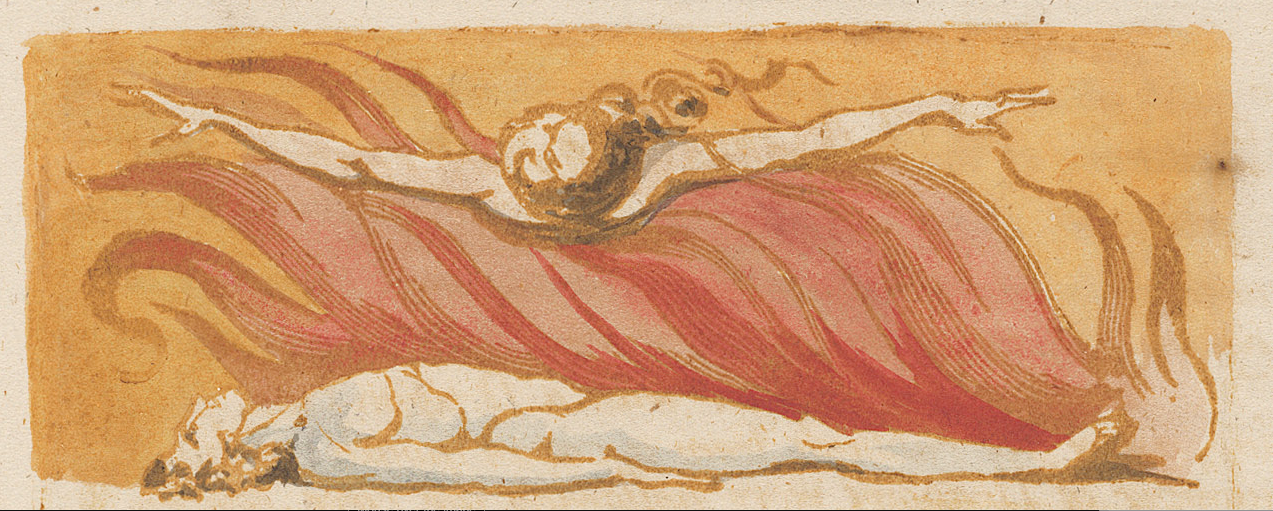
This painting by the poet William Blake is the image I use as the banner image for this blog. The “flaming sword” comes from the story of “the Fall” in Genesis three, which I’ll quote below; I’ll also quote from Blake and from George Fox.
The image
But Blake’s painting is hardly directly representational, as we’ll see from the Genesis passage.
- There are flames but no sword or gate into Paradise.
- The cherub is oddly presented and is human, or at least humanoid, in form, whereas cherubim are variously described in the Bible and other ancient mythologies, but always in some composite and mostly animal form. The cherubim that sit atop the ark of the covenant at least have wings.
- The human, presumably Adam, is supine, laid out almost as though he is dead. He has fallen.
Genesis 3:22–24:
And Yahweh God said, Behold, the man is become as one of us, to know good and evil; and now, lest he put forth his hand, and take also of the tree of life, and eat, and live forever:
Therefore Yahweh God sent him forth from the garden of Eden, to till the ground from whence he was taken.
So he drove out the man, and he placed at the east of the garden of Eden Cherubim, and a flaming sword which turned every way, to keep the way of the tree of life.
Comment
So the cherubim’s charge is to keep humans from reentering Paradise, eating from the tree of life, and becoming immortal. Yahweh and his angelic court (the “us” in the quote) are worried that humans will become like them. And we are already halfway there, having learned good and evil.
Blake’s blanket of flames and the outstretched arms of the cherub block the laid out Adam from rising.
Blake’s text
This image accompanies a page in Blake’s “The Marriage of Heaven and Hell”, one of his prophetic books, which is mostly text as captions for a series of paintings with a poem prologue. The poet presents himself as having descending into Hell and come back with prophecy that will reconcile heaven and hell. Here’s the text on that page. Note that Blake has given us here a significant phrase.
The ancient tradition that the world will be consumed in fire at the end of six thousand years is true, as I have heard from Hell.
For the cherub with his flaming sword is hereby commanded to leave his guard at tree of life; and when he does, the whole creation will be consumed and appear infinite and holy, whereas it now appears finite & corrupt.
This will come to pass by an improvement of sensual enjoyment.
But first the notion that man has a body distinct from his soul is to be expunged; this I shall do by printing in the infernal method, by corrosives, which in Hell are salutary and medicinal, melting apparent surfaces away, and displaying the infinite which was hid.
If the doors of perception were cleansed every thing would appear to man as it is, infinite.
For man has closed himself up, till he sees all things thro’ narrow chinks of his cavern.
George Fox
This image, these texts, together build an astonishing set of figures, both visual and theological, a kind of theological koan, a reality that seeks to transcend our either/or. But I used the image as a banner for my blog because of George Fox’s account of one of his visions. Here’s that passage from his journal:
Now I was come up in spirit through the flaming sword into the paradise of God. All things were new, and all the creation gave another smell unto me than before, beyond what words can utter. I knew nothing but pureness, and innocency, and righteousness, being renewed up into the image of God by Christ Jesus, so that I say I was come up to the state of Adam which he was in before he fell. The creation was opened to me, and it was showed me how all things had their names given them according to their nature and virtue. And I was at a stand in my mind whether I should practice physic [medicine] for the good of mankind, seeing the nature and virtues of the creatures were so opened to me by the Lord. But I was immediately taken up in spirit, to see into another or more steadfast state than Adam’s in innocency, even into a state in Christ Jesus, that should never fall. And the Lord showed me that such as were faithful to him in the power and light of Christ, should come into that state in which Adam was before he fell, in which the admirable works of the creation, and the virtues thereof, may be known, through the openings of that divine Word of wisdom and power by which they were made. [John 1:3] Great things did the Lord lead me into, and wonderful depths were opened unto me, beyond what can by words be declared; but as people come into subjection to the spirit of God, and grow up in the image and power of the Almighty, they may receive the Word of wisdom, that opens all things, and come to know the hidden unity in the Eternal Being. [Journal, Nickalls edition, page 27–28]
Fox claims to have made it past the guardian cherubim and the flaming sword back into Paradise. He says he came “up in spirit through the flaming sword.” He ascended through the flames into Paradise, just as the supine Adam in Blake’s painting would have to do. And the first thing that happens to him is Blake’s “improvement of sensual enjoyment”: Fox’s sense of smell became transcendentally acute.
And he was “renewed up into the image of God”. He was restored to the condition of Adam before the Fall, including the wisdom with which Adam named all the animals from mystical insight into their true nature—the doors of his perception were cleansed. [Check out Bob Dylan’s wonderful song Man Gave Names To All The Animals.] And Fox ate of the tree of life, though he does not describe it this way—through Christ he attained eternal life.
Many Lighted Candles
November 22, 2025 § Leave a comment
In his Apology, Robert Barclay offers a lovely metaphor for the gathered meeting (page 280 in Dean Freiday’s modern translation):
He [God] also causes the inward life to be more abundant when his children are diligent in assembling together to wait upon him. . . . The mere sight of each other’s faces when two persons are gathered inwardly into the life gives occasion for that life to rise secretly and pass from vessel to vessel. Many lighted candles, when gathered together in a single place, greatly augment each other’s light and make it shine more brilliantly. In the same way, when many are gathered together into the same life, there is more of the glory of God. Each individual receives greater refreshment, because he partakes not only of the light and life that has been raised in him, but in the others as well.
With his description of the life rising secretly and passing from vessel to vessel, Barclay is describing the transcendental, psychic dimension of the gathered meeting. By “secretly”, I think he means invisibly, without a tangible mode of communication or transference, and inwardly, coming to abide within each of us as vessels. And I suspect that he means the image of many candles augmenting the light in the same transcendental way.
But we can carry the candle metaphor further. The tangible reality of many candles in a real meeting room augments the light by revealing many areas that would be in shadow with fewer candles. One candle would cast many shadows in the room. But the more candles you add, the more of these shadow regions in the room become illuminated.
In this way, the metaphor obviously applies to vocal ministry, in which the Spirit can work through more vessels, more life stories, knowledge, and experiences, more perspectives, more openings into truth, and more faithfulness, to illuminate the shadows in each other’s hearts.
But the worshippers also bring these qualities with them into the silence, as well as into their ministry, to animate and shape the transcendental dimension of the gathered meeting. This is more of a mystery. How do the inward unspoken qualities of the worshippers give the gathered meeting its energy and joy? How do their intentions and focus and spiritual yearnings bring the Life into the gathering? And what provides the medium through which this Life flows from vessel to vessel?
A subject for another post.
I am the vine
November 9, 2025 § 1 Comment
A meditation in meeting for worship this morning. An “Afterthought”, I guess, though I did not share it.
In the gospel of John, Jesus says, “I am the vine, you are the branches.” (John 15:5) A passage the weekly Bible study that I moderate has been exploring.
When I try to feel inside myself this intimacy with the Spirit of Love and Life, it sometimes feels forced. When I try to feel the Sap of Life flowing into me from some holy Source beyond myself, or even within myself, when I try to open to its action within me, flowing through me to bring forth fruit in the world through my words and actions, I often feel like I’m trying to fake it until I make it.
But every once in a while, this faith and practice of inward attunement and at-one-ment with divine love and life does bear fruit, and its promise is fulfilled. I do feel divine love and life pouring through my spiritual veins, and I am alive with love and joy and gratitude.
Then my faith is renewed and my practice is strengthened in happy expectation.
Ministry for and to Different Conditions
October 25, 2025 § Leave a comment
I’ve just finished reading Brian Drayton’s Messages to Meetings, a book of epistles to Quaker meetings and gatherings “written originally out of a motion of love and with the intent that they might help some readers on their path towards the more abundant life that Christ promises and makes possible.”
The book is a wonderful source of spiritual nurture, for both readers and their meetings. Parts of this book spoke to me so deeply that I want to share them more widely here. I’m going to pass on more from this book in future posts.
For instance, in letter number four, titled: “As we reflect on our meetings’ spiritual condition,” Brian writes about “Ministry for and to different conditions” in ways I found very useful as I work with my own meeting to bring my ministries into the life of the meeting. The entire letter, and especially the last paragraph, are an appeal to our meetings to be more proactive in our nurture of ministry, which resonates with my own calling to have more “fire in the Spirit” in the nurture of ministry in our meetings.
I quote Brian in full (page 16–18):
The ministry of the meeting, which includes the words spoken and the silent ministry, and the words or deeds of service or prayer with individuals or groups at other times, is rooted in a listening, loving focus on the actual people gathered and on the One in whom they are gathered.
As you consider the meeting’s condition this year, Friends, listen for the conditions within the community in compassion and honesty. Three conditions that have come particucarly to mind in my exercise are these: the “young” members, of any age, who are new to Friends; the “established”; and the “well-grown in the truth.” Each of these condition has characteristics that may require particular kinds of service to help them forward, and it is good sometimes for a meeting to reflect on whether the ministry is offering what it can under God’s guidance.
In the “young,” that is, those new to Friends, there may be exploration, enthusiasm, receptivity, and a need and desire to learn the foundations of the Quaker path. They need guidance, but not only instruction. They have come to you in curiosity, perhaps, but under that is a restlessness or inquiry, and it is through the witness of your acts and life joined with words of explanation and welcome that they will be helped to see that among you they can find a living path. Inquirers need to feel our humility, but also where we are touched with fire and the Holy Spirit.
In “established Friends,” there is a growth of discipline and order, a maturing exploration of and use of gifts, and a habit of bearing responsibility for the life and support of the meeting. But in this period, there can be an engagement with contradictions and continued mysteries in the understanding of Quakerism. Faith and discoveries that were nourishing and inspiring in the first days among Friends may feel stale or insufficient for the demands now encountered. New resources and opportunities are needed if such active Freinds are to rediscover their spiritual childhood—the place of wonder and gratitude, openness and receptivity. Fire and the Spirit!
Those well grown in the truth have a tested understanding of the value of the diverse paths people can follow as well as the dangers of a mere celebration of diversity. They have an understanding of the pirtfalls and dangers of life in the Spirit, for individuals and meetings, and a sympathy for questioning and doubt. Their expeirence has brought a reliance on the workings of the Lord in many situations, and they have learned to wait and listen; they have seen (or others have seen in them) a growth in tenderness, courage, freedom, and discipline in love and truth. At this stage, though, there are fresh challenges that come from habits long established, the same problems and challenges returning over and over. They can read the indicators of the meeting’s long-term good or ill health and stability, its growth and depth; caring deeply, they can yet feel taken for granted and that their own seeking and spiritual thirst is not seen.
Fire and the Spirit—the baptism is needed at every stage!
People in each of these stages of their spiritual life offer ministry rooted in the questions and findings of that condition, but each stage also has its temptations and problems. In each stage there are times of dryness, or misplaced complacency, of frustration, and of hope. Everyone needs to receive nurture and love, in meeting and out, if their gifts and strengths are to be confirmed and to grow. All need exhortation or inspiration, instruction, reasurance, consolation, gratitude, and challenge—accompaniment in the Spirit as individuals trying to walk in the Light.
“That of God”—Again
October 17, 2025 § 6 Comments
For decades, I have complained about Friends claiming that “that of God in everyone” is our central tenet of faith and that it’s to be understood as a divine spark of some kind, something inherent in the human that partakes somehow of God’s being or nature. I’ve heard Friends equate it with the “image of God” in which Genesis one says we were created.
For all these years, I have accepted Lewis Benson’s argument that this usage of the phrase was introduced by Rufus Jones and is a misunderstanding of Fox’s use of the phrase. Benson claims that Fox used the phrase almost always in the pastoral sense implied in the quote that we use as our source for it in an epistle which he includes in his journal, that Fox did not use the phrase in the doctrinal sense that is common among us nowadays, usually stated as “there is that of God in everyone.
Then, in Michael Langford’s Becoming fully human: Writings on Quakers and Christian thought, I find this quote from Fox:
None that is upon the earth shall ever come to God but as they come to that of God in them, the light that God has enlightened them with; and that is it which must guide everyone’s mind up to God, and to wait upon to receive the spirit from God. . . . That which is of God within everyone is that which brings them together to wait upon God, which brings them into unity, which joins their hearts together up to God (Doctrinals, Works, Vol. 4, pp. 131–132; page 117 in Becoming fully human)
This quote demonstrates how complex and fluid Fox’s thinking was, how hard it is to pin down what he actually means, or at least what kind of coherent theology we might reconstruct from his truly prolific output. Fox is edging right up to Jones here. Or to put it in chrono-theological order, you can see how Jones might see in this passage some foundation for his own understanding. And there it is in one of Fox’s doctrinal works.
However, Fox is still giving “that of God in everyone” a pastoral role; that is, it brings us to God. And he equates “that of God” with the light of John 1:9, “the true light, which enlightens everyone,” which is the Word, which is Christ. So it looks like this is an Inward Light, because God has given it/him to us for our enlightenment. It’s not inherently in-dwelling; it was given to us.
On the other hand, however, “that which is of God within us”—that looks more like an Inner Light, an indwelling light that might in fact be inherent, since it is within us and everyone has it. It looks like Fox is having it both ways.
My sense from reading Jones’s books on mysticism is that he was some kind of neo-neoplatonist, in the sense that neoplatonism believes that a universal divine spark is what brings us to God, just as Fox is saying here. God’s spark seeks to return to its origin-home in God; this is the source of the religious/mystical impulse. Likewise, God reaches us inwardly by reaching this God-seeking God’s-self within us, and that divine spark recognizes and receives God when God comes. In mystical union, the divine spark has finally come home. This is the dynamic of mystical union experience.
Jones believed that this universally possible God-to-God’s spark connection is what lies behind all mystical experience, whatever the mystical tradition. And Jones is the one who taught us to think of Quakerism as “practical mysticism”. All of this is very close to what Fox seems to be saying in this quote.
Fox’s sublime innovation is to equate all this—the pastoral “bringing” to God, the doctrinal dwelling “within” us—with the light of Christ, the enlightening Word. “God” in this dynamic is Christ speaking to our condition, penetrating the sheath of sin and ignorance around our soul with the Light, seeking to reach that of God within us, which yearns for him.
“That of God” yearns for God, Fox implies in the quote we always use for this phrase. In that epistle, once we have done the inner work of our own transformation in the light of Christ ourselves, then we can answer that of God in others. That of God within us is calling out in the darkness, and the Light answers with the Word.
Vocal Ministry: A Garden, a School of the Spirit
October 6, 2025 § 1 Comment
Vocal ministry is the signature form of ministry in the Quaker way. As such, it is the classroom and laboratory in the school of the Spirit for Quaker ministry of all kinds. In our practice of vocal ministry, we can learn and experiment with all of the spiritual elements that make up the faith and practice of Quaker ministry more generally.
Listening for the Voice. The spiritual foundation of ministry is listening for the Voice that is calling us into service, an expectant attention to a possible anointing by the Spirit within us for service. Something there is within us that can hear that call, that can see that light, that can feel that prompt as a seed sprouting, pushing aside the soil of our soul and unfurling into the light of consciousness.
Nurturing the plant. Once you feel that baptism, then the attention changes into a form of waiting to see how the plant grows, combined with however we water such emerging shoots with deep contemplation. We nurture it, give it the fertilizer of this new kind of attention, until it matures and perhaps a flower blooms, a message, or a mission, that is taking more definite form.
Expectant waiting. Once the shoot, now a plant, has produced a blossom, a possible message, attention shifts again. We remain attentive and open, trying to hold onto the opening but not obstructing its development. Will we see it pollenated? Will new thoughts and feelings enter our regard and enrich it, so that some fruit begins to form? Or will the ministry of others bring some truth to the body ahead of our own that settles us back into silence? Or perhaps just the mystery of the deep silence itself will bring the fruit to maturity. If so, eventually a beam of Light shines upon it with clarity, a wind of the Spirit shakes the branch, and it falls ripe into your hand.
Discerning the Spirit. But we are not done yet. Another form of attention is required. Has it truly been pollenated by God? Is this fruit the fruit of the Spirit or of ego, or of a mind engaged but without a true spiritual transmission? Is it just for my own nourishment, or has it been given to me to serve to the meeting? If so, then, we become clear and out to the diners at the messianic banquet it goes.
Serving faithfully. Now, more deep listening even while speaking is required. If it has been given for the meeting, do I keep my ego off the plate in its delivery? Is my ministry truly service and savory in itself, or have I over-seasoned it? And do I know when the plate has been cleared, and I can sit down, having fulfilled my service?
Eldering. Once I’ve sat down, how do I feel—deeply at peace or quite energized, not in the satisfaction of self, but in some transcending sense of relief or of satisfaction? How does my Guide, the spirit of the christ, of the anointing, feel about my service? This inner reflection is just as subtle and delicate as all the other forms of spiritual attention we’ve exercised, just as reliant on experiment and practice. But we are not alone. What does the meeting think of my service? Is our meeting paying attention, deeply listening not just to the message but also to the Seed from which it grew? Is our meeting passing on the faith and tools for listening spirituality and ways to enter the depths of our being and listen? Is the meeting looking for opportunities to nurture those who are being called into service?
All of these forms of attention are versions of our listening spirituality, ways to attune ourselves to the movement of the Spirit within us and among us, to hear its message for us, as individuals and as meetings. Do we have teachers in this classroom? Have we given our ministers the tools they need to find their own faith and practices, so that they may grow in their service? And is the soil of our meeting’s garden fertile and ready to receive the new seeds that our ministry brings to us?
Stand Still in the Light
September 3, 2025 § 2 Comments
George Fox and early Friends had a phrase that defined a spiritual practice: Stand still in the Light. If we turn inward toward the Light of Christ within us, it will reveal to us our sins, our faults, our shadow side. If we stand still in the Light, it will burn away that shadow, it will bring forgiveness, moral strength, and peace. Rex Ambler has developed a more fully defined practice from his understanding of this usage among early Friends.
But the Light’s illumination also has a positive side, an outward looking and forward looking and expressive side that is companion to the inward looking, soul searching side. For the Light is also always trying to heal us, to inspire us, to renew us, to strengthen us, to guide us in our walking through life and lead us into fulfillment and joy. Standing still in the Light opens the doors of the heart and mind and soul so that God’s anointing spirit, the spirit of the christ, may enter, but also, after we have supped, we may walk out singing into the world.
Meetings and Ministry, Part 4: Reviewing Faith and Practice
August 7, 2025 § Leave a comment
Yearly meetings should review their books of Faith and Practice to ensure that they treat minutes of travel and service fully, including what to do with such minutes when a member transfers membership. The recommendations below are based on Philadelphia Yearly Meeting’s entry on minutes of travel and service, which is rather brief but it covers the essentials pretty well.
The F&P entry on minutes of travel should:
- Process. Lay out the process for clearness regarding the leading—to whom a Friend with a leading should go and what the clearness for discerning a leading should be. Lay out the process for writing the minute, and for its approval.
- Minute’s content. Provide guidelines for the content of the minute—nature, scope, and duration of the proposed service, affirmation of the meeting’s support, room for endorsements.
- Support. Consider forming a spiritual support committee of some kind for the minister while pursuing their ministry.
- Release. Recommend that the meeting consider ways to help release the minister from obstacles to their service, if there are any.
- Companionship. Recommend traveling with an elder or companion, if possible.
- Meeting endorsement. Recommend endorsement by the regional meeting and the yearly meeting if the travel will extend beyond the region or the yearly meeting.
- Visitation endorsement. Recommend asking that the bodies being visited endorse the minute, on its back or on an attached page, giving the name of the body visited, its location, and the date of service, comments on the character and quality of the service, and a signature and date of signature by the person(s) presiding in the visited body.
- Reporting. Provide guidelines for reporting back to the meeting, perhaps annually.
- Laying down. Provide guidelines for discernment and the laying down of the minute with final reporting when the minister and the meeting are clear that the minister has been released from their leading by the Holy Spirit.
- Transfer of membership. Provide guidelines for both the transferring meeting and a member’s new meeting regarding the transfer of the minute and of care for any spiritual support that the transferring meeting may have convened for the minister.
Meetings and Ministry, Part 2: My Story
July 28, 2025 § Leave a comment
A Leading Leads to Frustration, and to New Leading
In 1990, Buffalo Meeting in New York asked New York Yearly Meeting’s Friends in Unity with Nature Task Group to bring them an earthcare program on the twentieth anniversary of Earth Day. A f/Friend and I answered their call.
On Saturday night before the program on Sunday, I was sitting up praying over my notes for the following morning when an opening came to me that pushed its way in front of my preparations. It came out of nowhere—well, as it turns out, it came out of Spirit-where—and it would not go away. It was this: If Christ was the Word “through whom were all things were made and without whom nothing was made that was made,” as John 1:3 puts it, then destroying creation is re-crucifying Christ.
Now this was what Friends in the elder days called a cross to the will: my will and my intentions and expectations were being crucified. Because I was in those days actively hostile to Christ, Christianity, and the Bible.
But I had been raised in a pretty pious and active evangelical Lutheran family and I knew the Bible pretty well. And the more I thought about it, the more important this new idea seemed, and the more it ramified—the more I remembered and discovered that I could say to Buffalo Meeting. But I did not want to say it. And I was pretty sure that Buffalo Meeting wouldn’t want to hear it.
But the Holy Spirit had seized me by the scruff of the neck and would not let me go. I had to scrap my original notes and go with this crazy new thing. So I gave Buffalo Meeting a little Bible-based sermon and, as I remember it, they did in fact give it a rather cool reception.
It was weird. Or wyrd, in the Old Norse sense of the origins of the word, a situation that was so important the gods were involved. God was involved. And it didn’t stop there.
Over the next few weeks, the original opening expanded and ramified and it dug in. Eventually, I felt I was called to write a book of Bible-based earth stewardship theology—another cross to the will. I did not want to do this. First of all, I knew it meant probably years of research; I didn’t know nearly enough. I had read none of the earth stewardship theology that had been written up to that time, and I didn’t know the Bible well enough to treat it properly. But more importantly, I still felt hostile to Christianity and the Bible.
So I brought my leading to my meeting. I asked for an oversight committee. I knew that my prejudices threatened to thwart or distort my faithfulness and I wanted my meeting to help me stay faithful.
In my first meeting with ministry and counsel, they did not understand what I was asking for, even though some weighty and seasoned Friends served on that committee. I went away frustrated. But I still felt it was important to get some support. So I went back to them. This time, some of them understood just enough to actually misunderstand in a new way.
“We can’t tell you what to think,” they said. I didn’t want them to tell me what to think, I wanted them to tell me if I was going off the rails. “That’s for your editor to tell you,” they said. That would be way too late, I said. In the end, they said no again.
I was left to my own discernment and discipline. I hustled some financial support and went to Pendle Hill for two terms in 1991 to begin research on the book. There, I was mentored by Bill Taber and Doug Gwyn, who taught Quakerism and the Bible respectively. My time with them and at Pendle Hill confirmed my calling and gave me the support I needed. I reclaimed the love of the Bible I had had as a teenager. I stopped being Christ and Christianity’s adversary. And the course work with Doug and Bill deepened my knowledge of and commitment to the faith and practice of Quaker ministry. The experience deepened my love for and commitment to the Quaker way. It changed my life.
And: the leading to write that book and the frustrating experience I had with my meeting led to two new leadings, both of which I still carry as ministries. The first was—is—to foster in our meetings the recovery of our traditions regarding ministry, so that others with leadings would not be left bereft, as I had been. The second was a sustained and intensive study of, the Bible, such that I have for years now moderated a weekly online Bible study and written another (unpublished) book on the gospel of Jesus, which grew out of the things I learned writing the first one; and I have two more in my head and heart.
 Through the Flaming Sword