
Membership Decline Case Study, Part 5—Outreach Solutions
September 16, 2026 § Leave a comment
Solutions: Outreach
Let’s assume that your meeting has done the inreach. You are ready to welcome newcomers and have the three elements that will matter most in holding onto them initially: warm, welcoming fellowship, deep silence, and Spirit-led vocal ministry. How do you get newcomers in the first place?
I’ve prepared a Meeting Outreach Checklist, which I hope you will find useful.
Also, Friends General Conference has a lot of Resources for Outreach. Click that link and check it out.
And good luck!
Membership Decline Case Study, Part 4—Inreach Solutions
September 5, 2026 § 1 Comment
Solutions
We are in decline. Membership is falling, some individual meetings are on the verge of dissolving, charitable giving is flat, while our costs are steadily rising. But this structural decline is only part of the story. I fear that we are declining spiritually as well.
This is a perennial complaint of white-hairs like me. John Woolman recounted such a complaint from an elder in the very early 1700s. And I bet it was true.
When’s the last time your meeting for worship was gathered in the Spirit? Are you getting Spirit-led vocal ministry? Do you have a lot of attenders who only come to meeting for worship?
The good news is that we’ve also been through periods of renewal, usually at the hands of young adult Friends. Cases in point are the emergence of programmed worship and pastoral meetings in the 1870s and ‘80s, the emergence of the liberal Quaker movement in the late 19th century, the growth of meetings in college towns in the 1950s and ‘60s, and the revitalization of our witness life during the 20th century’s wars.
I believe that renewal in our own time will come from the Holy Spirit. That is, it will depend on Friends called to the ministry of renewal. Are you so called? And it will take two forms: effective in-reach and meaningful outreach.
It WILL NOT come from restructuring our meetings. I served on New York Yearly Meeting’s first Renewal Committee in the early 1990s. The yearly meeting has since then convened no fewer than six more formal efforts focused on meeting structure; all failures. Real renewal comes from God.
In this post, let’s look at in-reach. In the next post, we’ll look at outreach.
In-reach
Holding onto visitors
I believe that newcomers to our meetings decide to stay when they get at least some of these three elements of meeting life:
- True fellowship of the Spirit—a warm personal welcome, including especially, for young families, childcare and First Day School already waiting for them; not necessarily already with kids, but adults prepared to welcome any families who show up.
- Spirit-led vocal ministry—messages that speak to the yearning that brought those visitors to us in the first place with their hopes for an experience that answers that of God within them, messages delivered with discipline and integrity and genuine spiritual inspiration.
- A living silence—achievable only through the presence of a critical mass of spiritually mature members holding the meeting in grace.
Holding onto newcomers
Once visitors become attenders, they need more than just a welcome and the meeting for worship. They need to know that there’s a there here. This means visible and regular efforts at spiritual nurture—a vital culture of eldership.
- Does your meeting have a committee or at least individuals who proactively pay attention to newcomers, inquiring about their lives and spiritual interests?
- Do you have adult religious education or other programs that introduce them to the Quaker way, and especially about Quaker worship and vocal ministry?
- Do you inquire into newcomers’ spiritual gifts and interests?
- Do you invite their participation in things besides committee work (though that, too)?
Membership
- Do you regularly announce and explain the process for becoming a member and invite newcomers to consider applying, in a general way?
- Do you approach individual newcomers when you think they might be ready?
- In your clearness committees for membership, do you try to identify the applicant’s spiritual gifts (not just what committees they might want to serve on), and try to identify their ministries—whatever they are doing in their lives that they could see as Spirit-led service? Do you explore their spiritual interests, what kind of spiritual formation and nurture they might welcome?
- And after people become members, do you follow through with focused personal mentoring and support on the things you’ve discovered in their clearness committee?
The culture of eldership
- Do your committees, especially adult and youth RE (you have them, right?) and worship and ministry committees—do they regularly consider how to foster deeper vocal ministry, how to support leadings and ministries, how to nurture individual members and attenders in their spiritual lives?
- Do you know how to conduct clearness committees for personal decision making and the discernment of leadings, and regularly announce their availability?
- Do you hold discussion groups and worship sharing opportunities around aspects of the Quaker way and any issues the meeting may be currently facing?
- For the newcomers who do not attend meeting for business and/or your programs, are you willing to use the meeting for worship itself as a venue for these kinds of spiritual nurture? Or are you treating the meeting for worship as a fixed outward form and as a sacred cow that can’t be experimented with?
Membership Decline Case Study, Part 3—The Money
September 1, 2026 § 4 Comments
Donations per member
Before I began this study, I thought that, in addition to a steady decline in membership, the giving by the members we do have was also declining. But that’s not quite the case.
As you can see from the chart below, until the last decade or so, donations by membership actually kept pace with expenses, even though the expenses curve has been rising. In fact, expenses rose relatively steeply from the mid-1970s to roughly 1992, but donations kept up. In 1992, expenses leveled off some, then they rose a bit around 2001, and then they leveled off again around 2004.
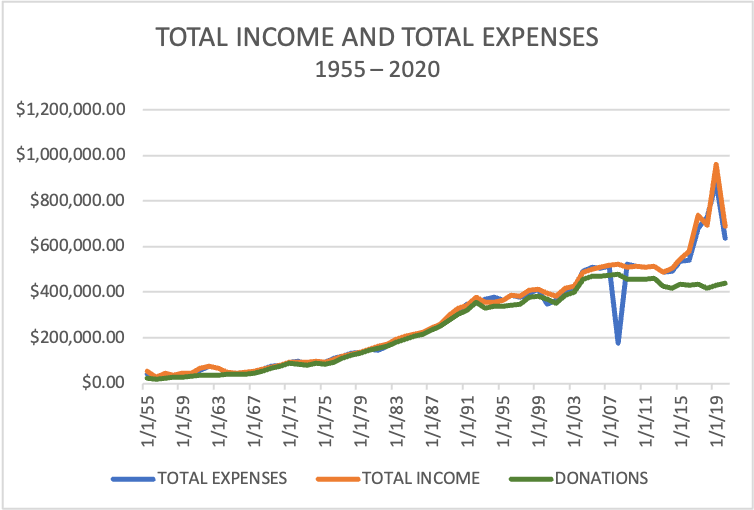
Meanwhile, donations per adult member kept up through that first stable period, but couldn’t quite match the upturn in expenses between 2001 and 2004. Then, beginning with the Great Recession in 2008, donations began a slow decline that had not stopped by 2020, while expenses remained fairly stable for a while.
Until 2014. Around then, the expenses curve turns chaotic. Expenses rose very steeply and spiked dramatically in 2019 and then crashed in 2020. Meanwhile, all through that period donations remained flat. I suspect that the pandemic caused the crash in expenses in 2020. But I’m not close enough to the yearly meeting anymore to explain what was going on during that last period.
In this period since 2014, the yearly meeting apparently made up the difference with its annual general appeals, with its investments, and with other income. I’m no finance expert, but it looks like a dramatic increase in the value of investments in that period helped to fund the dramatic increases in total income while donation income remained flat.
As this disparity between income and expenses becomes more obviously a threat for some yearly meetings, they will have to make increasingly severe cuts in their budgets. Some of these cuts will necessarily fall upon staff, as they already have in Philadelphia YM, as I know, and reduced staff is not likely to reverse membership decline or increase charitable giving. It’s a feedback loop.
What’s a yearly meeting to do? I’ll think about that in the next post.
Membership Decline Case Study, Part 2—The Data
September 1, 2026 § Leave a comment
Members
As I said in the previous post, New York Yearly Meeting membership has been declining since the Orthodox and Hicksite yearly meetings reunited in 1955.
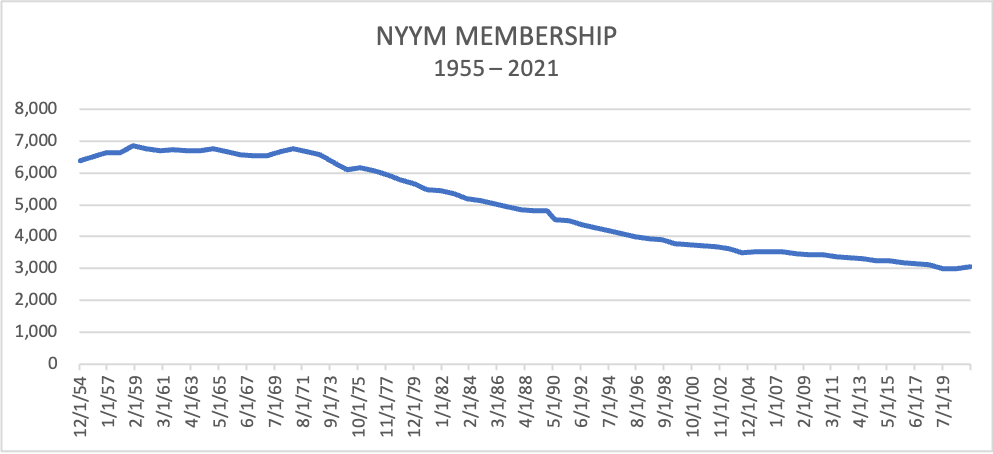
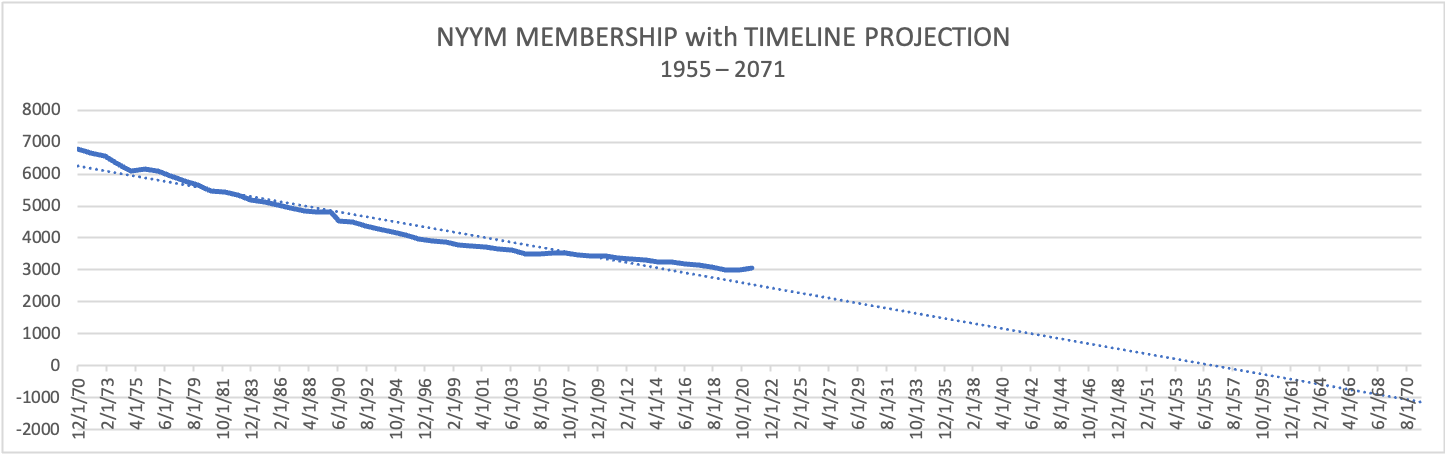
The broad conclusions are as follows. In the 66 years from 1955 through 2021, NYYM membership declined by 3,342 members, from 6395 to 3,053, or 52.3%. As you can see from the chart above, the decline began around 1970 and may have started leveling off a bit beginning around 2003. As you can see from the second chart below, the trendline, if it holds, reaches 0 members in 2056.
Yearly meeting appointments
When I was active in the yearly meeting from the 1980s through the late 2010s, yearly meeting session attendance—people actually in the room for business meetings, rarely got above 120, roughly 3% or so of total membership. If that percentage of active Friends holds, the yearly meeting will have only 50 people doing its business by around 2035, less than ten years from now. In 2020, the yearly meeting had 49 committees or other bodies to which members were appointed and more than 400 appointments that were filled on paper. You can do the math.
Factors
Removals. Unfortunately, I don’t have data for 1973 through 1985, which latter year is about when I joined. But I remember that in the late 1980s into the early 2000s, meetings became more resolved to remove folks from their rolls because the yearly meeting used a membership formula to calculate requests for contributions from the quarterly meetings, and meetings were then paying for “members” whom they never saw and/or who lived away from their area. I don’t remember when the quota practice was dropped, but I suspect that trying to reduce their covenantal commitment was a factor in the number of removals from membership that made the membership decline curve steeper in that period than later.
Resignations. In addition, in this same period, lots of Christ-centered Friends left the yearly meeting as individual meetings and then the yearly meeting itself gradually came to a new testimony regarding marrying same sex couples—another factor in the decline.
Meetings
Lets look at the number of meetings instead of the number of members. For this I’m comparing 2012 and 2021.
The number of meetings declined in this period from 63 to 61, losing three and gaining one. But the more important figures lie in the number of very small meetings.
In 2012, NYYM had 8 meetings with membership at 10 or less, with an average membership of 6.6, representing 12.7% of all meetings. NYYM had 9 meetings with between 11 and 20 members with an average membership of 16.1, representing 14.3% of all the meetings. Thus 27.0% of NYYM’s meetings had 20 or fewer members
In 2021, NYYM had nine meetings with 10 or fewer members, with an average membership of 5.2, representing 14.8% of all meetings—an increase from 2012 of 2.1%. Twelve meetings had between 11 and 20 members, with an average membership of 16.8, representing 19.7% of all meetings. Thus 34.4% of NYYM’s meetings had 20 or fewer members—more than a third. That’s a 7.4% increase since 2012.
Meeting summary: In the nine years between 2012 and 2021, NYYM lost a net two meetings, but the number of small meetings (20 and fewer members) increased by 7.4%. Meetings with 17 or so members (the average for meetings with 11 to 20 members) will hang on for a while, but they are likely to lose members, as the increase in the number of meetings with 10 members or less indicates. Meetings with just five members are probably in real trouble.
Quaker Membership Decline—A Case Study
September 1, 2026 § Leave a comment
In an earlier series of posts which I titled Quaker-pocalypse, I talked about three curves that I thought were converging for Quaker meetings and institutions with potentially catastrophic consequences. These trends are: declining membership, declining donations from the members we do have, and rising fixed institutional costs. When the first two curves crossed the third, I expected that meetings—meaning, mostly, yearly meetings—would have to radically restructure themselves or they would collapse.
I’ve made a case study of New York Yearly Meeting (NYYM) to study these factors and trends. I chose NYYM because I know it well; I was a member for decades and was its communications director for several years, and in that role I wrote its annual reports, so I’m very familiar with its data-keeping format. Also, NYYM’s records are kept in the Quaker collection at Swarthmore College, which is easily accessible for me. Furthermore, NYYM’s Orthodox and Hicksite yearly meetings reunited in 1955, which provides a clean starting point for the data. My data field thus extends from 1955 through 2020/2021.
The results surprised me some. Membership has been steadily declining, and maybe more important, the number of monthly meetings that are inching toward collapse has been accelerating. The rate of giving by members to their meetings is more complicated, but shows a troubling trend over the last twenty years, especially when compared to fixed expenses.
In the next post, I look at the membership figures.
Matthew 18:20 and the Gathered Meeting—Timeframes #2
August 20, 2026 § Leave a comment
What Was Matthew trying to say?
RECAP: I’ve been exploring in recent posts the various levels of intention and meaning in Matthew 18:14–20, and especially Jesus’s promise to guarantee the church’s authority in dealing with conflict in the church with his “presence” in verse 20, from which we get the phrase “gathered meeting”. In this and in the previous post, I’m looking at the passage from the perspective of the timeframes in which we could read it: in the time of Jesus, in the time of Matthew, and in our own time.
Matthew writes for a community that believed in Jesus’s resurrection, or at least for a community that he feels should believe, one that perhaps needs reassurance. Matthew’s account of the resurrection, with its posted guards and the chief priests’ cover up of the event with the disinformation that the disciples had stolen Jesus’s body, seems designed to counter rumors to that effect, especially since neither Luke nor John mention this story.
So, like us, Matthew and his readers could have thought that Jesus in 18:20 might have been speaking about gatherings taking place after his death, that he might be promising to appear among them as the resurrected Christ somehow.
However, there’s no hint of such a projection in time in the actual wording of the passage; it seems very present tense. Jesus doesn’t say “there I will be” in your midst; he says “there I am.”
And the passage might be a part of Q, the collection of sayings from which Matthew and Luke drew to add sayings material to their narrative gospels. Furthermore, Matthew 18:14–20 is in the instruction form of Q sayings, like much of the Sermon on the Mount. These instruction sayings formed the original core of Q, according to some scholars. That instruction core may be the earliest look we have at the very early Jesus movement.
On the other hand, Matthew 18:14–20 sits in the middle of a whole chapter on the theme of forgiveness in a tone that might suggest a milieu in which Jesus’s followers are facing the problems of a mature community dealing with managing members’ behavior. Like the 1660s and’70s in the history of the Quaker movement with its beginnings of “gospel order”, rather than the wild and sometimes chaotic 1650s.
I think that this reinforces the conclusion that Matthew is giving us a Q saying that comes out of the living ministry of Jesus and is not necessarily a projection into the future of a promise of a resurrection presence. But he’s put this material together in a way that speaks in a coherent way to the concerns of his own community.
At the same time, Matthew 18:20, with its use of some kind of “name” theology, is hinting at a more mystical, or metaphysical, dimension that reflects the reality of Jesus’s death and the hope of the resurrection.
So we’ll dive into that “name theology” in the next post.
Matthew 18:20 and the Gathered Meeting—Timeframes #1
August 11, 2026 § Leave a comment
I tend to read the Bible as though what I am reading is addressed to me. I suspect that we all tend to do this. But it never is addressed to us in the 21st century. Every passage in the Bible is always addressed to someone besides us, who lived in a completely different time and cultural milieu.
In fact there are at least three timeframes at work in Matthew 18:14–20:
- Jesus speaking to his disciples;
- Matthew writing for his audience; and
- us reading the passage for ourselves today.
Or put another way: What did Jesus mean by this passage? What was Matthew trying to say—why did he include it in his gospel? What does it mean to us for our attempts to apply the passage to our situation as readers today? In particular, how do we understand its value in fostering the gathered meeting?
So the timeframe questions are: Who is speaking, whom are they addressing, and why?
Jesus speaking to his disciples
In Matthew 18:20, on the face of it, as the sentence comes to us, Jesus is speaking to his disciples while he is still alive, during his living ministry. He is laying out a protocol for dealing with conflict between his disciples. Presumably the church he refers to in verse 17 is one of the household churches he had set up during his ministry, like the one in Bethany in the home of Mary, Martha, and Lazarus.
So when he promises to the disciples that he will be “in their midst,” he doesn’t mean literally, physically, because he couldn’t be everywhere that such a conflict occurs when it occurs. So he must be promising to be present in some other way—some “metaphysical” way.
The key to the answer seems to be in whatever he means by gathering “in [his] name” in verse 20. What does “in my name” mean?
I see two sets of possibilities here (though we will return to this matter of the name in a later post). One set is “secular” in nature; the other is magico-religious.
One’s name is one’s reputation, especially in Jesus’s time; see Matthew 10:22 and 24:9, for instance. Or “in my name” could mean upon his authority—a “tell them I sent you” kind of authority; see John 14:13. Or “in my name” could mean “as I have taught you.” Jesus might have meant this promise in all of these ways.
But the fact that the second promise invokes the Father’s authority through the use of prayer suggests another dimension to this passage, a metaphysical one, if you will. Jesus repeatedly associates himself with the Father, even almost equates himself with the Father, especially in the gospel of John. In this regard he often speaks of being sent by the Father.
Meanwhile, ancient Israelite tradition has a rich and complex theology of the Name as God’s presence.
The writers of Deuteronomy, who had close ties to Jeremiah and Hosea, and who compiled the so-called Deuteronomic history—Joshua, Judges, 1 & 2 Samuel and 1 & 2 Kings—considered Yahweh’s name as his presence on earth. A number of extra-canonical and inter-testamental Jewish texts went to town with this theology of divine presence in the Name. And Jesus seems to have adopted some version of this magico-religious understanding of the power of the divine name: “hallowed be thy name,” reads the Lord’s prayer, for instance. The name also has power to cast out unclean spirits in a number of accounts.
I think it is possible that Jesus’s promise in 18:20 ties the presence of the Father and his authority promised in verse 19 to the authority Jesus exercised on the Father’s behalf with this teaching regarding this protocol: through prayer during the proceedings of the protocol, the church invokes the presence of the Father, and also of his son by virtue of following his teaching, invoking Jesus’s name for authority—because, for these purposes, at least, the name/power/authority of the Father and of the son were one and the same, for, as his son, Jesus was his Father’s presence in the world. (Let’s put aside what being the “son of God” meant.)
I think Jesus was saying: conduct this matter as I have instructed you and pray to the Father as I have taught you, so that he will know that I sent you, and he / I—we—will answer your prayer; that is, your decision will have his / my—our—authority.
We will return to the theology of the Name in a later post.
Vocal Ministry and the School of the Spirit
August 6, 2026 § Leave a comment
As the signature form of ministry in the Quaker way, vocal ministry is a classroom and laboratory in the school of the Spirit, for the faith, the practice, and the experience of ministry of all kinds, for the fostering of its openings, the refinement of its discernment, and its nurture in the meeting.
Faith
In the vocal ministry, we believe in the Light within us, the light of the christ, God’s anointing spirit, which anointed Jesus as the Christ for his vocal ministry (Luke 4:18), and which is the source of our own openings, leadings, and callings.
In the vocal ministry, we have faith in the discernment of spirits, in an inner Guide who threshes the messages and winnows the kernels from the chaff.
In the vocal ministry, we have faith (or perhaps just hope) in the meeting’s eldership, in its proactive, Spirit-led tutelage and nurture of the vocal ministry and its ministers, and in its clarity and faithfulness in maintaining the peace of the Word.
Practice
In the vocal ministry, we practice the spirituality of inward listening that is distinctive to the Quaker way, of attuning ourselves to our inner Spirit-voice, who may call us to service; and as meetings we teach the ministry’s faith and practice and watch for those whose gifts are emerging, ready to water their sprouts with love.
In the vocal ministry, we practice the spirituality of discernment, testing whether the words of our mouth and the meditations of our heart are truly from the Word of wisdom; and as meetings we mind the vines as they grow to maturity and we accept the fruits of their ministry in the Spirit in which it is given forth.
In the vocal ministry, we practice the spirituality of faithfulness, we are led by our Guide on the path of love and truth, lest we step through the traces or run past our guide; and as meetings we help to prune the vine so as to restore its fruitfulness, when necessary.
Experience
In the vocal ministry, we experience the joy of divine openings, the caring hand of our Guide, and the deep satisfaction of faithful service.
In the vocal ministry, we experience the Holy Spirit’s continuing revelation.
In the vocal ministry, we experience the covering of the Spirit, the in-gathering of our collective consciousness in the cascade of Spirit-led ministry; we experience the Presence in our midst.
Patterns and Examples
In the vocal ministry, in all these ways we see how the blessings of the Spirit manifest in the patterns and examples of our vocal ministry for all the forms of Quaker ministry, in its faith and practice and experience, as the anointing/christ-ing Spirit of God in action within us and among us, calling us into service both personally and collectively.
Matthew 18:20 and the Gathered Meeting—The promise(s)
August 4, 2026 § 1 Comment
A promise more than a condition for gathering (and a thing with numbers)
I suspect that many of us tend to read Matthew 18:20 as a condition: If you gather in my name, then I will come. But he actually says wherever you gather in my name, there I am in your midst. He is making a promise, not necessarily establishing a condition for his presence, though I think it’s reasonable to think that he’s implying a condition. We will return to the role of his name and this possible condition for gathering in a later post.
The wider context for this promise is Matthew 18:15–20, which defines a 3-step process that Jesus prescribed for dealing with conflict in his household churches. The promise in 18:20 is the third in a series of three promises, and each promise relates to one of the three action steps in the reconciliation protocol.
The first promise confers on one person heavenly authority to “bind” or “loose”. “Binding” and “loosing”, which also appears in Matthew 16:19 in which Jesus gives Peter the keys to the kingdom of heaven, represents the authority of the church and its leadership to settle matters of doctrine and of discipline. The second promise confers on two people (or three) the Father’s authority through an answer to prayer.
The third promise—the promise we’re looking at specifically—confers on the whole church Jesus’s own authority through his presence to expel the offender. Or at least, to treat them as a Gentile or tax collector, an outsider of some kind. The gospels give mixed messages about Jesus’s attitudes toward Gentiles, but from the stories of Zacchaeus and the call of Matthew, we know he had a special mission of conversion focused on tax collectors.
Furthermore, there’s a subtle number thing going on here. The action steps involve first one, then one or two more people, then two or three more people, and so do the promises. Here’s what that structure looks like:
| If any member of the church sins against you, go and point out the fault when the two of you are alone. If the member listens to you, you have regained that one. | Whatever you (singular) bind on earth will be bound in heaven, and whatever you loose on earth with be loosed in heaven. |
| But if you ae not listened to, take one or two others along with you, so that every word may be confirmed by the evidence of two or three witnesses. | If two of you agree on earth, about anything you ask, it will be done for you by my Father in heaven. |
| If the member refuses to listen to them, tell it to the church; and if the offender refuses to listen even to the church, let such a one be to you a Gentile and a tax collector. | For wherever two or three are gathered in my name, there I am in their midst. |
The three promises form a binding triangle of authority in which the disciple(s) derives authority from the Father through Jesus. Jesus somehow represents or mediates the Father’s ultimate authority through his presence.
We will discuss the nature of his presence and what his name has to do with it in later posts.
Matthew 18:20 and the Gathered Meeting—Introduction
August 4, 2026 § 1 Comment
Friends get the phrase “gathered meeting” from Matthew 18:20: “Wherever two or three are gathered in my name, there I am in their midst.” I believe that the promise and experience of the gathered meeting—direct communion with God as a worshipping community—is what makes us a religious society and that it is one of the most distinctive and important gifts we offer to seekers and our members and attenders. As a result, this foundational Bible passage deserves our special attention.
The wider context for Matthew 18:20—verses 15–20—describe Jesus’s 3-step process for reconciling a conflict in his household churches. Early Friends adopted this protocol for their own practice, calling it “gospel order”—bringing gospel order to a situation. This wider context is key for understanding Matthew 18:20’s promise.
And as always with the sayings of Jesus, once we read below the surface, we uncover one nuance after another. This passage (Matthew 18:20) and its wider context are very rich in this regard.
So this introductory post begins a series of posts that seek to unpack what this passage means and how it can foster and deepen our experience of the gathered meeting. Each of the posts that follow offers a careful reading of the passage from a different angle.
Here are the headings for the posts in the series:
- A promise (not a condition) of a gathered meeting, a culminating promise out of three promises corresponding to the three steps in Jesus’s protocol for resolving conflicts in the church.
- Timeframes—We can read this passage in three different timeframes: Jesus speaking to his disciples; Matthew writing for his audience; us reading the passage for ourselves today; OR: what did Jesus mean by this passage? What did Matthew mean? And what do we mean?
- Literary structure—what can the passage’s literary structure tell us?
- “Name”—what does “name” mean in this context?
- “The midst”—what are the ‘geographical’ metaphysics of Jesus’s presence?
- Conclusions— How do we read the passage in the light of our own experience? How does all this foster and deepen the gathered meeting?

