
Matthew 18:20 and the Gathered Meeting—Timeframes #2
August 20, 2026 § Leave a comment
What Was Matthew trying to say?
RECAP: I’ve been exploring in recent posts the various levels of intention and meaning in Matthew 18:14–20, and especially Jesus’s promise to guarantee the church’s authority in dealing with conflict in the church with his “presence” in verse 20, from which we get the phrase “gathered meeting”. In this and in the previous post, I’m looking at the passage from the perspective of the timeframes in which we could read it: in the time of Jesus, in the time of Matthew, and in our own time.
Matthew writes for a community that believed in Jesus’s resurrection, or at least for a community that he feels should believe, one that perhaps needs reassurance. Matthew’s account of the resurrection, with its posted guards and the chief priests’ cover up of the event with the disinformation that the disciples had stolen Jesus’s body, seems designed to counter rumors to that effect, especially since neither Luke nor John mention this story.
So, like us, Matthew and his readers could have thought that Jesus in 18:20 might have been speaking about gatherings taking place after his death, that he might be promising to appear among them as the resurrected Christ somehow.
However, there’s no hint of such a projection in time in the actual wording of the passage; it seems very present tense. Jesus doesn’t say “there I will be” in your midst; he says “there I am.”
And the passage might be a part of Q, the collection of sayings from which Matthew and Luke drew to add sayings material to their narrative gospels. Furthermore, Matthew 18:14–20 is in the instruction form of Q sayings, like much of the Sermon on the Mount. These instruction sayings formed the original core of Q, according to some scholars. That instruction core may be the earliest look we have at the very early Jesus movement.
On the other hand, Matthew 18:14–20 sits in the middle of a whole chapter on the theme of forgiveness in a tone that might suggest a milieu in which Jesus’s followers are facing the problems of a mature community dealing with managing members’ behavior. Like the 1660s and’70s in the history of the Quaker movement with its beginnings of “gospel order”, rather than the wild and sometimes chaotic 1650s.
I think that this reinforces the conclusion that Matthew is giving us a Q saying that comes out of the living ministry of Jesus and is not necessarily a projection into the future of a promise of a resurrection presence. But he’s put this material together in a way that speaks in a coherent way to the concerns of his own community.
At the same time, Matthew 18:20, with its use of some kind of “name” theology, is hinting at a more mystical, or metaphysical, dimension that reflects the reality of Jesus’s death and the hope of the resurrection.
So we’ll dive into that “name theology” in the next post.
Matthew 18:20 and the Gathered Meeting—Timeframes #1
August 11, 2026 § Leave a comment
I tend to read the Bible as though what I am reading is addressed to me. I suspect that we all tend to do this. But it never is addressed to us in the 21st century. Every passage in the Bible is always addressed to someone besides us, who lived in a completely different time and cultural milieu.
In fact there are at least three timeframes at work in Matthew 18:14–20:
- Jesus speaking to his disciples;
- Matthew writing for his audience; and
- us reading the passage for ourselves today.
Or put another way: What did Jesus mean by this passage? What was Matthew trying to say—why did he include it in his gospel? What does it mean to us for our attempts to apply the passage to our situation as readers today? In particular, how do we understand its value in fostering the gathered meeting?
So the timeframe questions are: Who is speaking, whom are they addressing, and why?
Jesus speaking to his disciples
In Matthew 18:20, on the face of it, as the sentence comes to us, Jesus is speaking to his disciples while he is still alive, during his living ministry. He is laying out a protocol for dealing with conflict between his disciples. Presumably the church he refers to in verse 17 is one of the household churches he had set up during his ministry, like the one in Bethany in the home of Mary, Martha, and Lazarus.
So when he promises to the disciples that he will be “in their midst,” he doesn’t mean literally, physically, because he couldn’t be everywhere that such a conflict occurs when it occurs. So he must be promising to be present in some other way—some “metaphysical” way.
The key to the answer seems to be in whatever he means by gathering “in [his] name” in verse 20. What does “in my name” mean?
I see two sets of possibilities here (though we will return to this matter of the name in a later post). One set is “secular” in nature; the other is magico-religious.
One’s name is one’s reputation, especially in Jesus’s time; see Matthew 10:22 and 24:9, for instance. Or “in my name” could mean upon his authority—a “tell them I sent you” kind of authority; see John 14:13. Or “in my name” could mean “as I have taught you.” Jesus might have meant this promise in all of these ways.
But the fact that the second promise invokes the Father’s authority through the use of prayer suggests another dimension to this passage, a metaphysical one, if you will. Jesus repeatedly associates himself with the Father, even almost equates himself with the Father, especially in the gospel of John. In this regard he often speaks of being sent by the Father.
Meanwhile, ancient Israelite tradition has a rich and complex theology of the Name as God’s presence.
The writers of Deuteronomy, who had close ties to Jeremiah and Hosea, and who compiled the so-called Deuteronomic history—Joshua, Judges, 1 & 2 Samuel and 1 & 2 Kings—considered Yahweh’s name as his presence on earth. A number of extra-canonical and inter-testamental Jewish texts went to town with this theology of divine presence in the Name. And Jesus seems to have adopted some version of this magico-religious understanding of the power of the divine name: “hallowed be thy name,” reads the Lord’s prayer, for instance. The name also has power to cast out unclean spirits in a number of accounts.
I think it is possible that Jesus’s promise in 18:20 ties the presence of the Father and his authority promised in verse 19 to the authority Jesus exercised on the Father’s behalf with this teaching regarding this protocol: through prayer during the proceedings of the protocol, the church invokes the presence of the Father, and also of his son by virtue of following his teaching, invoking Jesus’s name for authority—because, for these purposes, at least, the name/power/authority of the Father and of the son were one and the same, for, as his son, Jesus was his Father’s presence in the world. (Let’s put aside what being the “son of God” meant.)
I think Jesus was saying: conduct this matter as I have instructed you and pray to the Father as I have taught you, so that he will know that I sent you, and he / I—we—will answer your prayer; that is, your decision will have his / my—our—authority.
We will return to the theology of the Name in a later post.
Matthew 18:20 and the Gathered Meeting—The promise(s)
August 4, 2026 § 1 Comment
A promise more than a condition for gathering (and a thing with numbers)
I suspect that many of us tend to read Matthew 18:20 as a condition: If you gather in my name, then I will come. But he actually says wherever you gather in my name, there I am in your midst. He is making a promise, not necessarily establishing a condition for his presence, though I think it’s reasonable to think that he’s implying a condition. We will return to the role of his name and this possible condition for gathering in a later post.
The wider context for this promise is Matthew 18:15–20, which defines a 3-step process that Jesus prescribed for dealing with conflict in his household churches. The promise in 18:20 is the third in a series of three promises, and each promise relates to one of the three action steps in the reconciliation protocol.
The first promise confers on one person heavenly authority to “bind” or “loose”. “Binding” and “loosing”, which also appears in Matthew 16:19 in which Jesus gives Peter the keys to the kingdom of heaven, represents the authority of the church and its leadership to settle matters of doctrine and of discipline. The second promise confers on two people (or three) the Father’s authority through an answer to prayer.
The third promise—the promise we’re looking at specifically—confers on the whole church Jesus’s own authority through his presence to expel the offender. Or at least, to treat them as a Gentile or tax collector, an outsider of some kind. The gospels give mixed messages about Jesus’s attitudes toward Gentiles, but from the stories of Zacchaeus and the call of Matthew, we know he had a special mission of conversion focused on tax collectors.
Furthermore, there’s a subtle number thing going on here. The action steps involve first one, then one or two more people, then two or three more people, and so do the promises. Here’s what that structure looks like:
| If any member of the church sins against you, go and point out the fault when the two of you are alone. If the member listens to you, you have regained that one. | Whatever you (singular) bind on earth will be bound in heaven, and whatever you loose on earth with be loosed in heaven. |
| But if you ae not listened to, take one or two others along with you, so that every word may be confirmed by the evidence of two or three witnesses. | If two of you agree on earth, about anything you ask, it will be done for you by my Father in heaven. |
| If the member refuses to listen to them, tell it to the church; and if the offender refuses to listen even to the church, let such a one be to you a Gentile and a tax collector. | For wherever two or three are gathered in my name, there I am in their midst. |
The three promises form a binding triangle of authority in which the disciple(s) derives authority from the Father through Jesus. Jesus somehow represents or mediates the Father’s ultimate authority through his presence.
We will discuss the nature of his presence and what his name has to do with it in later posts.
Matthew 18:20 and the Gathered Meeting—Introduction
August 4, 2026 § 1 Comment
Friends get the phrase “gathered meeting” from Matthew 18:20: “Wherever two or three are gathered in my name, there I am in their midst.” I believe that the promise and experience of the gathered meeting—direct communion with God as a worshipping community—is what makes us a religious society and that it is one of the most distinctive and important gifts we offer to seekers and our members and attenders. As a result, this foundational Bible passage deserves our special attention.
The wider context for Matthew 18:20—verses 15–20—describe Jesus’s 3-step process for reconciling a conflict in his household churches. Early Friends adopted this protocol for their own practice, calling it “gospel order”—bringing gospel order to a situation. This wider context is key for understanding Matthew 18:20’s promise.
And as always with the sayings of Jesus, once we read below the surface, we uncover one nuance after another. This passage (Matthew 18:20) and its wider context are very rich in this regard.
So this introductory post begins a series of posts that seek to unpack what this passage means and how it can foster and deepen our experience of the gathered meeting. Each of the posts that follow offers a careful reading of the passage from a different angle.
Here are the headings for the posts in the series:
- A promise (not a condition) of a gathered meeting, a culminating promise out of three promises corresponding to the three steps in Jesus’s protocol for resolving conflicts in the church.
- Timeframes—We can read this passage in three different timeframes: Jesus speaking to his disciples; Matthew writing for his audience; us reading the passage for ourselves today; OR: what did Jesus mean by this passage? What did Matthew mean? And what do we mean?
- Literary structure—what can the passage’s literary structure tell us?
- “Name”—what does “name” mean in this context?
- “The midst”—what are the ‘geographical’ metaphysics of Jesus’s presence?
- Conclusions— How do we read the passage in the light of our own experience? How does all this foster and deepen the gathered meeting?
Through the Flaming Sword
February 14, 2026 § Leave a comment
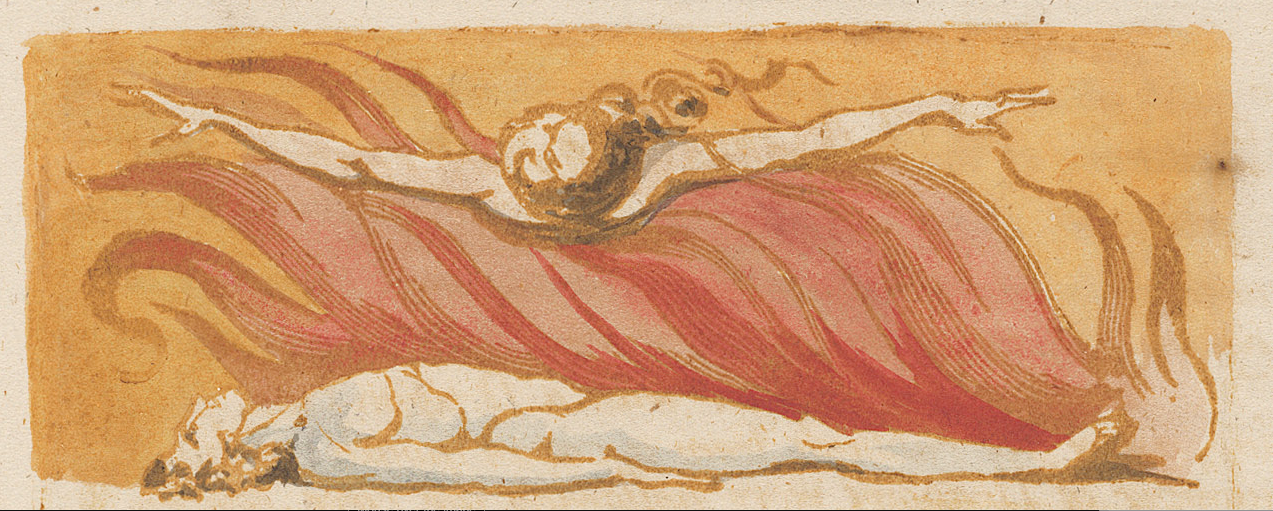
This painting by the poet William Blake is the image I use as the banner image for this blog. The “flaming sword” comes from the story of “the Fall” in Genesis three, which I’ll quote below; I’ll also quote from Blake and from George Fox.
The image
But Blake’s painting is hardly directly representational, as we’ll see from the Genesis passage.
- There are flames but no sword or gate into Paradise.
- The cherub is oddly presented and is human, or at least humanoid, in form, whereas cherubim are variously described in the Bible and other ancient mythologies, but always in some composite and mostly animal form. The cherubim that sit atop the ark of the covenant at least have wings.
- The human, presumably Adam, is supine, laid out almost as though he is dead. He has fallen.
Genesis 3:22–24:
And Yahweh God said, Behold, the man is become as one of us, to know good and evil; and now, lest he put forth his hand, and take also of the tree of life, and eat, and live forever:
Therefore Yahweh God sent him forth from the garden of Eden, to till the ground from whence he was taken.
So he drove out the man, and he placed at the east of the garden of Eden Cherubim, and a flaming sword which turned every way, to keep the way of the tree of life.
Comment
So the cherubim’s charge is to keep humans from reentering Paradise, eating from the tree of life, and becoming immortal. Yahweh and his angelic court (the “us” in the quote) are worried that humans will become like them. And we are already halfway there, having learned good and evil.
Blake’s blanket of flames and the outstretched arms of the cherub block the laid out Adam from rising.
Blake’s text
This image accompanies a page in Blake’s “The Marriage of Heaven and Hell”, one of his prophetic books, which is mostly text as captions for a series of paintings with a poem prologue. The poet presents himself as having descending into Hell and come back with prophecy that will reconcile heaven and hell. Here’s the text on that page. Note that Blake has given us here a significant phrase.
The ancient tradition that the world will be consumed in fire at the end of six thousand years is true, as I have heard from Hell.
For the cherub with his flaming sword is hereby commanded to leave his guard at tree of life; and when he does, the whole creation will be consumed and appear infinite and holy, whereas it now appears finite & corrupt.
This will come to pass by an improvement of sensual enjoyment.
But first the notion that man has a body distinct from his soul is to be expunged; this I shall do by printing in the infernal method, by corrosives, which in Hell are salutary and medicinal, melting apparent surfaces away, and displaying the infinite which was hid.
If the doors of perception were cleansed every thing would appear to man as it is, infinite.
For man has closed himself up, till he sees all things thro’ narrow chinks of his cavern.
George Fox
This image, these texts, together build an astonishing set of figures, both visual and theological, a kind of theological koan, a reality that seeks to transcend our either/or. But I used the image as a banner for my blog because of George Fox’s account of one of his visions. Here’s that passage from his journal:
Now I was come up in spirit through the flaming sword into the paradise of God. All things were new, and all the creation gave another smell unto me than before, beyond what words can utter. I knew nothing but pureness, and innocency, and righteousness, being renewed up into the image of God by Christ Jesus, so that I say I was come up to the state of Adam which he was in before he fell. The creation was opened to me, and it was showed me how all things had their names given them according to their nature and virtue. And I was at a stand in my mind whether I should practice physic [medicine] for the good of mankind, seeing the nature and virtues of the creatures were so opened to me by the Lord. But I was immediately taken up in spirit, to see into another or more steadfast state than Adam’s in innocency, even into a state in Christ Jesus, that should never fall. And the Lord showed me that such as were faithful to him in the power and light of Christ, should come into that state in which Adam was before he fell, in which the admirable works of the creation, and the virtues thereof, may be known, through the openings of that divine Word of wisdom and power by which they were made. [John 1:3] Great things did the Lord lead me into, and wonderful depths were opened unto me, beyond what can by words be declared; but as people come into subjection to the spirit of God, and grow up in the image and power of the Almighty, they may receive the Word of wisdom, that opens all things, and come to know the hidden unity in the Eternal Being. [Journal, Nickalls edition, page 27–28]
Fox claims to have made it past the guardian cherubim and the flaming sword back into Paradise. He says he came “up in spirit through the flaming sword.” He ascended through the flames into Paradise, just as the supine Adam in Blake’s painting would have to do. And the first thing that happens to him is Blake’s “improvement of sensual enjoyment”: Fox’s sense of smell became transcendentally acute.
And he was “renewed up into the image of God”. He was restored to the condition of Adam before the Fall, including the wisdom with which Adam named all the animals from mystical insight into their true nature—the doors of his perception were cleansed. [Check out Bob Dylan’s wonderful song Man Gave Names To All The Animals.] And Fox ate of the tree of life, though he does not describe it this way—through Christ he attained eternal life.
“That of God”—Again
October 17, 2025 § 6 Comments
For decades, I have complained about Friends claiming that “that of God in everyone” is our central tenet of faith and that it’s to be understood as a divine spark of some kind, something inherent in the human that partakes somehow of God’s being or nature. I’ve heard Friends equate it with the “image of God” in which Genesis one says we were created.
For all these years, I have accepted Lewis Benson’s argument that this usage of the phrase was introduced by Rufus Jones and is a misunderstanding of Fox’s use of the phrase. Benson claims that Fox used the phrase almost always in the pastoral sense implied in the quote that we use as our source for it in an epistle which he includes in his journal, that Fox did not use the phrase in the doctrinal sense that is common among us nowadays, usually stated as “there is that of God in everyone.
Then, in Michael Langford’s Becoming fully human: Writings on Quakers and Christian thought, I find this quote from Fox:
None that is upon the earth shall ever come to God but as they come to that of God in them, the light that God has enlightened them with; and that is it which must guide everyone’s mind up to God, and to wait upon to receive the spirit from God. . . . That which is of God within everyone is that which brings them together to wait upon God, which brings them into unity, which joins their hearts together up to God (Doctrinals, Works, Vol. 4, pp. 131–132; page 117 in Becoming fully human)
This quote demonstrates how complex and fluid Fox’s thinking was, how hard it is to pin down what he actually means, or at least what kind of coherent theology we might reconstruct from his truly prolific output. Fox is edging right up to Jones here. Or to put it in chrono-theological order, you can see how Jones might see in this passage some foundation for his own understanding. And there it is in one of Fox’s doctrinal works.
However, Fox is still giving “that of God in everyone” a pastoral role; that is, it brings us to God. And he equates “that of God” with the light of John 1:9, “the true light, which enlightens everyone,” which is the Word, which is Christ. So it looks like this is an Inward Light, because God has given it/him to us for our enlightenment. It’s not inherently in-dwelling; it was given to us.
On the other hand, however, “that which is of God within us”—that looks more like an Inner Light, an indwelling light that might in fact be inherent, since it is within us and everyone has it. It looks like Fox is having it both ways.
My sense from reading Jones’s books on mysticism is that he was some kind of neo-neoplatonist, in the sense that neoplatonism believes that a universal divine spark is what brings us to God, just as Fox is saying here. God’s spark seeks to return to its origin-home in God; this is the source of the religious/mystical impulse. Likewise, God reaches us inwardly by reaching this God-seeking God’s-self within us, and that divine spark recognizes and receives God when God comes. In mystical union, the divine spark has finally come home. This is the dynamic of mystical union experience.
Jones believed that this universally possible God-to-God’s spark connection is what lies behind all mystical experience, whatever the mystical tradition. And Jones is the one who taught us to think of Quakerism as “practical mysticism”. All of this is very close to what Fox seems to be saying in this quote.
Fox’s sublime innovation is to equate all this—the pastoral “bringing” to God, the doctrinal dwelling “within” us—with the light of Christ, the enlightening Word. “God” in this dynamic is Christ speaking to our condition, penetrating the sheath of sin and ignorance around our soul with the Light, seeking to reach that of God within us, which yearns for him.
“That of God” yearns for God, Fox implies in the quote we always use for this phrase. In that epistle, once we have done the inner work of our own transformation in the light of Christ ourselves, then we can answer that of God in others. That of God within us is calling out in the darkness, and the Light answers with the Word.
Worship in Spirit and Truth
October 3, 2025 § 2 Comments
In the weekly Bible study that I moderate (Thursdays, 3:30, via Zoom), we’ve been looking at the wonderful story of Jesus and the Samaritan woman at the well in John chapter four. It includes a passage that is one of the scriptural foundations for worship in the manner of Friends, John 4:23–24, and, as very often happens, our exploration brought to me some openings. Here is that passage:
The hour is coming, and is now here, when the true worshippers will worship the Father in spirit and truth, for the Father seeks such as these to worship him. God is spirit, and those who worship him must worship in spirit and truth.
The structure of this saying suggests to me an identity or deep correspondence between spirit and truth. And I think a key to that relationship can be found in the word for truth in Greek, and also in another passage in John, John 14:15–17.
“Truth” in New Testament Greek is aletheia, in which the “a-“ is a prefix which we might render in English as “un-“. Lanthano, the Greek root word for aletheia means to hide. So “truth” is an un-covering, a revealing. Truth is revelation. A revelation of the Spirit of Truth, our Advocate, as in John 14:15–17:
If you love me, you will keep my commandments. And I will ask the Father, and he will give you another Advocate, to be with you forever. This is the Spirit of Truth, whom the world cannot receive, because it neither sees him nor knows him. You know him, because he abides with you, and he will be in you [or among you].
So to “worship in spirit and truth” is to worship in the Spirit-Advocate whom God sends to us for revelation—continuing revelation, because that spirit is “forever”. The vehicle for revelation in our worship is our vocal ministry. So true worship is manifest in truly Spirit-led ministry.
This Spirit of Revelation is within us, and it is among us. It arises from within us as love, as vocal ministry, and as our presence in worship. It arises among us as it brings us into the Presence in our midst in worship that is gathered and covered by the Spirit. True worship is the gathered meeting.
To “worship in spirit and truth” is also to follow Jesus’s commandments, and “This is my commandment, that you love one another as I have loved you.” (John 15:12) So true fellowship in the Spirit is also a form of worship. It is worship in action, worship that continues after we have left the meeting room at close of formal worship, a continuing revealing of divine love.
Meetings and Ministry, Part 2: My Story
July 28, 2025 § Leave a comment
A Leading Leads to Frustration, and to New Leading
In 1990, Buffalo Meeting in New York asked New York Yearly Meeting’s Friends in Unity with Nature Task Group to bring them an earthcare program on the twentieth anniversary of Earth Day. A f/Friend and I answered their call.
On Saturday night before the program on Sunday, I was sitting up praying over my notes for the following morning when an opening came to me that pushed its way in front of my preparations. It came out of nowhere—well, as it turns out, it came out of Spirit-where—and it would not go away. It was this: If Christ was the Word “through whom were all things were made and without whom nothing was made that was made,” as John 1:3 puts it, then destroying creation is re-crucifying Christ.
Now this was what Friends in the elder days called a cross to the will: my will and my intentions and expectations were being crucified. Because I was in those days actively hostile to Christ, Christianity, and the Bible.
But I had been raised in a pretty pious and active evangelical Lutheran family and I knew the Bible pretty well. And the more I thought about it, the more important this new idea seemed, and the more it ramified—the more I remembered and discovered that I could say to Buffalo Meeting. But I did not want to say it. And I was pretty sure that Buffalo Meeting wouldn’t want to hear it.
But the Holy Spirit had seized me by the scruff of the neck and would not let me go. I had to scrap my original notes and go with this crazy new thing. So I gave Buffalo Meeting a little Bible-based sermon and, as I remember it, they did in fact give it a rather cool reception.
It was weird. Or wyrd, in the Old Norse sense of the origins of the word, a situation that was so important the gods were involved. God was involved. And it didn’t stop there.
Over the next few weeks, the original opening expanded and ramified and it dug in. Eventually, I felt I was called to write a book of Bible-based earth stewardship theology—another cross to the will. I did not want to do this. First of all, I knew it meant probably years of research; I didn’t know nearly enough. I had read none of the earth stewardship theology that had been written up to that time, and I didn’t know the Bible well enough to treat it properly. But more importantly, I still felt hostile to Christianity and the Bible.
So I brought my leading to my meeting. I asked for an oversight committee. I knew that my prejudices threatened to thwart or distort my faithfulness and I wanted my meeting to help me stay faithful.
In my first meeting with ministry and counsel, they did not understand what I was asking for, even though some weighty and seasoned Friends served on that committee. I went away frustrated. But I still felt it was important to get some support. So I went back to them. This time, some of them understood just enough to actually misunderstand in a new way.
“We can’t tell you what to think,” they said. I didn’t want them to tell me what to think, I wanted them to tell me if I was going off the rails. “That’s for your editor to tell you,” they said. That would be way too late, I said. In the end, they said no again.
I was left to my own discernment and discipline. I hustled some financial support and went to Pendle Hill for two terms in 1991 to begin research on the book. There, I was mentored by Bill Taber and Doug Gwyn, who taught Quakerism and the Bible respectively. My time with them and at Pendle Hill confirmed my calling and gave me the support I needed. I reclaimed the love of the Bible I had had as a teenager. I stopped being Christ and Christianity’s adversary. And the course work with Doug and Bill deepened my knowledge of and commitment to the faith and practice of Quaker ministry. The experience deepened my love for and commitment to the Quaker way. It changed my life.
And: the leading to write that book and the frustrating experience I had with my meeting led to two new leadings, both of which I still carry as ministries. The first was—is—to foster in our meetings the recovery of our traditions regarding ministry, so that others with leadings would not be left bereft, as I had been. The second was a sustained and intensive study of, the Bible, such that I have for years now moderated a weekly online Bible study and written another (unpublished) book on the gospel of Jesus, which grew out of the things I learned writing the first one; and I have two more in my head and heart.
Meetings and Ministry, Part 1 : Introduction
July 28, 2025 § Leave a comment
I’m starting a new series of posts that looks at how our meetings recognize gifts in ministry, how we help emerging ministers discern their calling, and how we support their ministries.
I’ve been away from this blog more or less for quite a while, but I think I’m back. I have been paying attention to publishing my poetry and more recently, I’ve been working on a couple of submissions to Pendle Hill. One of these is on the meeting’s role in supporting vocal ministry. At the same time, while thinking and praying and writing in a deep and sustained way about vocal ministry for many months, my own ministries are in an exciting and exercising period of engagement and transition.
In the middle of all this, I became aware of the Friends Incubator for Public Ministry, which I mentioned in my last post, and I participated in the development of “The Public Friends Recording Process,” which the Incubator’s convener Windy Cooler shepherded
Back in 1992, I had been part of a three-person team that updated New York Yearly Meeting’s process for recording gifts in ministry and soon after that, I served on the first clearness committee convened under the new guidelines to consider the recording of a Friend’s gifts. We did recommend recording to the Yearly Meeting and they approved it. So I have been carrying a concern for the recognition, discernment, and support of gifts in ministry for a long time.
All this focus and activity around our meetings and their support of our ministers and their ministries has reactivated my own call to a ministry focused on fostering greater attention in our meetings on these concerns. It has produced new openings that I want to share with you my readers and raised questions that I hope my readers will be led to answer, here in this blog, but also in your own meetings.
Much of this exploration will be personal, as many of these issues are front and center for me and my meeting right now. But some of it will be about our tradition, our faith and practice, our history and our experience.
In the next post, I want to start with the story of my own first call to ministry and how it has led to this moment.
The First “Palm Sunday”
April 13, 2025 § 4 Comments
Today is Palm Sunday and the weird political vibe of our time prompts me to reflect on the first “Palm Sunday.” The first “Palm Sunday” was a radical political event, but its import has not been taught to us. In fact, a surface reading of the accounts does not even really tell us what actually happened, let alone what the event meant in the moment.
Just a little imagination and common sense shows us something quite different than the “cleansing of the temple” summary that we usually get as a heading in our Bibles for these passages. While Jesus was vehemently opposed to the corruption of the temple, he was not much concerned with its “uncleanness”; he famously disregarded his culture’s obsession with “uncleanness” in the first place. His real concern was the temple’s thievery.
It started out with what amounted to a royal coronation procession into the gates of Jerusalem in which he and his followers proclaimed that God’s kingdom was being established right then and there. Never mind those high priests behind the curtain pretending to be in charge of Judea’s temple-state, or the Roman imperial occupiers who had the final say over all the really important stuff in Judea’s governance.
After proclaiming his alternative kingdom, what does the herald of this new kingdom do next? He raids the temple-state’s currency exchange.
Jesus and his followers burst into the court where Jews from all over the empire, who had come to celebrate Passover in the Holy Land, have come to change their unclean foreign currency for temple-state coinage and then buy the animals they need for their guilt offerings and sin offerings and for Passover itself.
Picture the scene: Jesus and his followers drive the animals into a frenzy. He or his people pitch over the cashiers’ tables, with their record keeping scrolls and their trays of money. His people intercept the servants who are desperately trying to escape into the temple precincts with the “vessels”.
This is the scene: Animals are crashing around, the noise a raucous din, maybe the door has been left open and the animals are making a break for it. Disciples are grabbing the record scrolls off the floor and making off with them or tearing them up. Others are scrambling on the floor to scoop up the coins that are rolling around. Others seize the big clay jars with the coin reserves in them that the temple servants are trying to escape with. And all the while, Jesus is calling down an oracle of God’s judgment, quoting Jeremiah about a “den of thieves”, while his own people are themselves Robin Hood-thieving the temple-state’s money. A wonderful, even comical irony.
If the insurrectionists had left the door open and the animals are finding their way out, you can picture his followers making their escape, too, under cover of the herd’s bleating retreat out the door, much like Odysseus did with his men when escaping from the cyclops’s cave in the Odyssey.
One wonders where the security forces were in this melee. Surely the temple-state had some kind of security there to guard the money. Maybe they are the “servants” who try to make it to the doors with the “vessels.” Clearly the mayhem, the tactical genius of the action, outmaneuvers them.
Meanwhile, all this takes place in the literal shadow of the Roman fort that had been built right up against the city’s walls next to the temple precinct to prevent exactly this kind of peasant revolt from happening, as it had occurred just a few years before and would soon again. Passover is, after all, a religious holiday celebrating God liberating his people from their captivity by a foreign imperial power. Rome sent an entire extra legion to Palestine during the Passover season to deal with any insurrectionists (like Jesus) who might be too inspired by the holiday’s message, because it happened so often.
Meanwhile, the city is extremely crowded with all the pilgrims from the Jewish Roman diaspora come here for Passover, crowded in a massive tent city throughout the streets of the city because there aren’t enough rooms to let. People, tens, animals, all trying to find a place as close to the temple as possible, ‘cause that’s where all the action is, that’s where all the crowds will be going. It’s as if all the families in America that could afford it planned to go to Disney World on the same day.
So the rioters just melt into the massive crowds with their loot and maybe some animals and their grins on their faces, while the Roman soldiers arrive too late to do anything but scoop up some leftover coins themselves.
I imagine the high priests in charge of the temple-state calling the guys in charge of the exchange onto the carpet to answer for the loss of all that revenue and monetary reserves, maybe taking it out of their salaries, or even out of their hides. I imagine the famously cruel and erratic Pontius Pilate calling the garrison commander onto the carpet to answer for how he let this rabble raid the temple under their very noses and demanding some intel about where the insurrectionist leader might have skied off to—“He announced himself at the city gates, for Tiberius’s sake. What—were you playing lots with your officers and drinking this terrible Judean wine while a riot breaks out next door?” I wonder who lost their commission that day?
No wonder they all wanted his head.
The Christian faith is radical in its very core, and much of the gospel message is about money, poverty, and economic oppression—“forgive us our debts as we forgive our debtors” reads the very heart of the Lord’s Prayer.
Ani, the Hebrew word for “poor,” can mean either poor or oppressed because, in ancient Israel, they were the same thing. Ani, as in Bethany—beth ani, house of the poor/oppressed, home of Mary, Martha, Lazarus, and Simon the Leper. Ani, the poor and oppressed, are Jesus’ constituency (Like 15-30). And “Palm Sunday” was their breakout moment, their formal declaration of their kingdom intentions and their first insurrectionist act.

