
Membership Decline Case Study, Part 5—Outreach Solutions
September 16, 2026 § Leave a comment
Solutions: Outreach
Let’s assume that your meeting has done the inreach. You are ready to welcome newcomers and have the three elements that will matter most in holding onto them initially: warm, welcoming fellowship, deep silence, and Spirit-led vocal ministry. How do you get newcomers in the first place?
I’ve prepared a Meeting Outreach Checklist, which I hope you will find useful.
Also, Friends General Conference has a lot of Resources for Outreach. Click that link and check it out.
And good luck!
Membership Decline Case Study, Part 4—Inreach Solutions
September 5, 2026 § 1 Comment
Solutions
We are in decline. Membership is falling, some individual meetings are on the verge of dissolving, charitable giving is flat, while our costs are steadily rising. But this structural decline is only part of the story. I fear that we are declining spiritually as well.
This is a perennial complaint of white-hairs like me. John Woolman recounted such a complaint from an elder in the very early 1700s. And I bet it was true.
When’s the last time your meeting for worship was gathered in the Spirit? Are you getting Spirit-led vocal ministry? Do you have a lot of attenders who only come to meeting for worship?
The good news is that we’ve also been through periods of renewal, usually at the hands of young adult Friends. Cases in point are the emergence of programmed worship and pastoral meetings in the 1870s and ‘80s, the emergence of the liberal Quaker movement in the late 19th century, the growth of meetings in college towns in the 1950s and ‘60s, and the revitalization of our witness life during the 20th century’s wars.
I believe that renewal in our own time will come from the Holy Spirit. That is, it will depend on Friends called to the ministry of renewal. Are you so called? And it will take two forms: effective in-reach and meaningful outreach.
It WILL NOT come from restructuring our meetings. I served on New York Yearly Meeting’s first Renewal Committee in the early 1990s. The yearly meeting has since then convened no fewer than six more formal efforts focused on meeting structure; all failures. Real renewal comes from God.
In this post, let’s look at in-reach. In the next post, we’ll look at outreach.
In-reach
Holding onto visitors
I believe that newcomers to our meetings decide to stay when they get at least some of these three elements of meeting life:
- True fellowship of the Spirit—a warm personal welcome, including especially, for young families, childcare and First Day School already waiting for them; not necessarily already with kids, but adults prepared to welcome any families who show up.
- Spirit-led vocal ministry—messages that speak to the yearning that brought those visitors to us in the first place with their hopes for an experience that answers that of God within them, messages delivered with discipline and integrity and genuine spiritual inspiration.
- A living silence—achievable only through the presence of a critical mass of spiritually mature members holding the meeting in grace.
Holding onto newcomers
Once visitors become attenders, they need more than just a welcome and the meeting for worship. They need to know that there’s a there here. This means visible and regular efforts at spiritual nurture—a vital culture of eldership.
- Does your meeting have a committee or at least individuals who proactively pay attention to newcomers, inquiring about their lives and spiritual interests?
- Do you have adult religious education or other programs that introduce them to the Quaker way, and especially about Quaker worship and vocal ministry?
- Do you inquire into newcomers’ spiritual gifts and interests?
- Do you invite their participation in things besides committee work (though that, too)?
Membership
- Do you regularly announce and explain the process for becoming a member and invite newcomers to consider applying, in a general way?
- Do you approach individual newcomers when you think they might be ready?
- In your clearness committees for membership, do you try to identify the applicant’s spiritual gifts (not just what committees they might want to serve on), and try to identify their ministries—whatever they are doing in their lives that they could see as Spirit-led service? Do you explore their spiritual interests, what kind of spiritual formation and nurture they might welcome?
- And after people become members, do you follow through with focused personal mentoring and support on the things you’ve discovered in their clearness committee?
The culture of eldership
- Do your committees, especially adult and youth RE (you have them, right?) and worship and ministry committees—do they regularly consider how to foster deeper vocal ministry, how to support leadings and ministries, how to nurture individual members and attenders in their spiritual lives?
- Do you know how to conduct clearness committees for personal decision making and the discernment of leadings, and regularly announce their availability?
- Do you hold discussion groups and worship sharing opportunities around aspects of the Quaker way and any issues the meeting may be currently facing?
- For the newcomers who do not attend meeting for business and/or your programs, are you willing to use the meeting for worship itself as a venue for these kinds of spiritual nurture? Or are you treating the meeting for worship as a fixed outward form and as a sacred cow that can’t be experimented with?
Membership Decline Case Study, Part 3—The Money
September 1, 2026 § 4 Comments
Donations per member
Before I began this study, I thought that, in addition to a steady decline in membership, the giving by the members we do have was also declining. But that’s not quite the case.
As you can see from the chart below, until the last decade or so, donations by membership actually kept pace with expenses, even though the expenses curve has been rising. In fact, expenses rose relatively steeply from the mid-1970s to roughly 1992, but donations kept up. In 1992, expenses leveled off some, then they rose a bit around 2001, and then they leveled off again around 2004.
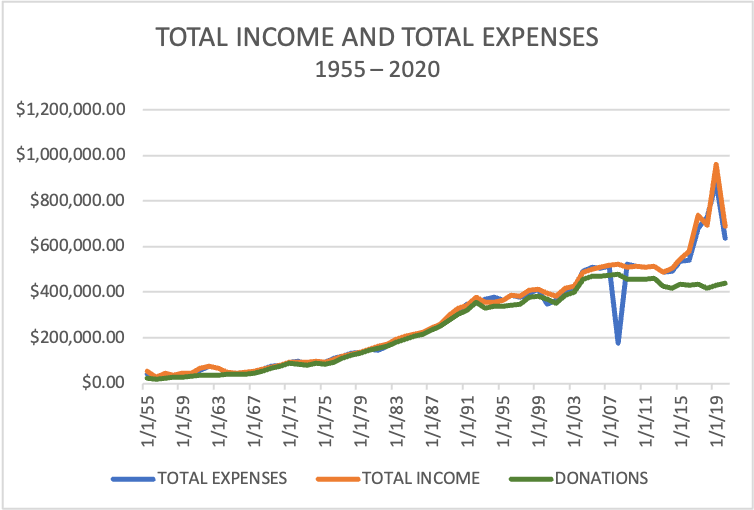
Meanwhile, donations per adult member kept up through that first stable period, but couldn’t quite match the upturn in expenses between 2001 and 2004. Then, beginning with the Great Recession in 2008, donations began a slow decline that had not stopped by 2020, while expenses remained fairly stable for a while.
Until 2014. Around then, the expenses curve turns chaotic. Expenses rose very steeply and spiked dramatically in 2019 and then crashed in 2020. Meanwhile, all through that period donations remained flat. I suspect that the pandemic caused the crash in expenses in 2020. But I’m not close enough to the yearly meeting anymore to explain what was going on during that last period.
In this period since 2014, the yearly meeting apparently made up the difference with its annual general appeals, with its investments, and with other income. I’m no finance expert, but it looks like a dramatic increase in the value of investments in that period helped to fund the dramatic increases in total income while donation income remained flat.
As this disparity between income and expenses becomes more obviously a threat for some yearly meetings, they will have to make increasingly severe cuts in their budgets. Some of these cuts will necessarily fall upon staff, as they already have in Philadelphia YM, as I know, and reduced staff is not likely to reverse membership decline or increase charitable giving. It’s a feedback loop.
What’s a yearly meeting to do? I’ll think about that in the next post.
Membership Decline Case Study, Part 2—The Data
September 1, 2026 § Leave a comment
Members
As I said in the previous post, New York Yearly Meeting membership has been declining since the Orthodox and Hicksite yearly meetings reunited in 1955.
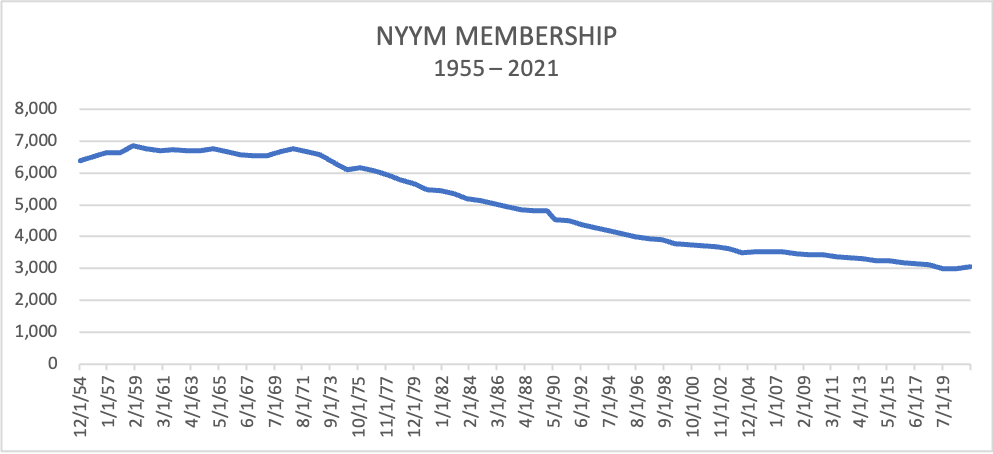
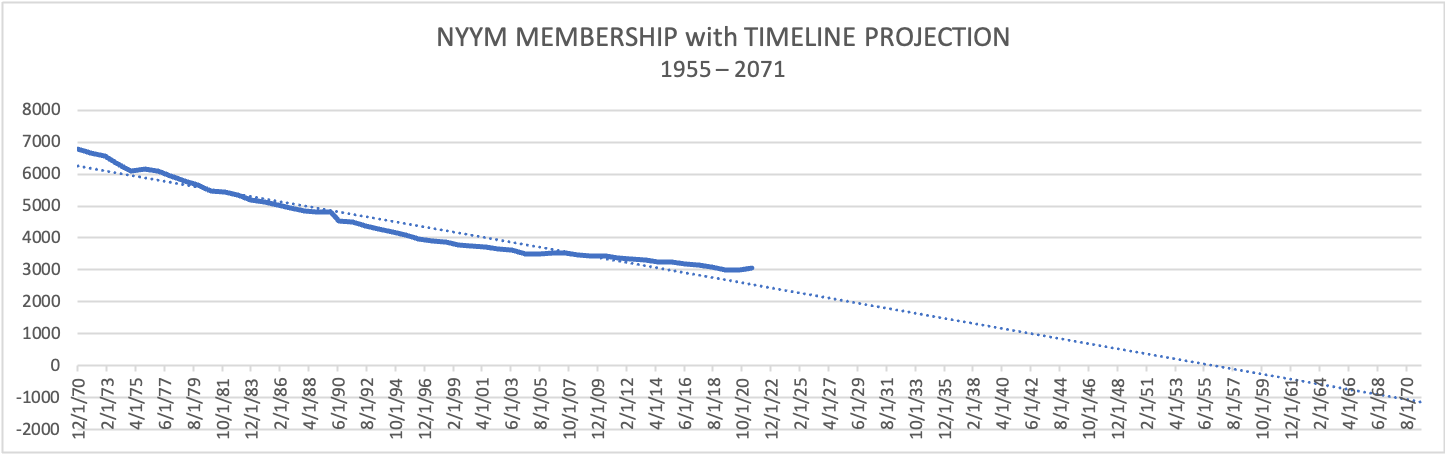
The broad conclusions are as follows. In the 66 years from 1955 through 2021, NYYM membership declined by 3,342 members, from 6395 to 3,053, or 52.3%. As you can see from the chart above, the decline began around 1970 and may have started leveling off a bit beginning around 2003. As you can see from the second chart below, the trendline, if it holds, reaches 0 members in 2056.
Yearly meeting appointments
When I was active in the yearly meeting from the 1980s through the late 2010s, yearly meeting session attendance—people actually in the room for business meetings, rarely got above 120, roughly 3% or so of total membership. If that percentage of active Friends holds, the yearly meeting will have only 50 people doing its business by around 2035, less than ten years from now. In 2020, the yearly meeting had 49 committees or other bodies to which members were appointed and more than 400 appointments that were filled on paper. You can do the math.
Factors
Removals. Unfortunately, I don’t have data for 1973 through 1985, which latter year is about when I joined. But I remember that in the late 1980s into the early 2000s, meetings became more resolved to remove folks from their rolls because the yearly meeting used a membership formula to calculate requests for contributions from the quarterly meetings, and meetings were then paying for “members” whom they never saw and/or who lived away from their area. I don’t remember when the quota practice was dropped, but I suspect that trying to reduce their covenantal commitment was a factor in the number of removals from membership that made the membership decline curve steeper in that period than later.
Resignations. In addition, in this same period, lots of Christ-centered Friends left the yearly meeting as individual meetings and then the yearly meeting itself gradually came to a new testimony regarding marrying same sex couples—another factor in the decline.
Meetings
Lets look at the number of meetings instead of the number of members. For this I’m comparing 2012 and 2021.
The number of meetings declined in this period from 63 to 61, losing three and gaining one. But the more important figures lie in the number of very small meetings.
In 2012, NYYM had 8 meetings with membership at 10 or less, with an average membership of 6.6, representing 12.7% of all meetings. NYYM had 9 meetings with between 11 and 20 members with an average membership of 16.1, representing 14.3% of all the meetings. Thus 27.0% of NYYM’s meetings had 20 or fewer members
In 2021, NYYM had nine meetings with 10 or fewer members, with an average membership of 5.2, representing 14.8% of all meetings—an increase from 2012 of 2.1%. Twelve meetings had between 11 and 20 members, with an average membership of 16.8, representing 19.7% of all meetings. Thus 34.4% of NYYM’s meetings had 20 or fewer members—more than a third. That’s a 7.4% increase since 2012.
Meeting summary: In the nine years between 2012 and 2021, NYYM lost a net two meetings, but the number of small meetings (20 and fewer members) increased by 7.4%. Meetings with 17 or so members (the average for meetings with 11 to 20 members) will hang on for a while, but they are likely to lose members, as the increase in the number of meetings with 10 members or less indicates. Meetings with just five members are probably in real trouble.
Quaker Membership Decline—A Case Study
September 1, 2026 § Leave a comment
In an earlier series of posts which I titled Quaker-pocalypse, I talked about three curves that I thought were converging for Quaker meetings and institutions with potentially catastrophic consequences. These trends are: declining membership, declining donations from the members we do have, and rising fixed institutional costs. When the first two curves crossed the third, I expected that meetings—meaning, mostly, yearly meetings—would have to radically restructure themselves or they would collapse.
I’ve made a case study of New York Yearly Meeting (NYYM) to study these factors and trends. I chose NYYM because I know it well; I was a member for decades and was its communications director for several years, and in that role I wrote its annual reports, so I’m very familiar with its data-keeping format. Also, NYYM’s records are kept in the Quaker collection at Swarthmore College, which is easily accessible for me. Furthermore, NYYM’s Orthodox and Hicksite yearly meetings reunited in 1955, which provides a clean starting point for the data. My data field thus extends from 1955 through 2020/2021.
The results surprised me some. Membership has been steadily declining, and maybe more important, the number of monthly meetings that are inching toward collapse has been accelerating. The rate of giving by members to their meetings is more complicated, but shows a troubling trend over the last twenty years, especially when compared to fixed expenses.
In the next post, I look at the membership figures.
Meetings and Ministry, Part 5: Transferring Travel Minutes and Ministry Support Groups
August 7, 2025 § 1 Comment
As I said in a previous post, I have a minute of travel for the fostering of the gathered meeting among Friends, originally adopted by Central Philadelphia Meeting (CPM), and a spiritual support group that is nominally under the care of CPM’s Gifts and Leadings Committee. When I transferred my membership to Princeton Meeting in New Jersey, it wasn’t clear to anybody what to do with the minute or the support group. Philadelphia Yearly Meeting’s Faith and Practice offers no help, so the two meetings have had to work it out on their own. Having just been through that process, I have some ideas about how to handle the transfer of minutes of travel and service and of care for the minister.
Review of discernment. Before writing a letter of transfer, I feel that the transferring member’s meeting should consider whether the Friend they are writing the letter for is still under the leading that originally led to the minute and whether she or he has been faithful in its service. If so, the meeting should recommend in its letter of transfer that the new meeting conduct some kind of discernment itself regarding the minute and any spiritual support group that the transferring member’s meeting has convened.
The minute. Regarding the minute, the new meeting could do one of three things:
- adopt the minute as it is on the recommendation of the transferring meeting;
- invite the new member to meet with worship and ministry or some committee to determine next steps; or
- convene its own clearness committee for discernment of a leading, along the lines laid out in Patricia Loring’s Pendle Hill Pamphlet Spiritual Discernment, #305.
In my case, we followed the second option, which worked fine. I met with Princeton Meeting’s Care and Concerns Committee (its pastoral care committee), and they crafted a revised version of the minute and recommended it to the meeting, which then approved it. This process was simple and it worked well.
The spiritual support group. Regarding any spiritual support group or anchor committee that may have been formed by the transferring meeting to support the minister and her or his ministry, the new meeting’s actions would depend on circumstances. The basic principle should be this, though: that the support committee should at least have members from the minister’s new worshipping community and it should probably be under the new meeting’s care.
In my situation, because the members of my committee are from different meetings and regions and even continents, and because all of the members of my current support committee want to remain on the committee, and because we meet on Zoom, my current committee is staying in place. So we have asked Princeton Meeting to name at least two new members to the committee, so that my support and my support committee will have a direct relationship with my worshipping community. We have yet to work out whether Princeton Meeting will formally take the committee under its care, but as I said, I think that that would be rightly ordered.
However, if the support committee has been meeting in person, and/or some of its members don’t want to continue serving, then the new meeting and any committee members that do want to continue serving will have to decide whether to start meeting virtually. Or, if the new meeting feels that in-person meeting is important, it might want to convene its own all new committee. Ultimately, care of the ministry is now up to the new meeting.
Friends Journal article: Speaking to Our Members’ Conditions
May 14, 2024 § 1 Comment
A Friends Journal article
My article on membership in the May issue of Friends Journal is currently featured on FJ's website:Speaking to Our Members’ Conditions: Giving Us Back to Ourselves.
You can also view a video FJ’s editor Martin Kelley recorded of his interview with me about the article here.
Why Join A Quaker Meeting?
January 21, 2022 § 3 Comments
In a comment, John Edminster raised up what I feel is the best reason to join a Quaker meeting, which I had failed to do in my first version of this post, so I’ve added to it with red font. See John’s comment.
The best reason to join a meeting, which is my own reason, is that you feel led to join. Your Guide has brought you here and now it’s clear that this is a home where your soul can flourish. You might be able to identify some particulars about the meeting or about Quakerism that attract you; but deeper than that, behind this conscious appraisal, lies a less articulate and more compelling truth—God wants me here.
In many meetings, one can see no obvious or outward difference between being a member of a meeting and being an attender, beyond, perhaps, being able to serve on some committees, and even these strictures seem to be relaxing here and there. Meetings tend to expect more commitment from members, so that’s a difference, but they are less clear about what members can expect from the meeting. We are less clear about what the incentive to join really is—why join a Quaker meeting?
Joining a Quaker meeting is a little like getting married. Becoming a member changes you inwardly much the same way that getting married does. And it changes your relationship with the meeting and with the other members of the community much as getting married changes your relationship with your spouse and with your friends and other relations.
Inward transformation. This is hard to express. There is something about the declaration and commitment of membership that transforms your identity, your sense of yourself, your sense of who you are. It somehow makes you feel more whole, more expanded as a person while at the same time more rooted. This runs deeper than just a sense of alignment with the community’s values.
Community. Although we each identify with different aspects of the Quaker tradition, with its history, faith, and practice, and with its people, still there is something deep and meaningful that we all feel in common, however hard it is to express. We become members one of another, as the apostle Paul said (Romans 12:5); we come to know each other in the things that are eternal, as early Friends expressed it. This runs deeper than just loving the society of good, like-minded people. The spiritual dimension of this relationship comes blazing to the fore in the gathered meeting for worship, when we share with each other somehow psychically a sense of presence to each other that transcends all understanding. But this feeling is also there in some subtle way outside of the experience of gathered worship.
Reality check. This rosy picture is not always true, of course. It’s not necessarily true for everyone, and it is not necessarily true all of the time or for all of one’s life. Sometimes couples divorce, and sometimes members find they are members no longer in the inward ways that matter. But it’s safe to say that it’s true for most of us and for a lot of the time, and this identity and this immersion in religious fellowship, are deeply fulfilling for those who seek and find it in ways that are unique to the Quaker way.
Membership, Part 9: Membership and the life of the Spirit
January 3, 2021 § 1 Comment
In an earlier post in this membership series, I ended by posing three basic questions about membership in the Religious Society of Friends, which should form the context for considering alternatives to our current faith and practice regarding membership, especially for young adult Friends. But there should have been four questions:
- What is membership for?
- What is religious community for?
- What holds a religious community together?
- And, as the foundation for these three concerns, What do we mean by the life of the Spirit in the first place?
Let’s start with the foundation: What do we mean by the life of the Spirit? This is the question that anybody seeking an alternative to regular membership in a monthly meeting should be asking themselves. Well, people seeking monthly meeting membership should ask these questions, too. And for that matter, so should meetings.
We can put the question another way that elicits a different kind of answer: What is the spiritual life for? What do we hope to get out of it?
My own opinion is that the life of the Spirit flows from a temperament. It’s not a choice, but rather more of a drive, something one feels impelled to pursue. For me this impulse expresses itself as a yearning for the transcendental, for experience that transcends the usual directions and boundaries of our everyday lives. It has a lot in common with the artistic temperament, the drive to create.
Furthermore, as their art is for many artists, spirituality is integral to the spiritual person’s identity. It is essential to one’s sense of self and one’s relation to the world and to one’s experience.
And what do we hope to create with the life of the Spirit? My answer: I do not just seek transcendental experience; I seek to transcend my self. I seek my true self, my whole self, my higher self. I seek inner transformation for the better.
And I feel instinctively that this transformation is to be found in the transcendental, in God, in that Spirit, that Mystery Reality that I sense lies within me at the center of my little-“s” self and that I experience in the gathered meeting.
My true self is free of ego investments in my behavior. My true self is free of habitual behavior, programmed and conditioned behavior. The true self is who I am at the center of all that armor.
My whole self includes the broken parts of my self, the parts that are healing and the parts that aren’t healing yet, and even the parts that will never heal. My whole self includes the scars and the burden of the things my un-healed self has done. But my whole self is aspirational, also: it is who I would be if I could wholly heal and become whole.
That is, the life of the spirit draws me into my higher self. It is the path of making the world a better place by being a better me.
Thus the purpose of the spiritual life is to illuminate that path, to project an image of the destination, and to be a walking stick and compass—to provide inward and outward aids for the journey.
The destination is within us; it is to stand within the Light that enlightens everyone who comes into the world. And the destination is among us; it is to stand together in the embrace of that Spirit that gathers us as a people of God.
The walking takes place within us, turning ever toward that Light that guides us. And the walking takes place together, not alone, but as members one of another.
For the individual, this means that Quaker membership is a declaration of unity with the way this community defines the path and an embrace of the tools Quakerism provides for the journey. For the meeting, this means that you clearly define that path and you provide the community and the tools that bring support and joy to the journey. You help make members whole.
Now, while Quaker meetings do have a collective spirit and consciousness, it is individuals who actually do the work of supporting members in these ways. This is the genius of the Quaker way, that we minister to each other. So membership means responsibility, not primarily for financial support or committee service or attendance at meetings for business, but for turning ourselves toward the Light, for fostering the gathered meeting, for caring for each other, and for employing our own gifts of the Spirit in the service of each other’s journeys.
Membership, Part 8—Proposal: a new kind of meeting
January 1, 2021 § 1 Comment
Presumably, for people who seek membership in the Religious Society of Friends, the life of the Spirit is important to them, they feel they need to pursue it in the embrace of a community, and the Society of Friends looks like the right community.
None of that requires membership in a monthly meeting. But it does require community. A community that is capable of embracing your spiritual life in a meaningful way. That is, a community that can give you the things I outlined in the second post in this series, namely communion, community, pastoral care, spiritual nurture, and religious identity.
Many of our monthly meetings are not doing that great a job at providing these things. Gathered meetings are infrequent. Opportunities for community may be confined to two hours on Sundays and a local meeting may not have a critical mass of young adults to meet the need for a community of peers. Pastoral care can be spotty, depending on how well you’re known in the community. Proactive, confident, effective spiritual nurture is just as uncommon as gathered meetings. Religious education may or may not take place or have a clear and useful focus.
Yearly meetings are even less equipped to provide these things, because of their population size, geographical scope, and infrequency of shared worship. (I analyzed the problems with yearly meeting membership in more detail in my previous post.) I think many young adult Friends gravitate to the yearly meeting because that is where they build community with their peers; yearly meetings are big enough to provide a critical mass of young people for community.
So I don’t think yearly meeting membership is the answer. A yearly meeting can offer community, communion, and spiritual or religious identity to a degree (more on the difference later), but not meaningful spiritual nurture or pastoral care.
The YAF community itself is really the only “organization” that can minister to all of these member needs in a meaningful way. Thus I propose that yearly meeting YAF communities be given meeting status, with a new set of characteristics that will differentiate them from the traditional monthly meeting:
- Membership. Membership would mean whoever happens to be there. No clearness committees for membership. This fluidity would mean doing away with the usual responsibility of the meeting recorder (the keeper of the meeting records, not the office of the recording clerk, who keeps the minutes) to report numbers to the yearly meeting. I still think the YAF meeting (shall we call it a pod?) should keep number records for its own self-knowledge and they might report an average annually to the yearly meeting for the YM minutes, but not for the official YM records.
- Business. The YAF pod would conduct its business in meetings for worship with attention to the life of the pod under the guidance of the Holy Spirit, as monthly meetings do, meeting whenever they can, rather than monthly, presumably, online some of the time, at YAF gatherings, and at YM sessions.
- Gospel order. The YAF pod would relate to the YM organization and business body as if it were a monthly meeting (MM), in all areas of gospel order—facilitating transfer of formal membership to a monthly meeting when and if a “member” seeks membership in a monthly meeting, but perhaps with a careful explanatory letter; seasoning minutes and epistles that are passed on to the YM for approval; providing discernment for leadings and ministries and support for the ministries it endorses; writing minutes of travel and service for its “members” when their ministry takes them outside the pod; endorsing applications by its members for grants from YM funds; recommending members to YM nominating committee for service on YM committees; providing the YM with an annual State of the Pod report, if their YM writes an annual State of the Society Report; encouraging financial support among its “members” for its own activities; passing a portion of its budget on to the YM for support of the YM’s operations as if it were a monthly meeting; and so on.
- Ministry. The YAF pod would take responsibility for the spiritual nurture of its “members” as it sees fit, providing for its members eldership in all its forms—discernment and support for leadings and ministries,, programs and other efforts towards spiritual formation, spiritual pastoral care, and religious education.
- Pastoral care. Likewise with pastoral care for the outward lives of its “members”, as they are able.
- Have I missed anything? I think you get the idea.

