
Membership Decline Case Study, Part 2—The Data
September 1, 2026 § Leave a comment
Members
As I said in the previous post, New York Yearly Meeting membership has been declining since the Orthodox and Hicksite yearly meetings reunited in 1955.
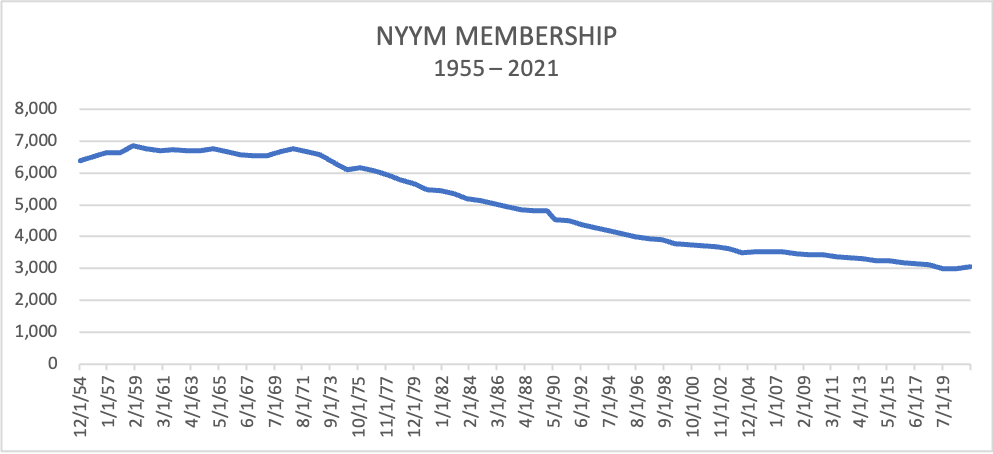
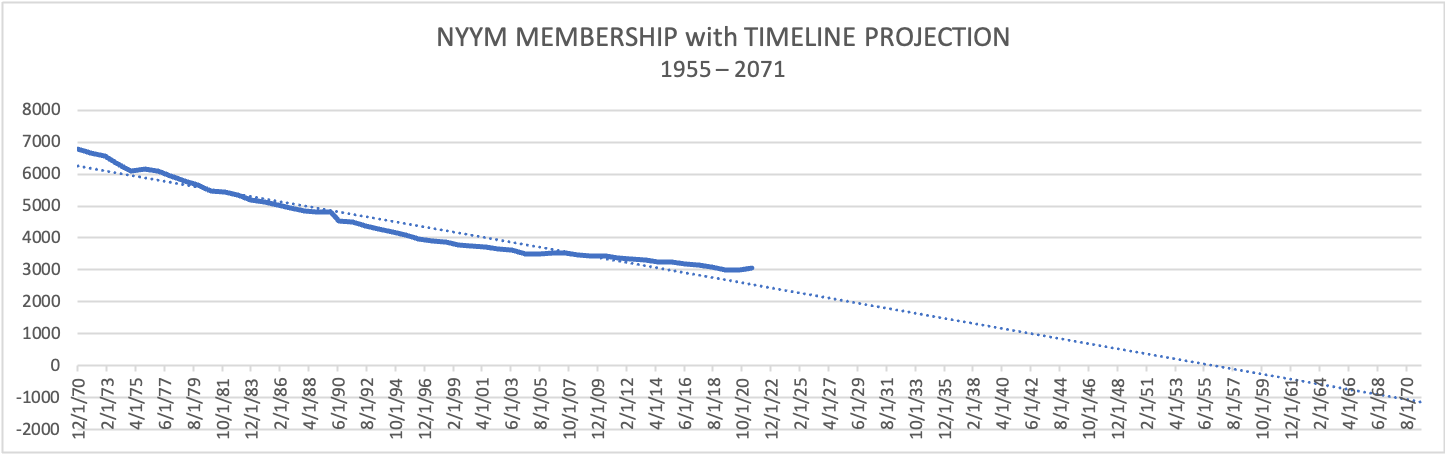
The broad conclusions are as follows. In the 66 years from 1955 through 2021, NYYM membership declined by 3,342 members, from 6395 to 3,053, or 52.3%. As you can see from the chart above, the decline began around 1970 and may have started leveling off a bit beginning around 2003. As you can see from the second chart below, the trendline, if it holds, reaches 0 members in 2056.
Yearly meeting appointments
When I was active in the yearly meeting from the 1980s through the late 2010s, yearly meeting session attendance—people actually in the room for business meetings, rarely got above 120, roughly 3% or so of total membership. If that percentage of active Friends holds, the yearly meeting will have only 50 people doing its business by around 2035, less than ten years from now. In 2020, the yearly meeting had 49 committees or other bodies to which members were appointed and more than 400 appointments that were filled on paper. You can do the math.
Factors
Removals. Unfortunately, I don’t have data for 1973 through 1985, which latter year is about when I joined. But I remember that in the late 1980s into the early 2000s, meetings became more resolved to remove folks from their rolls because the yearly meeting used a membership formula to calculate requests for contributions from the quarterly meetings, and meetings were then paying for “members” whom they never saw and/or who lived away from their area. I don’t remember when the quota practice was dropped, but I suspect that trying to reduce their covenantal commitment was a factor in the number of removals from membership that made the membership decline curve steeper in that period than later.
Resignations. In addition, in this same period, lots of Christ-centered Friends left the yearly meeting as individual meetings and then the yearly meeting itself gradually came to a new testimony regarding marrying same sex couples—another factor in the decline.
Meetings
Lets look at the number of meetings instead of the number of members. For this I’m comparing 2012 and 2021.
The number of meetings declined in this period from 63 to 61, losing three and gaining one. But the more important figures lie in the number of very small meetings.
In 2012, NYYM had 8 meetings with membership at 10 or less, with an average membership of 6.6, representing 12.7% of all meetings. NYYM had 9 meetings with between 11 and 20 members with an average membership of 16.1, representing 14.3% of all the meetings. Thus 27.0% of NYYM’s meetings had 20 or fewer members
In 2021, NYYM had nine meetings with 10 or fewer members, with an average membership of 5.2, representing 14.8% of all meetings—an increase from 2012 of 2.1%. Twelve meetings had between 11 and 20 members, with an average membership of 16.8, representing 19.7% of all meetings. Thus 34.4% of NYYM’s meetings had 20 or fewer members—more than a third. That’s a 7.4% increase since 2012.
Meeting summary: In the nine years between 2012 and 2021, NYYM lost a net two meetings, but the number of small meetings (20 and fewer members) increased by 7.4%. Meetings with 17 or so members (the average for meetings with 11 to 20 members) will hang on for a while, but they are likely to lose members, as the increase in the number of meetings with 10 members or less indicates. Meetings with just five members are probably in real trouble.


Leave a Reply