
Membership Decline Case Study, Part 3—The Money
September 1, 2026 § 4 Comments
Donations per member
Before I began this study, I thought that, in addition to a steady decline in membership, the giving by the members we do have was also declining. But that’s not quite the case.
As you can see from the chart below, until the last decade or so, donations by membership actually kept pace with expenses, even though the expenses curve has been rising. In fact, expenses rose relatively steeply from the mid-1970s to roughly 1992, but donations kept up. In 1992, expenses leveled off some, then they rose a bit around 2001, and then they leveled off again around 2004.
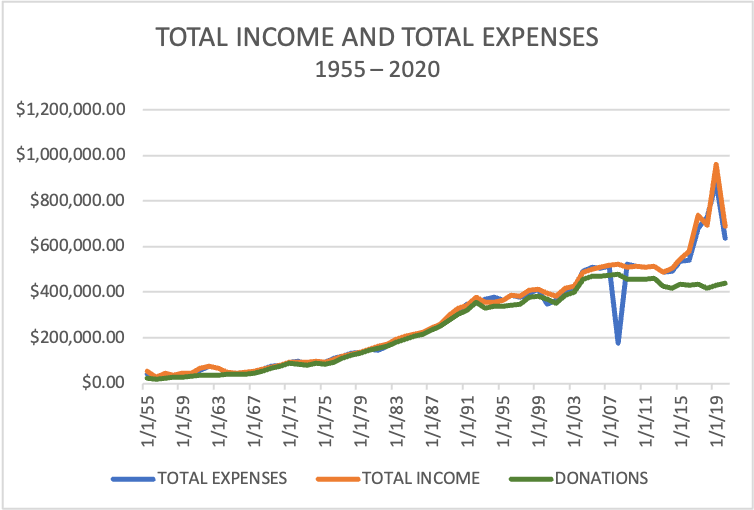
Meanwhile, donations per adult member kept up through that first stable period, but couldn’t quite match the upturn in expenses between 2001 and 2004. Then, beginning with the Great Recession in 2008, donations began a slow decline that had not stopped by 2020, while expenses remained fairly stable for a while.
Until 2014. Around then, the expenses curve turns chaotic. Expenses rose very steeply and spiked dramatically in 2019 and then crashed in 2020. Meanwhile, all through that period donations remained flat. I suspect that the pandemic caused the crash in expenses in 2020. But I’m not close enough to the yearly meeting anymore to explain what was going on during that last period.
In this period since 2014, the yearly meeting apparently made up the difference with its annual general appeals, with its investments, and with other income. I’m no finance expert, but it looks like a dramatic increase in the value of investments in that period helped to fund the dramatic increases in total income while donation income remained flat.
As this disparity between income and expenses becomes more obviously a threat for some yearly meetings, they will have to make increasingly severe cuts in their budgets. Some of these cuts will necessarily fall upon staff, as they already have in Philadelphia YM, as I know, and reduced staff is not likely to reverse membership decline or increase charitable giving. It’s a feedback loop.
What’s a yearly meeting to do? I’ll think about that in the next post.


really basic questions: is the chart of income and expenses for a monthly meeting, a yearly meeting, or what? also, what caused the big increase in expenses? thanks!
The charts are for the expenses of New York Yearly Meeting.
As for the jump in expenses, good question. Beginning in 2016, the yearly meeting must have added staff because the salaries figures jumped from $182,000 in 2015 to $291k in 2016, and then again to $419k in 2017. I wasn’t active in NYYM at those times, so I’m not sure what the details are.
I was born into Quakerism; attending meeting from age 6 to 21 in the Bucks Qtr of PYM. So in 1971, Buckingham Friends was in good shape, had a lively engaged membership.
I moved out of state, lived in many places but none had a spirit-lead Friends Meetings.
Now, 50 some years later, I have moved back the Philadelphia area and now attend Gwynedd Friends.
The amount of change has been a challenge to overcome. My brother has been attending meeting in this area throughout these years and is easier with the changes, but is mostly disappointed.
My sense is that many (used to be called) Convinced Quakers are not truly Quakers. They like meeting for worship. They like the social hour after. But too many, from what I have experienced in the past 3 years have no interest in Monthly Meeting or Yearly Meeting, they balk at volunteering, don’t pay attention to important communications, and yes, our donations are down.
Even more troubling, I have recently learned that there many “attenders” who have been attending for decades. Not enough effort is put into having them commit to the community. I had one woman say, “I didn’t want to be a member because then I’d have to be on a committee.” Yet, she gladly accepts all the benefits of the meeting.
I have no idea if this is true, but I think a lot of it is rooted in both the distaste for proselytizing and being direct with the membership about financial obligations. The treasurer is so worried about offending someone doing the best they can when they have no idea what a member’s financial status might be.
There is also the reality of a missing fixed leadership. Churches have a minister in place for years at a time. The church is clear about tithing.
In the 1960s our meeting never had public discussions about the need for a fixed donation, but I guarantee the Elders spoke to those not holding up their end. At the time, the major of that membership was birthright… multi-generational. Long before we got to meeting, we had lived a Quaker life.
I accept that dynamic is gone. The old ways do not work in this new, looser, “do what you feel” world.
Without new members, we will go the way of the Shakers. To convince new Quakers, we need to market our way of worship, educate the newcomers about more than how to sit quietly, and expect them to be full members of the community.
So many are searching for what Quakerism has to offer. All are welcome… with the understanding that it’s not a Sunday kind of thing.
Dear Elizabeth
I agree with you about all this. We have something wonderful to offer (in theory); we should offer it. Decades ago I read a book titled Paul the Convert about how being a “convinced” follower of Christ affected his thinking. At some point the author talked about the sociology of church growth, which shows that the churches that grow are the ones that ask something of their members, and, up to a point, at least, the more you ask the more you grow. That this is part of the key to the growth of evangelical and pentecostal churches today.
If you don’t ask much of your members, you don’t get much; you get wishy-washy members and attenders. If you really offer something and ask for something in return, you might lose the wishy-washy attenders but you will get new ones who want to engage, who are looking for a religious community that actually enriches their lives.
But you really have to offer something. That means, especially: