
Membership Decline Case Study, Part 5—Outreach Solutions
September 16, 2026 § Leave a comment
Solutions: Outreach
Let’s assume that your meeting has done the inreach. You are ready to welcome newcomers and have the three elements that will matter most in holding onto them initially: warm, welcoming fellowship, deep silence, and Spirit-led vocal ministry. How do you get newcomers in the first place?
I’ve prepared a Meeting Outreach Checklist, which I hope you will find useful.
Also, Friends General Conference has a lot of Resources for Outreach. Click that link and check it out.
And good luck!
Membership Decline Case Study, Part 4—Inreach Solutions
September 5, 2026 § 1 Comment
Solutions
We are in decline. Membership is falling, some individual meetings are on the verge of dissolving, charitable giving is flat, while our costs are steadily rising. But this structural decline is only part of the story. I fear that we are declining spiritually as well.
This is a perennial complaint of white-hairs like me. John Woolman recounted such a complaint from an elder in the very early 1700s. And I bet it was true.
When’s the last time your meeting for worship was gathered in the Spirit? Are you getting Spirit-led vocal ministry? Do you have a lot of attenders who only come to meeting for worship?
The good news is that we’ve also been through periods of renewal, usually at the hands of young adult Friends. Cases in point are the emergence of programmed worship and pastoral meetings in the 1870s and ‘80s, the emergence of the liberal Quaker movement in the late 19th century, the growth of meetings in college towns in the 1950s and ‘60s, and the revitalization of our witness life during the 20th century’s wars.
I believe that renewal in our own time will come from the Holy Spirit. That is, it will depend on Friends called to the ministry of renewal. Are you so called? And it will take two forms: effective in-reach and meaningful outreach.
It WILL NOT come from restructuring our meetings. I served on New York Yearly Meeting’s first Renewal Committee in the early 1990s. The yearly meeting has since then convened no fewer than six more formal efforts focused on meeting structure; all failures. Real renewal comes from God.
In this post, let’s look at in-reach. In the next post, we’ll look at outreach.
In-reach
Holding onto visitors
I believe that newcomers to our meetings decide to stay when they get at least some of these three elements of meeting life:
- True fellowship of the Spirit—a warm personal welcome, including especially, for young families, childcare and First Day School already waiting for them; not necessarily already with kids, but adults prepared to welcome any families who show up.
- Spirit-led vocal ministry—messages that speak to the yearning that brought those visitors to us in the first place with their hopes for an experience that answers that of God within them, messages delivered with discipline and integrity and genuine spiritual inspiration.
- A living silence—achievable only through the presence of a critical mass of spiritually mature members holding the meeting in grace.
Holding onto newcomers
Once visitors become attenders, they need more than just a welcome and the meeting for worship. They need to know that there’s a there here. This means visible and regular efforts at spiritual nurture—a vital culture of eldership.
- Does your meeting have a committee or at least individuals who proactively pay attention to newcomers, inquiring about their lives and spiritual interests?
- Do you have adult religious education or other programs that introduce them to the Quaker way, and especially about Quaker worship and vocal ministry?
- Do you inquire into newcomers’ spiritual gifts and interests?
- Do you invite their participation in things besides committee work (though that, too)?
Membership
- Do you regularly announce and explain the process for becoming a member and invite newcomers to consider applying, in a general way?
- Do you approach individual newcomers when you think they might be ready?
- In your clearness committees for membership, do you try to identify the applicant’s spiritual gifts (not just what committees they might want to serve on), and try to identify their ministries—whatever they are doing in their lives that they could see as Spirit-led service? Do you explore their spiritual interests, what kind of spiritual formation and nurture they might welcome?
- And after people become members, do you follow through with focused personal mentoring and support on the things you’ve discovered in their clearness committee?
The culture of eldership
- Do your committees, especially adult and youth RE (you have them, right?) and worship and ministry committees—do they regularly consider how to foster deeper vocal ministry, how to support leadings and ministries, how to nurture individual members and attenders in their spiritual lives?
- Do you know how to conduct clearness committees for personal decision making and the discernment of leadings, and regularly announce their availability?
- Do you hold discussion groups and worship sharing opportunities around aspects of the Quaker way and any issues the meeting may be currently facing?
- For the newcomers who do not attend meeting for business and/or your programs, are you willing to use the meeting for worship itself as a venue for these kinds of spiritual nurture? Or are you treating the meeting for worship as a fixed outward form and as a sacred cow that can’t be experimented with?
Membership Decline Case Study, Part 3—The Money
September 1, 2026 § 4 Comments
Donations per member
Before I began this study, I thought that, in addition to a steady decline in membership, the giving by the members we do have was also declining. But that’s not quite the case.
As you can see from the chart below, until the last decade or so, donations by membership actually kept pace with expenses, even though the expenses curve has been rising. In fact, expenses rose relatively steeply from the mid-1970s to roughly 1992, but donations kept up. In 1992, expenses leveled off some, then they rose a bit around 2001, and then they leveled off again around 2004.
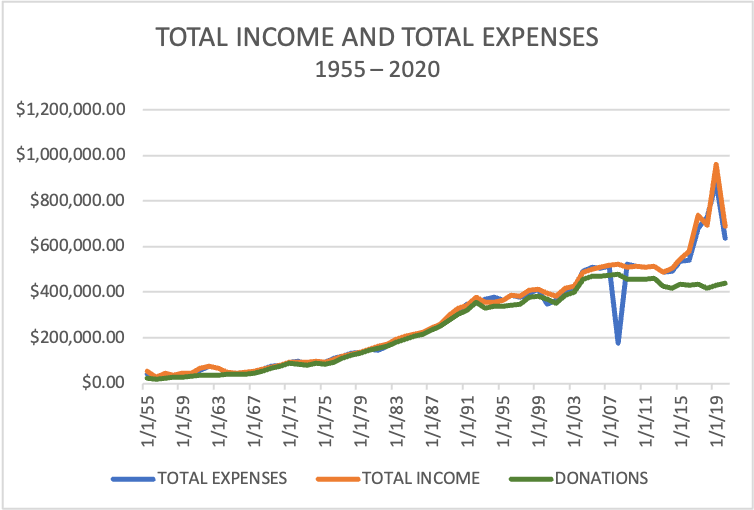
Meanwhile, donations per adult member kept up through that first stable period, but couldn’t quite match the upturn in expenses between 2001 and 2004. Then, beginning with the Great Recession in 2008, donations began a slow decline that had not stopped by 2020, while expenses remained fairly stable for a while.
Until 2014. Around then, the expenses curve turns chaotic. Expenses rose very steeply and spiked dramatically in 2019 and then crashed in 2020. Meanwhile, all through that period donations remained flat. I suspect that the pandemic caused the crash in expenses in 2020. But I’m not close enough to the yearly meeting anymore to explain what was going on during that last period.
In this period since 2014, the yearly meeting apparently made up the difference with its annual general appeals, with its investments, and with other income. I’m no finance expert, but it looks like a dramatic increase in the value of investments in that period helped to fund the dramatic increases in total income while donation income remained flat.
As this disparity between income and expenses becomes more obviously a threat for some yearly meetings, they will have to make increasingly severe cuts in their budgets. Some of these cuts will necessarily fall upon staff, as they already have in Philadelphia YM, as I know, and reduced staff is not likely to reverse membership decline or increase charitable giving. It’s a feedback loop.
What’s a yearly meeting to do? I’ll think about that in the next post.
Membership Decline Case Study, Part 2—The Data
September 1, 2026 § Leave a comment
Members
As I said in the previous post, New York Yearly Meeting membership has been declining since the Orthodox and Hicksite yearly meetings reunited in 1955.
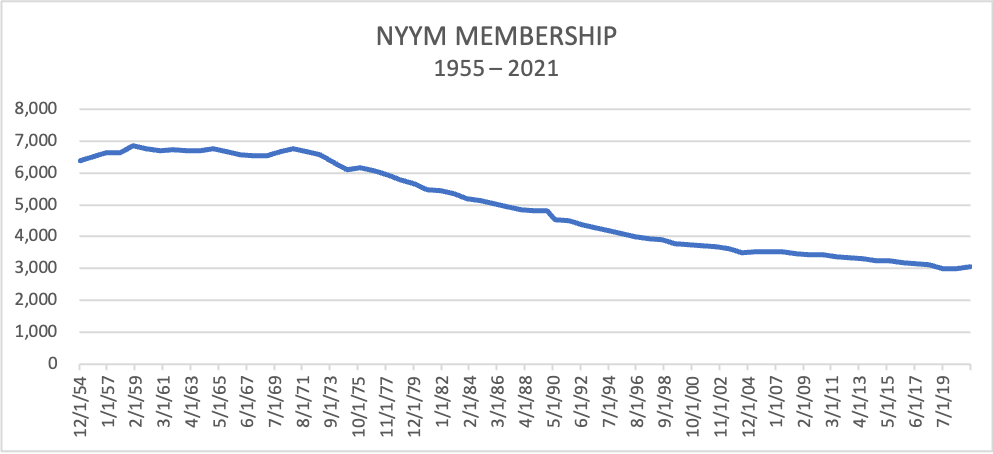
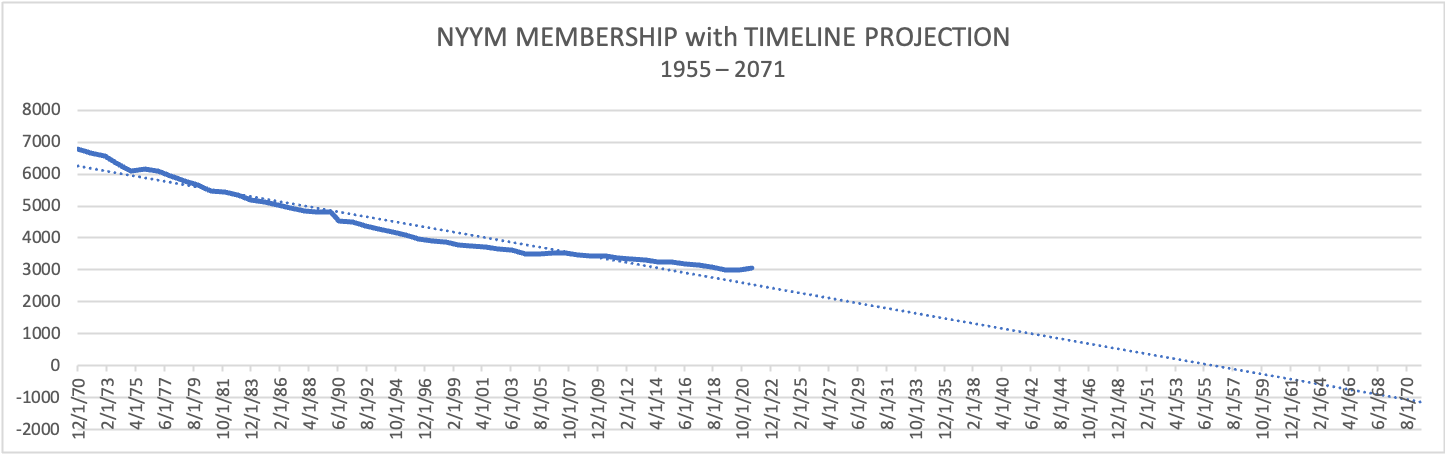
The broad conclusions are as follows. In the 66 years from 1955 through 2021, NYYM membership declined by 3,342 members, from 6395 to 3,053, or 52.3%. As you can see from the chart above, the decline began around 1970 and may have started leveling off a bit beginning around 2003. As you can see from the second chart below, the trendline, if it holds, reaches 0 members in 2056.
Yearly meeting appointments
When I was active in the yearly meeting from the 1980s through the late 2010s, yearly meeting session attendance—people actually in the room for business meetings, rarely got above 120, roughly 3% or so of total membership. If that percentage of active Friends holds, the yearly meeting will have only 50 people doing its business by around 2035, less than ten years from now. In 2020, the yearly meeting had 49 committees or other bodies to which members were appointed and more than 400 appointments that were filled on paper. You can do the math.
Factors
Removals. Unfortunately, I don’t have data for 1973 through 1985, which latter year is about when I joined. But I remember that in the late 1980s into the early 2000s, meetings became more resolved to remove folks from their rolls because the yearly meeting used a membership formula to calculate requests for contributions from the quarterly meetings, and meetings were then paying for “members” whom they never saw and/or who lived away from their area. I don’t remember when the quota practice was dropped, but I suspect that trying to reduce their covenantal commitment was a factor in the number of removals from membership that made the membership decline curve steeper in that period than later.
Resignations. In addition, in this same period, lots of Christ-centered Friends left the yearly meeting as individual meetings and then the yearly meeting itself gradually came to a new testimony regarding marrying same sex couples—another factor in the decline.
Meetings
Lets look at the number of meetings instead of the number of members. For this I’m comparing 2012 and 2021.
The number of meetings declined in this period from 63 to 61, losing three and gaining one. But the more important figures lie in the number of very small meetings.
In 2012, NYYM had 8 meetings with membership at 10 or less, with an average membership of 6.6, representing 12.7% of all meetings. NYYM had 9 meetings with between 11 and 20 members with an average membership of 16.1, representing 14.3% of all the meetings. Thus 27.0% of NYYM’s meetings had 20 or fewer members
In 2021, NYYM had nine meetings with 10 or fewer members, with an average membership of 5.2, representing 14.8% of all meetings—an increase from 2012 of 2.1%. Twelve meetings had between 11 and 20 members, with an average membership of 16.8, representing 19.7% of all meetings. Thus 34.4% of NYYM’s meetings had 20 or fewer members—more than a third. That’s a 7.4% increase since 2012.
Meeting summary: In the nine years between 2012 and 2021, NYYM lost a net two meetings, but the number of small meetings (20 and fewer members) increased by 7.4%. Meetings with 17 or so members (the average for meetings with 11 to 20 members) will hang on for a while, but they are likely to lose members, as the increase in the number of meetings with 10 members or less indicates. Meetings with just five members are probably in real trouble.
Quaker Membership Decline—A Case Study
September 1, 2026 § Leave a comment
In an earlier series of posts which I titled Quaker-pocalypse, I talked about three curves that I thought were converging for Quaker meetings and institutions with potentially catastrophic consequences. These trends are: declining membership, declining donations from the members we do have, and rising fixed institutional costs. When the first two curves crossed the third, I expected that meetings—meaning, mostly, yearly meetings—would have to radically restructure themselves or they would collapse.
I’ve made a case study of New York Yearly Meeting (NYYM) to study these factors and trends. I chose NYYM because I know it well; I was a member for decades and was its communications director for several years, and in that role I wrote its annual reports, so I’m very familiar with its data-keeping format. Also, NYYM’s records are kept in the Quaker collection at Swarthmore College, which is easily accessible for me. Furthermore, NYYM’s Orthodox and Hicksite yearly meetings reunited in 1955, which provides a clean starting point for the data. My data field thus extends from 1955 through 2020/2021.
The results surprised me some. Membership has been steadily declining, and maybe more important, the number of monthly meetings that are inching toward collapse has been accelerating. The rate of giving by members to their meetings is more complicated, but shows a troubling trend over the last twenty years, especially when compared to fixed expenses.
In the next post, I look at the membership figures.
In the Shadow of Trump a Beacon?
December 17, 2016 § 15 Comments
The Friends I know are totally freaked out over the election. They break out crying. They wake up crying. They are literally throwing up. In every aspect of his being, Donald Trump assaults our sensibilities. His decadent moral character, his coarse, bullying personality, his utterly self-absorbed psychology, his willful and dangerous ignorance and lack of identifiable personal or political philosophy, his divisive and demeaning political tactics, his racism, xenophobia, and misogyny—we can’t believe that this man, a self-confessed sexual predator, will now be our president.
But I live and worship among liberal Friends on the East Coast. What about the evangelical Friends who live in Iowa and Kansas and Indiana? Are they among the 80% of evangelicals who voted for Trump? Hard to imagine, but it’s clearer than ever that we really don’t know each other in America anymore. I hope any Friends who read my blog and who voted for Trump comment here, to help me understand.
The election of Donald Trump is a rebuke, not just of the week and outdated liberalism of the Democratic party, but of liberal identity itself, including that of liberal Quakerism. We liberal Friends are waking up with nightmares partly because the liberal identity and sensibilities that drove the Clinton campaign are dominant elements of liberal Quaker culture and identity, as well, so his election feels like a personal assault and an existential threat.
But clearly Donald Trump speaks to the legitimate concerns of a lot of Americans whom the Democratic party has betrayed and abandoned—the white working class, especially those folks whose economic prosperity used to rest in the manufacturing sector, and especially their men, who, unlike some of their wives, have found jobs in the service and public sectors both demeaning and hard to find; folks in rural America and in those suburbs that have avoided becoming exurbs and remain predominantly white; and the strongly and overtly religious.
Both parties have some soul searching to do. Both are on trajectories aimed toward collapse. But what about us liberal Quakers (and Christ-centered Quakers, for that matter)?
Have we also abandoned the white working class? Do we have a message that speaks to folks whose jobs followed NAFTA’s “giant sucking sound” out of the country, as Ross Perrot put it so presciently way back when? Do we harbor veiled prejudice against “guys”—men who have not internalized the sensibilities we value in today’s liberal Quaker culture, men who don’t work behind a desk or in the secular church? And about the church . . .
Hillary Clinton may be a genuinely religious person, but you would never know it. She seems deaf to the voices of a large portion of one of the most religious countries in the world. I am glad she ran openly on a woman’s right to choose, so it was going to be uphill from there with evangelical Christians, granted.
But the gospel of Jesus is one of the most revolutionary ideologies on the planet. Did she have any advisors who know the many elements of the “good news for the poor”, as Jesus put it in Luke 4, with which she might fill out a meaningful progressive message to the Christian electorate? Either she didn’t have progressive Christian advisors or she decided against such a message, fearing she would push away her non-religious base, or I missed it.
So also with many of our meetings. Do we have members who know and cherish the progressive message of the gospel? Do some of us cringe when some vocal ministry invokes Jesus Christ or quotes the Bible, for fear that we will push away the non-religious among us? To that point, to what degree do we think of ourselves as “spiritual” but not “religious”?
And the gospel of Jesus is, at its core, a message about relief for the sufferings of the poor. Do we know the economics of redemption in the commonwealth of God, the planks in the platform of the new covenant Jesus offered? Are we equipped to offer the Christian electorate that voted for Trump an alternative vision for society that is fully grounded in the gospel and the rest of Christian scripture? Are we interested in taking our place in the progressive religious opposition to the proto-fascism that Donald Trump and his conservative and alt-conservative coattail riders will be shoveling up? Are we ready with the Word of wisdom and truth, the weapon of the Lamb’s War?
For surely, Donald Trump will betray his Christian voters. He only wanted their votes, and that not very badly. Otherwise, he really has nothing in common with them. Do we?
And he will betray his core, the abandoned white working class, not by failing to give them what he promised, but by delivering on promises that were never going to solve their problems in the first place, by driving the real economy into the dirt, by guaranteeing a global warming catastrophe, and by degrading all the shaky protections we have against an immoral and predatory capitalist system and its captive social and political cultures.
Like the Democratic party, we now need to examine our identity and our message. What do we have to say to the millions of Americans that we now think are either stupid, ignorant, or snookered by a dangerous con man?
Much of America is held together by the ties of religion, family, and community. Is liberal Quakerism a religion or a “spirituality”? Do we have a meaningful message for those who identify as religious? Do our meetings reach and retain young families? Do we know our local communities and share their struggles?
We are going to be a haven for those who are fleeing the reality of Trump. But will we also be a beacon for those who voted for him and whom he will probably ultimately betray?
Quaker-pocalypse: Collapse and Renewal in Quaker Social Witness, Part Three
January 31, 2016 § 7 Comments
Radical witness today?
I think the liberal, committee-based approach to Quaker witness has run its race.
The liberal approach: Study the problem, find the causes, develop a program, fund it with public money and action—we’ve been doing this since the New Deal, but since the 1960s, this approach has become increasingly impotent.
The committee-based approach: Someone feels led to engage some new concern—say, earthcare—so you form a working group. If you get enough people behind the concern, form a standing committee. Then spend half your time developing a budget, spend the rest of your time seeking unity over your direction, negotiating your leading with Friends who are maybe led in some other direction within the concern, or who have no direction at all; resort to brainstorming or visioning sessions when the group can’t find its corporate direction; call the seven minutes you sit in silence at the beginning of your meetings “worship”; hope nominating committee can find enough people to keep you going, linger on after the fire has died out because some Friend in the wider body can’t imagine your meeting without an [xyz] committee, become a zombie committee. X years later some Friends feel a new leading for the concern, the committee gets a defibrillator, and the cycle starts over again.
We may be standing today on the cusp of a new stage in the evolution of Quaker witness. I hope so.
We have awakened to the total integration of oppression across all areas of life, culture, economics, and politics. All of our problems are interrelated. The whole system is corrupt. Nothing less than a total social-cultural-economic-political-constitutional revolution will do. Civilization itself must change. How do you do that?
We are paralyzed by the enormity of the challenge. We are bereft of a prophetic vision that could take on this kind of monolithic global evil. We are chipping away at things here and there, and with some remarkable success. But a sense of helplessness and dread often looms over our efforts, as we seem to be losing ground on a number of really important fronts, especially ecologically. The human race seems bent on following the passenger pigeon into oblivion. It is as though the Book of Revelation has become our playbook.
Quaker witness now needs to recover the genius of all four stages of our witness history at once. We still need liberal activism and programs that alleviate the sufferings of the people and the planet. We still need the government—legislative reform and executive regulation and enforcement. We still need the truth and intelligence of science and the leverage of technology. We still need to threaten pharaoh in his own court with the prophecy of the plagues he is bringing upon us all.
But we also need a new evangelism, a message of good news that can bring individual people to the altar of light and life with a new consciousness. And that good news needs to be more than just the truth of salvation from sin in Christ.
And we need to recover, adapt, and embrace the faith and practice of spirit-led Quaker ministry, to rebuild a culture that is adept at recognizing and supporting G*d’s call to prophetic action, as we had in the 18th century. Now that we’ve expanded our understanding of ministry to include witness leadings, we need a robust infrastructure for the discernment and support of that ministry.
And we need a new Lamb’s War, a radical, unreasonable, Spirit-led assault on the roots of our civilization’s downturn, as we had in the 17th century. But with a new focus, a new sense of urgency, a new understanding of what the endtimes and the second coming of the Christ mean now that the seven seals are being opened and the Four Horsemen have been set loose, for real.
In short, we need the Holy Spirit.
We need a new apocalypse, a new revelation, one that gives us some hope and faith with which to overcome the fear and dread we feel and that helps us embrace the failure that we certainly face. For we are going down. The end is near—depending on what you mean by “the end” and “near”. My wife Christine just came back from a planning conference in which scientists studying the New Jersey shore say that the barrier islands won’t be there in 25 to 30 years; South Cape May is already under the Atlantic Ocean.
Climate change, sea level rise, species extinction, the death of our oceans, the spread of ideological evil, the collapse of old institutions, including our own—all this calls for something new, a lamentation that can reach the ears of God, a Seed that can awaken a new consciousness in at least a critical mass of the people.
We may be the only religious community on the planet that is already equipped to receive and nurture that seed, for whom continuing revelation is a concrete reality, a movement that knows that any one of us could hear that call and answer it.
This is very unlikely to happen in our witness committees. We have had committees for a hundred years and they, too, have run their course; they have become part of the problem.
If we take our faith in continuing revelation seriously; if we really believe in Spirit-led ministry, then meditation, prayer, and worship are where we will receive the Seed, not in some committee brainstorming session. Like the Seekers of the 1650s, we need to stand in expectant waiting for the Word to come.
Do we have the discipline, the patience, and the faith to do this? I’m not sure that I do. But I don’t know what else to think. I don’t know where else to turn, except radically, toward G*d, who century after century, has come through for us.
Quaker-pocalypse: Collapse and Renewal in Quaker Social Witness, Part Two
January 31, 2016 § Leave a comment
This is the second installment in a five-segment series on the history and future of Quaker witness, focusing on how we organize it.
Evangelical witness
Into the desert of late-18th century ossified Quaker ministry emerged evangelical Quakerism around the turn of the 19th century, giving rise to a third phase of Quaker witness. Evangelical witness had a new willingness to engage with the outside world and to minister to some of its needs. The new witness impulse took the forms of social witness against slavery, ministry to prisoners, the temperance movement, expanding women’s rights, and a few others I’m certain I have missed. It matured into the philanthropic movement as wealthy Friends felt compelled to use their wealth in positive ways for social change. Friends led the movement toward philanthropy that you see typified in scenes from Charles Dickens’s A Christmas Carol.
Evangelical witness had organizing principles that had been missing in the previous period: the cause of social ills was sin, and thus the solution was evangelism, calling people away from their lives in sin to a life in Christ. I think of Joseph John Gurney’s deep soul searching after the economic crash of 1828 in Britain, a depression that was worse in some ways than our Great Depression. The Gurney family nearly went under and Joseph John agonized over whether his greed had brought on his trials.
For evangelical political economists (the dominant economic school of the time) and evangelical ministers were laying the blame on those who had overextended themselves in debt through greed. The cause was the sin of greed. The solution was an avalanche of pamphlets and sermons against greed in particular, and sin in general. A clear understanding of business cycles, of boom, bubble, and burst, that would emerge in classical economic circles, had yet to find its adherents.
Evangelical witness was somewhat confrontational, but hardly unreasonable. The discourse was flooded with moral reasons, biblical reasoning, and intelligent argument. But it wasn’t radical. This was no real departure from 1,500 years of Christian religious culture, just a more focused intensification of an already seasoned message about sin and salvation. Thlnk of Elizabeth Fry teaching the women in Newgate prison to read the Bible.
The rise of liberal witness
The next phase of Quaker witness was a radical departure in very important ways from its evangelical roots. My poster boy for this revolution is Seebohm Rowntree, a member of the Rowntree chocolate dynasty located in York, and a member of the cohort of young Friends who gave birth to liberal Quakerism around the turn of the 20th century, a group that included Rufus Jones and Seebohm’s brother John Wilhelm Rowntree. Seebohm Rowntree’s book Poverty: A Town Life was the first widely-read sociological analysis of a social problem in human history. He interviewed virtually all of the households in York and tabulated their economic condition, then drew some conclusions and made his arguments.
His central conclusion about the cause of poverty was truly radical at the time, though it seems obvious to some of us today (though obviously, not all of us): sin was not the problem. Most poor people worked hard, they just didn’t have enough money. Their poverty was not the consequence of their character, as the evangelical model had insisted. It was not lust (too many children), intemperance, gambling, etc., that made them poor; it was the low wages their employers paid them.
Rowntree gave us the first systematic analysis of systemic evil, and he saw that it called for structural solutions. Moral exhortation of the poor would never raise their wages; only their employers could do that, and they weren’t likely to do it on their own. Seebohm Rowntree himself reformed the labor relations in his own family business after writing his book, but he did not substantially raise worker’s wages. Meanwhile, he also argued that the government had an important role to play in making up the gap, in relieving this human suffering, and in trying to regulate business toward greater compassion.
This, too, was a radical departure. Evangelical witness had actively opposed government involvement, seeing it as intervention in a process of conviction and repentance that rightly involved only the sinner and God. Helping poor people with alms actually enabled the sinful life, in the evangelical view. Rowntree saw that the only agent powerful enough to affect the behavior of business—the real source of poverty—was the government. Poverty played a significant role in the creation of the Liberal Party in Great Britain and of Britain’s welfare state. Among other breakthroughs, the book popularized for the first time the brand new idea of a “poverty line”, a formula for measuring poverty and therefore for evaluating programs. His formula was picked up wholesale by Roosevelt’s New Deal labor department and is still the basic framework for policy thinking and poverty metrics today.
Rowntree went on to serve in government in several capacities for the rest of his life. Rufus Jones went on to help found the American Friends Service Committee. With the onset of World War I, Friends recovered their testimony against war and, for the first time since the late 1600s, Quakers were again being persecuted for their witness. Thus the Great War forged a new consciousness in Quakerism and we have been much more focused on “mending the world” ever since.
AFSC illustrates the arc that this witness took as the twentieth century roared on. While many men went to jail rather than serve in the military, AFSC and similar efforts aimed to reduce the suffering that the war was causing. The genius of the Orthodox Quaker Herbert Hoover at organizing relief efforts put him on the political map.
But gradually Friends turned their attention more and more to the structural causes of our problems, as the consciousness that Seebohm Rowntree had ignited began to mature. Committees on industry and the social order in both Great Britain and the US published amazingly searching and radical pamphlets. A small but vocal and influential socialist movement eventually spawned some collective communities in the UK.
World War II returned us toward the peace testimony again. Then the Vietnam War and the cultural revolution of the 1960s helped broaden the “peace testimony” beyond just a testimony against war into a deeper understanding of violence. The Alternatives to Violence Project was born. AFSC became increasingly an advocacy organization rather than just a service organization. And other testimonies began to proliferate, as we woke up to new evils: environmental degradation, women’s rights (again), racial equality, then an even broader understanding of equality that could include the sanctuary movement, LGBTQ concerns, and so on.
Liberal witness is reasonable in the extreme and not radical, by definition; it is liberal. It works with existing institutions. it studies problems, proposes solutions, argues from science, develops programs, and seeks to move governments into the roles that only governmental scale, reach, and resources can assume.
And it is pursued by Friends through committees organized around concerns—a peace and social witness committee, Quaker Earthcare Witness, Friends Committee on National Legislation, the American Friends Service Committee. AFSC, I think, ,may have led the way into organization by committee. But the rise of liberal Quakerism settled the already significant trend toward abandoning the traditional infrastructure for Quaker ministry that had developed in the 18th century and continued into the 19th. It increasingly relied on membership donations and the operating budgets of local and yearly meetings rather than on the largesse of wealthy philanthropist Friends. And it was inspired by a more reasonable energy than the apocalyptic fervor that had ignited the Valiant Sixty.
Quaker-pocalypse: Collapse and Renewal in Quaker Social Witness, Part One
January 31, 2016 § Leave a comment
I think I feel led to return to my Quaker-pocalypse series, to focus a bit on our witness life. But my leading for this blog has been sputtering lately and I find myself darting from one theme to another without clear coherence, so I’m not sure where I’ll be led next.
Meanwhile, this post, when I finally finished it, was so long that I decided to break it up into segments. This one takes a historical look at our witness—how we have organized it—in the first two of four—possibly five—stages. These first two stages are The Lamb’s War and “Quietist” Ministry. The next two segments are Evangelical Witness and Liberal Witness. Finally I look at Radical Quaker Witness Today.
I think we need a new approach to witness. And to work my way feebly toward such an opening, I found myself reviewing how Quakers have organized our social witness in the past. I see four modes of organizing witness in our history, in which energy followed by maturity and then decline—or in the first case, persecution—has led to a new form with new energy. It’s as if the Holy Spirit wants us to keep at it, providing new openings, and—hooray!—finding us with ears to hear. One big reason we believe in continuing revelation.
The Lamb’s War
The first phase was the Lamb’s War, the Apocalypse of the Word (see Doug Gwyn’s groundbreaking book of this title). It focused on the world with the zealot’s intensity and often was confrontational. It was unreasonable, being founded on religious faith. It engaged virtually all the Children of the Light, in the sense that virtually all Friends eschewed hat honor, used plain speech, etc., in their everyday lives. It aimed at what early Friends believed to be the root of social ills—false religion, as the agent of an even deeper cause, alienation from God. And it was radical, not just in its critique, its methods, and its proposed solutions. It also arose from radical discipleship and it aimed at the roots, as they saw it, of a world that could not comprehend the light that was coming into the world.
Then came the persecutions, the backlash from the established church and the state, bringing the wholesale death of our early leadership in Britain’s gaols—the collapse of the Apocalypse of the Word and the need to change our stance toward the world.
“Quietist” ministry
The result was the second phase of Quaker witness—the reliance on Quaker ministry that characterized the 18th century. Think of John Bellars and John Woolman. Friends who felt a divine leading to mend the world in some way who took their leading to their meeting and, if the meeting discerned that the leading was a true one, off they went. It tended to be focused internally (think of Woolman visiting Friends to persuade them against slaveholding) and it was not, generally speaking, confrontational or radical. Putting aside the vigorous culture of travel in the gospel ministry, this period’s social witness ministry did not, as far as I can tell, engage very many people as either ministers or recipients.
There was no overarching organizing vision for collective action, as there had been for the first generation, no sense of mission like the earlier apocalyptic belief that the second coming of Christ was at hand. As Doug Gwyn describes in The Covenant Crucified, Friends had cut a deal with the powers of the world after the persecutions gave way to some level of tolerance: you leave us be and we’ll leave you be—that was the deal.
This witness was morally reasonable, in that it relied on arguing from a scriptural and a moral stand. But it was not yet reasonable in the secular humanist sense that so dominates Quaker witness today, in which we argue from a stand in social science and use liberal political rhetoric.
This witness was radical in that Quaker ministry still relied radically on the movement of the Holy Spirit, at least in theory, but it was much more contained and far less focused on the world outside the Quaker community than the Apocalypse of the Word had been.
But Quakerism became more and more quietist, more withdrawn from the world into Quaker distinctives and an ossified culture of eldership that tended to quench the spirit.
Quaker-pocalypse—Nominations and Meeting Renewal
October 11, 2015 § 8 Comments
The goal
On the surface, it looks like the goal regarding nominations and meeting service—too few people doing too much work—is to increase the number of Friends willing to serve on meeting committees. But I think the goal is to help Friends discover and develop their gifts in the context of a new kind of relationship with their meetings, in which Friends are serving each other in their spiritual lives with the extraordinary tools that we have inherited from our tradition, in a structure that better serves the spiritual lives of the members, without leaving the meetings any more under-served than they already are.
Some of those gifts will be useful to the meeting. Some of those Friends will feel led to use them in service to the meeting. There will almost certainly still be gaps. A handful of dedicated Friends will still probably shoulder more than their share of the meeting’s work and financial support. That’s just the way things are in an all-volunteer organization in our time. But the meeting’s energies—by which we mean the energies of its members—will be pointed in the right direction: toward the members.
The goal is to channel divine energy from the members through the meeting organization back toward the members. This energy is, essentially, love, in the form of service to each other in our spiritual lives—and, for that matter, in all aspects of our lives—work, family, and the emotional and even the material aspects of our lives—to the degree that is appropriate and we are able. The meeting’s role is to facilitate this channeling, not to gather unto itself all the members’ energy.
The challenge
The challenge is that we are talking about a radical change in Quaker meeting culture. We are talking about structural changes that Friends are likely to resist, when they can understand them at all. More importantly, we are talking about a change in consciousness—a much greater clarity about what the religious life could be, a significant shift in our understanding of the purpose of the meeting and the meaning of meeting membership.
This means doing a lot of different things at the same time with strategic purpose, a kind of full court press, sustained over a considerable period of time. Multi-dimensional strategic efforts are hard to conceive, hard to communicate, and hard to grasp, even when communicated well., hard to implement, and very hard to sustain. A “full court press” will involve a lot of the members, when the problem we are trying to solve is the fact that our members are already at the limit of their resources, and we have trouble getting a lot of them involved in anything. Furthermore, energy tends to wane over time, even when the community is behind a significant collective effort, but this level of transformation just can’t be done quickly with a magic tantric spell.
So this effort has to start small and progress in stages and it needs to work on several fronts at once. And it needs to live on the energy of Friends who feel led to the work. As soon as this transformative effort begins to feel like an obligation or duty, we might as well have stayed with the original, now ‘traditional’ committee structure.
Solutions?
In the short to medium term, we could try the following:
Clerking. Improve the effectiveness of our committees with some training and/or resources for their clerks. See these resources on the New York Yearly Meeting website.
Committee oversight—in a new way. See whether any Friend or group of Friends feel led to serve as elders in a particular way: as a kind of ad hoc working group on meeting life whose charge is to pay attention to the life of the meeting overall, to watch for emerging problems, trends, and patterns, and to serve as ombudspersons, people everyone knows they can go to with a difficulty. This could be the assistant clerk, or even the meeting’s clerk. And they should feel free to co-opt other Friends to help address a particular situation. I know, this sounds like another committee, another nomination. But I think this person or group should truly feel led to do this work. This should not be an appointment for a specified term, and if the meeting cannot find such a person, then so be it. This should not be a new standing committee, but rather a locus of concern for the overall life of the meeting. I suspect that this approach would be most appropriate for medium-sized and large meetings.
Trim the organizational tree. Take a look at your committees and see which ones could be laid down or combined.
Working groups instead of committees. We might try getting rid of committees altogether, except for those with fiduciary responsibility, and form working groups instead. Standing committees are hard shells with defined tasks occupied by nominated Friends for specified terms. What I am groping for here is rather a locus of activity around a meeting need or concern with a specified time and place to meet and with very permeable boundaries—whoever shows up does the work. Someone would have to manage a calendar to make sure groups meet in a timely way (planning in the summer for First Day School’s opening in the fall, for instance) and to arrange for the spaces needed. In this scenario, nominating committee might only have to present to the meeting names for meeting officers and a couple of Meeting Life Coordinators to manage the logistics.
In the long term:
Meaning, Quaker identity, and membership. In the end (or rather, in the beginning), it all comes down to membership—what do we think membership means and what do we ask of those who join us? The answers to these questions rest on a higher-order question: What is the Quaker meeting for? What is the Religious Society of Friends for? Who are we and what are we doing? Specifically, do we understand the meeting as a covenantal community in which the members and the meeting share promises of mutual service and enrichment? The ways in which members serve the community have long been defined, but in terms of committee service; and the ways the community serves the members usually have not been defined at all, beyond hosting of meeting for worship and some level of reactive (rather than proactive) pastoral care. Do we want the meeting—that is, our fellow Quakers—to be actively, proactively, engaged in our spiritual lives? Do we understand the life of the spirit to include active mutual engagement with our religious community, beyond simply sharing meeting for worship and working together to run the meeting? Do we understand the life of the spirit as something we cannot do well alone, that collective discernment and support and even oversight are essential to individual spiritual thriving? Can we offer attenders something more than committee service when they become members, a level of engagement that would be serious enough that you would have to ask for it—by applying for membership.
I expect that it would take a meeting quite a long time to answer these questions, and the answer might well be no—we like things the way they are. We don’t want to scare people away, and it’s okay if there’s really no difference between being an attender and being a member. We want to be able to keep our inner lives to ourselves. My spiritual life is none of your business.
Membership jubilee. If a meeting decides to try a radical approach to renewal, however, we might try declaring a jubilee on membership altogether, once we’re clear as a meeting about who we are. Wipe the slate clean and hold new membership clearness committees for everybody, so that everybody has a chance to re-up, as it were. This would take a long while, especially in a big meeting. We might experiment with a more collective approach: hold small groups led by a facilitator in which Friends would discuss their spiritual lives and their hopes and needs regarding meeting life and membership—and then hold an “altar call” at the end. Those who decide not to apply for membership then would, of course, be free to apply later.
I’m just throwing out ideas here. I really do think this problem is very difficult to grasp and to solve. I’ve been thinking about it for decades and my ideas just keep changing, and I still don’t feel very confident about any of them. So I would love to hear what others think and what others are doing.
I know of a couple of meetings that have laid down their committee structure and turned to working groups, including Philadelphia Yearly Meeting. I would love to hear how those experiments are going.
On a final note: I am going on vacation for two weeks, so it will probably be at least three before I post again.

