
The Wings of the Spirit
July 26, 2026 § Leave a comment
Behold!
The wings of the Spirit
enfold us in divine love,
gather us into unity and joy, and
lead us to the Presence in our midst.
Through the Flaming Sword—Fox’s Vision
July 5, 2026 § Leave a comment
I’ve been reading The Great Angel by Margaret Barker, an exploration, among other things, of the origins of Jesus’s title as the Son of God, Messiah, and Lord.
On page 39, Barker discusses the vision and exaltation of the shaman king in ancient Near Eastern mythology. She starts by quoting Psalm 89:19:
“Of old thou didst speak in a vision to thy faithful one, and say:
‘I have set the crown upon one who is mighty,
I have exalted one chosen from the people.’”
She goes on to say:
‘Vision’ and ‘exaltation’ are highly significant words, especially if exaltation means ‘raising up’ in more than just the sense of conferring high status. . . . The heavenly journey reinforced the belief that the ordinary world of human existence and the upper world of their [the visionary’s people’s] mythology were once in a harmony which had been destroyed by the action of evil forces. The shaman had to repel these forces and thus restore the cosmic harmony. As a result of his initiation he had enhanced powers of vision and hearing; he could see into the very nature of things and understand the processes of life itself. Thus he became a healer. The commonest way to induce the experience of ascent was by fasting, lightening the body so that the soul could fly. Once the shaman figure had ascended to the heavenly places and knew the secrets of the creation, he enjoyed a life which had already passed through death, and he became a being from another world.
Immediately upon reading this, I thought of George Fox’s account of one of his visions:
Now was I come up in spirit through the flaming sword into the paradise of God. All things were new, and all the creation gave another smell unto me than before, beyond what words can utter. I knew nothing but pureness, and innocency, and righteousness, being renewed up into the image of God by Christ Jesus, so that i say I was come up to the state of Adam which he was in before he fell. The creation was opened to me, and it was showed me how all things had their names given them according to their nature and virtue. And I was at a stand in my mind whether I should practice physic [medicine] for the good of mankind, seeing the nature and virtues of the creatures were so opened to me by the Lord. But I was immediately taken up in spirit, to see into another or more steadfast state than Adam’s in innocency, even into a state in Christ Jesus, that should never fall. And the Lord showed me that such as were faithful to him in the power and light of Christ, should come up into that state in which Adam was before he fell, in which the admirable works of the creation, and the virtues thereof, may be known, through the openings of that divine Word of wisdom and power by which we were made. Great things did the Lord lead me into, and wonderful depths were opened unto me, beyond what can by words be declared; but as people come into subjection to the spirit of God, and grow up in the image and power of the Almighty, they may receive the Word of wisdom, that opens all things, and come to know the hidden unity in the Eternal Being. (Journal, Nickalls edition, pages 27–28)
So many common themes in these two passages: the fall, that is, the destruction of cosmic harmony by evil forces, and its restoration; vision and ascension to a higher world; enhanced senses and understanding; the power of healing and insight into the secrets of creation; passage beyond the normal mortal human condition into a quasi-divine condition.
And both accounts echo the ascent of the Son of Man to receive royal status by the Ancient of Days in Daniel 7, with which Jesus identifies himself. But that is another subject.
The Quaker Spiritway–A Meditation
July 5, 2026 § 3 Comments
The Quaker way of the Spirit:
We each have within us
an Inner Teacher and Guide;
we seek to have ears that hear
the quiet, murmuring Voice
that offers us comfort and strength
in times of adversity
and the Word of Wisdom and Truth.
We each have within us
a Light that shines within us;
we seek to have eyes that see
how we should walk in the world,
and to be corrected
when we step off of the path;
a Light that can awaken us
to the hurts of the world
and to the beauty in the world;
that inspires us to acts
of love and compassion,
of kindness and creativity;
that leads us into service
and advocacy on behalf
of those who are oppressed
and into nonviolent witness
against their oppressors
and the systems of oppression
which they serve and maintain;
a light that can lead us
into joy and thankfulness,
into personal fulfillment,
and into the peace that passes
all understanding.
New Pendle Hill Pamphlet
June 5, 2026 § Leave a comment
Pendle Hill has just released my new pamphlet Nurturing Vocal Ministry: Toward a Vital Culture of Eldership.
In this essay, I explore ways to deepen our meetings’ vocal ministry, to support our ministers, and foster deeper worship and the gathered meeting through what I call a vital culture of eldership. By this I mean the faith and practices, the attitudes and agreements through which we nurture the spiritual lives of our members and attenders.
I worry that since we laid down the practice of recording ministers and elders in many of our yearly meetings, and even in those that still retain the practice, we’ve stopped paying proactive attention to vocal ministry and stopped offering support to emerging ministers. I lay out some reasons for why nurturing vocal ministry more attentively is so important to our spiritual lives, as worshippers, as ministers, and as meetings.
I discuss some ways that our meetings and our worship and ministry committees could do more to nurture Spirit-led ministry and deepen the worship. I answer some of the hesitations that Friends have regarding a more attentive culture of eldership and lay out the many benefits to both our meetings and our members of such a culture.
I point out that we are already there when it comes to nurturing other kinds of ministry, especially witness ministry—we are more likely to recognize when someone is called to service, we treat their leading as an essential aspect of Quaker faith, and we are much more likely to know how to support them in practice.
Meanwhile, however, vocal ministry is the signature form of ministry in the Quaker way. Why would we not support spoken ministry in worship with the same focus and care that we give to other forms of ministry, especially since virtually all forms of Quaker ministry involve Spirit-led spoken word, anyway?
For vocal ministry in worship is the classroom and laboratory of the school of the Spirit. Through spoken ministry in worship we can learn to listen for the call to service, discern what that service is and whether it is of God, and learn how to be faithful while we serve.
And I explore the role that faith plays in our vocal ministry. By what “Spirit” am I being led when I rise to speak?
My answer is that I am led by the spirit of the christ, little “c”, the Spirit that anointed Jesus as the Christ for his ministries of leading, healing, forgiving, and teaching—his vocal ministry; that anointed his first followers for vocal ministry at the Pentecost; that anointed George Fox when he convinced the Seekers on Firbank Fell in 1652 and jump-started the Quaker movement, and that anointed them all in that moment in a second Pentecost.
That same anointing/christing Spirit (for the Greek word christos means anointed) that has been anointing Quaker ministers ever since, including those who will rise to speak this coming First Day in our own meetings—in theory. Or so I am suggesting.
What can we do to nurture this essential blessing of Quaker worship and the Quaker way? This pamphlet tries to answer that question.
The Unifying Course of the Spirit
April 25, 2026 § 3 Comments
In meeting for worship today (February 15, 2026) I had an opening about what I’ll call “the unifying vector of the Spirit,” a thread or path that passes through and unites four essentials of Quaker faith in its course.
These four essentials of the Quaker way are: 1) the Light Within, in which we can commune directly with God without any mediators; 2) the gathered meeting, in which the worshipping community can commune directly with God; 3) continuing revelation, in which the Spirit is always active and productive, within us and among us; and 4) living our lives as testimony and sacrament. (By God I mean the Mystery Reality behind our religious experience, whatever our experience is.)
So this is a meditation in imagery on a dynamic figure of the movement of the Spirit conceived as a kind of vector. By vector I mean something that has magnitude and direction, as in Euclidean geometry, represented by an arrow, used here as a metaphor. Think of it as a beam of light with intensity (weight) and direction (truth), sometimes refracting into new directions as it passes from one “medium” into another.
The point source for the “vector” of Light is God, the Spirit, however we experience and name the transcendental Mystery Reality that brings animation, identity, meaning, guidance, and transformation into our lives, which our “souls” can touch somehow.
The essential opening of the Quaker way is that each of us can commune with God directly, without any mediating persons, rituals, substances, or texts. This immediate relationship with the Spirit arises from the Light Within us, the indwelling presence of the Spirit within us. So the Spirit’s first motion is its animating presence within us.
Vocal ministry. And sometimes this focus of Spirit takes on “material” substance during worship in vocal ministry. Some opening takes shape in one of the worshippers, some truth. It coalesces, gains definition and clarity and a kind of solidity, becoming a seed, as it were, until it precipitates out from the swirling soup of collective mystical Life into Truth, into a message, into continuing revelation. Now the vector has emerged from the medium into which it was seeded in a worshipper onto the body’s surface, buoyed up and embraced by the collective.
The gathered meeting. Now, just as each individual can commune with God directly, so also the worshipping community can commune directly with the Divine, as a community, collectively. We call this the gathered meeting. In worship, the vector moves through us inwardly in our prayer, in our intention, in our attention in worship on God, on Love, on Truth, on the Good, on Mystery, on the Sublime, on Christ, on Spirit—on whatever our individual attention and yearning in worship has as its focus.
And sometimes this focus of Spirit in motion by individual worshippers takes on collective metaphysical substance somehow. It may be because some vocal ministry has planted a seed, and perhaps subsequent ministry has joined with earlier ministry to add weight/light and direction/truth to that seed. Or it may be all in the transcendental realm, working just with our inward prayer and attention and intention, rather than with some vocal ministry.
However, the motion takes place, the individual “vectors” so intermesh that they coalesce. They become a single spiritually viscous medium, and this “medium” begins to move, it gains direction: it curls in upon its unified collective center, the Presence in the midst, as a cycling psychic matrix, like a spiritual hurricane forming around a divine eye, a vortex of gathering Presence in which some or all of the worshippers find themselves in a dynamic unified identity, sharing meaning and guidance and transformation as a corporate spiritual body, the body of the Christ, of the Spirit’s anointing (for the Greek christos means “anointed”). The individual vectors within each of us and from each of us retain their reality and their roots within us, still the same Spirit that comes from that mysterious Source and animates us as individuals, but now augmented and extended, shared and transfigured, a holy communion connecting us to each other and to the Presence in our midst.
Fruits of the Spirit. But the Spirit vector may still be in motion yet. The seed may sprout and aim for the Light. It may leaf out, mature, and blossom. It may bear fruit, as a leading, a call to God’s service in some form, carried out into the world by one or more of the worshippers to bring some meaning, guidance, nurture, or transformation into the world, with a new intensity of the Light of Truth and a new direction of Divine Love in motion.
Spiritual Gifts Revisited
February 14, 2026 § 4 Comments
I once became close to a Friend while teaching First Day School together and discovered that she volunteered once a week in a hospice. Who knew? I think it’s possible that nobody else in the meeting did. She obviously had a gift for pastoral care and a leading to serve in that gift. Did she think of it as a spiritual or religious calling? Did she sometimes carry home some of the grief and pain that she witnessed during her ministry? Did she go through rough patches sometimes, or doubt her calling? Did she need any kind of spiritual support? Would she come to the meeting for that support? And would her meeting be equipped to offer it? How many Friends have gifts and leadings like hers that remain invisible to their meeting, maybe even to themselves?
We Friends believe that each of us has been endowed with gifts of the Spirit, and that many of us, if not all of us, will be called into some form of life-affirming service, some “ministry”, at some point in our lives. At least, that’s the “official”, traditional conviction. Also, in theory, one of our meetings’ most important responsibilities is to recognize and nurture these gifts, to recognize leadings into service, and to support them both.
However, too often our members and attenders have never been invited to think about their spiritual gifts or how they might be led into ministry. Nor have our meetings done anything on their part to recognize and nurture their gifts and leadings. Often, the closest we get is nominating committee trying to match the experience and skills, the talents and interests of members to the slots in the meeting’s committee roster; nominating committee does recognize some gifts, and serving on a committee can be fulfilling. But that’s not real proactive spiritual nurture of the gifts themselves.
No one starts off thinking in terms of spiritual gifts and leadings. You have to be exposed, invited, even taught this way of thinking. Yet, we often find our way into our gifts by instinct anyway. People who have been given a chance will often find their gifts “accidentally”, by virtue of their family upbringing, or their education, or other aspects of their environment, their church, or hobbies, or Scouts or 4H, or some mentor(s), or whatever. And they need to be lucky enough not to have been traumatized or oppressed along the way.
So we may gravitate into our gifts and leadings naturally, organically, but still not think of them this way. I know I have. But I eventually came to recognize them as gifts of the Spirit because one of my callings is to the study of religion and of Quakerism, especially the faith and practice of Quaker ministry. Study is one of my gifts and one of my spiritual disciplines; I’m good at it and it feeds my soul. I ended up teaching myself until I found mentors in Doug Gwyn and Bill Taber at Pendle Hill.
So I came to understand and develop my gifts and leadings in the arms of my Quaker tradition. But it took decades to finally find a meeting whose arms embraced this kind of spiritual nurture. Until relatively recently, it has been mostly Quaker institutions that have helped me: Pendle Hill, as I said, and also Earlham School of Religion, the School of the Spirit, and lately, Woodbrooke.
Some meetings write memorial minutes for their deceased members, and often this is the first time their meeting has paid attention to the gifts that they brought to others, to the meeting, to the world. We need to make opportunities for our members and attenders to share what they’re up to with an eye to identifying their spiritual gifts before they die. I would build this role into the questions we ask folks who apply for membership in our clearness committees for membership, so that we identify their gifts upfront—not just so that we can match them up with appropriate committees, but so that we can look for ways to nurture those gifts more directly, if they want it.
Through the Flaming Sword
February 14, 2026 § Leave a comment
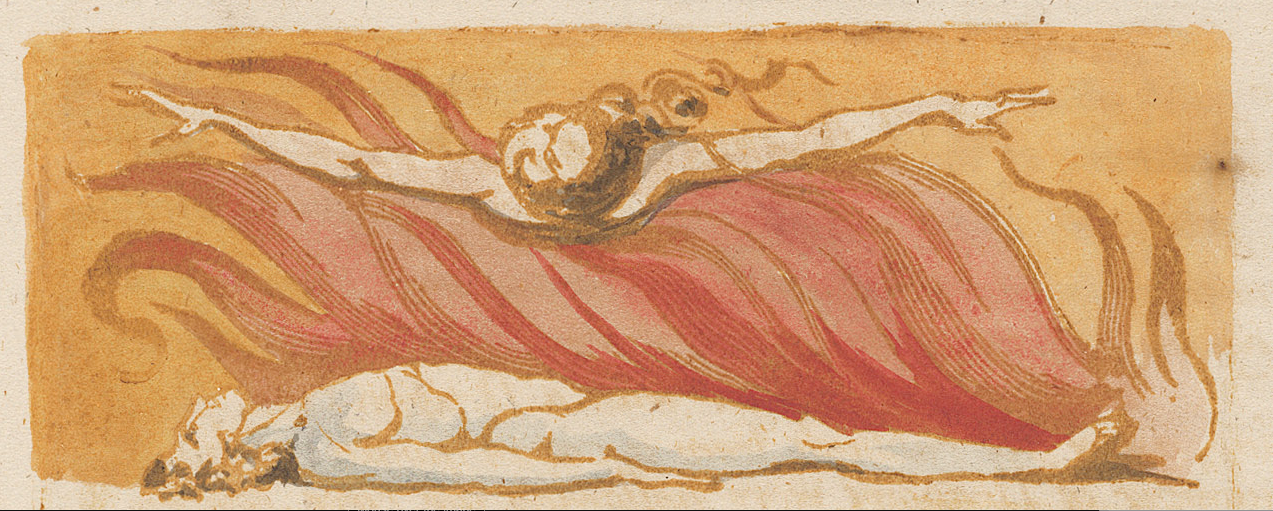
This painting by the poet William Blake is the image I use as the banner image for this blog. The “flaming sword” comes from the story of “the Fall” in Genesis three, which I’ll quote below; I’ll also quote from Blake and from George Fox.
The image
But Blake’s painting is hardly directly representational, as we’ll see from the Genesis passage.
- There are flames but no sword or gate into Paradise.
- The cherub is oddly presented and is human, or at least humanoid, in form, whereas cherubim are variously described in the Bible and other ancient mythologies, but always in some composite and mostly animal form. The cherubim that sit atop the ark of the covenant at least have wings.
- The human, presumably Adam, is supine, laid out almost as though he is dead. He has fallen.
Genesis 3:22–24:
And Yahweh God said, Behold, the man is become as one of us, to know good and evil; and now, lest he put forth his hand, and take also of the tree of life, and eat, and live forever:
Therefore Yahweh God sent him forth from the garden of Eden, to till the ground from whence he was taken.
So he drove out the man, and he placed at the east of the garden of Eden Cherubim, and a flaming sword which turned every way, to keep the way of the tree of life.
Comment
So the cherubim’s charge is to keep humans from reentering Paradise, eating from the tree of life, and becoming immortal. Yahweh and his angelic court (the “us” in the quote) are worried that humans will become like them. And we are already halfway there, having learned good and evil.
Blake’s blanket of flames and the outstretched arms of the cherub block the laid out Adam from rising.
Blake’s text
This image accompanies a page in Blake’s “The Marriage of Heaven and Hell”, one of his prophetic books, which is mostly text as captions for a series of paintings with a poem prologue. The poet presents himself as having descending into Hell and come back with prophecy that will reconcile heaven and hell. Here’s the text on that page. Note that Blake has given us here a significant phrase.
The ancient tradition that the world will be consumed in fire at the end of six thousand years is true, as I have heard from Hell.
For the cherub with his flaming sword is hereby commanded to leave his guard at tree of life; and when he does, the whole creation will be consumed and appear infinite and holy, whereas it now appears finite & corrupt.
This will come to pass by an improvement of sensual enjoyment.
But first the notion that man has a body distinct from his soul is to be expunged; this I shall do by printing in the infernal method, by corrosives, which in Hell are salutary and medicinal, melting apparent surfaces away, and displaying the infinite which was hid.
If the doors of perception were cleansed every thing would appear to man as it is, infinite.
For man has closed himself up, till he sees all things thro’ narrow chinks of his cavern.
George Fox
This image, these texts, together build an astonishing set of figures, both visual and theological, a kind of theological koan, a reality that seeks to transcend our either/or. But I used the image as a banner for my blog because of George Fox’s account of one of his visions. Here’s that passage from his journal:
Now I was come up in spirit through the flaming sword into the paradise of God. All things were new, and all the creation gave another smell unto me than before, beyond what words can utter. I knew nothing but pureness, and innocency, and righteousness, being renewed up into the image of God by Christ Jesus, so that I say I was come up to the state of Adam which he was in before he fell. The creation was opened to me, and it was showed me how all things had their names given them according to their nature and virtue. And I was at a stand in my mind whether I should practice physic [medicine] for the good of mankind, seeing the nature and virtues of the creatures were so opened to me by the Lord. But I was immediately taken up in spirit, to see into another or more steadfast state than Adam’s in innocency, even into a state in Christ Jesus, that should never fall. And the Lord showed me that such as were faithful to him in the power and light of Christ, should come into that state in which Adam was before he fell, in which the admirable works of the creation, and the virtues thereof, may be known, through the openings of that divine Word of wisdom and power by which they were made. [John 1:3] Great things did the Lord lead me into, and wonderful depths were opened unto me, beyond what can by words be declared; but as people come into subjection to the spirit of God, and grow up in the image and power of the Almighty, they may receive the Word of wisdom, that opens all things, and come to know the hidden unity in the Eternal Being. [Journal, Nickalls edition, page 27–28]
Fox claims to have made it past the guardian cherubim and the flaming sword back into Paradise. He says he came “up in spirit through the flaming sword.” He ascended through the flames into Paradise, just as the supine Adam in Blake’s painting would have to do. And the first thing that happens to him is Blake’s “improvement of sensual enjoyment”: Fox’s sense of smell became transcendentally acute.
And he was “renewed up into the image of God”. He was restored to the condition of Adam before the Fall, including the wisdom with which Adam named all the animals from mystical insight into their true nature—the doors of his perception were cleansed. [Check out Bob Dylan’s wonderful song Man Gave Names To All The Animals.] And Fox ate of the tree of life, though he does not describe it this way—through Christ he attained eternal life.
The Hope of Our Worship
November 30, 2025 § 1 Comment
What do we hope for when we gather in our expectant silence?
Fellowship in the spirit, to know each other in that which is transcendental.
Some peace, a little respite from the troubles of the world.
Inner renewal, refreshment of spirit that we can take with us when we go back into the world.
Communion with a Spirit of Love and Truth, a Teacher and Guide who can lead us as we walk in the world.
And a deeper holy communion with a Presence in the midst, a Mystery Reality that gathers us into unity and love and gratitude.
Many Lighted Candles
November 22, 2025 § Leave a comment
In his Apology, Robert Barclay offers a lovely metaphor for the gathered meeting (page 280 in Dean Freiday’s modern translation):
He [God] also causes the inward life to be more abundant when his children are diligent in assembling together to wait upon him. . . . The mere sight of each other’s faces when two persons are gathered inwardly into the life gives occasion for that life to rise secretly and pass from vessel to vessel. Many lighted candles, when gathered together in a single place, greatly augment each other’s light and make it shine more brilliantly. In the same way, when many are gathered together into the same life, there is more of the glory of God. Each individual receives greater refreshment, because he partakes not only of the light and life that has been raised in him, but in the others as well.
With his description of the life rising secretly and passing from vessel to vessel, Barclay is describing the transcendental, psychic dimension of the gathered meeting. By “secretly”, I think he means invisibly, without a tangible mode of communication or transference, and inwardly, coming to abide within each of us as vessels. And I suspect that he means the image of many candles augmenting the light in the same transcendental way.
But we can carry the candle metaphor further. The tangible reality of many candles in a real meeting room augments the light by revealing many areas that would be in shadow with fewer candles. One candle would cast many shadows in the room. But the more candles you add, the more of these shadow regions in the room become illuminated.
In this way, the metaphor obviously applies to vocal ministry, in which the Spirit can work through more vessels, more life stories, knowledge, and experiences, more perspectives, more openings into truth, and more faithfulness, to illuminate the shadows in each other’s hearts.
But the worshippers also bring these qualities with them into the silence, as well as into their ministry, to animate and shape the transcendental dimension of the gathered meeting. This is more of a mystery. How do the inward unspoken qualities of the worshippers give the gathered meeting its energy and joy? How do their intentions and focus and spiritual yearnings bring the Life into the gathering? And what provides the medium through which this Life flows from vessel to vessel?
A subject for another post.
Hellenistic Religion
November 16, 2025 § Leave a comment
I’ve been reading Hellenistic Religions: The Age of Syncretism, edited by Frederick C. Grant and published in 1953. It’s a collection of primary sources from the time of Alexander the Great’s conquest of Persia in 331 BCE until Octavian’s defeat of Antony and Cleopatra in 31 BCE, and then through the early Roman empire, which he calls the Hellenistic-Roman period. We tend to forget that Christianity is, then, also a Hellenistic religion, especially as Paul was a Hellenistic figure himself and the ultimate syncretist.
Grant offers brief introductions to his categorizations of these sources and to the individual texts themselves. These are personal accounts of encounters with gods, instructions from a donor patron for the establishment and maintenance of a new shrine, accounts of and instructions on how to petition an oracle, and so on.
They reveal that pagans were having experiences and talking about the gods in ways that are quite similar to our own experience and language in some ways, and especially to those of their Christian contemporaries. Here’s an example, the account of a healing told by a man named Philadelphus by the god Asclepius written by Aelius Aristides, a Greek author and orator, 117–181 CE:
“This is what Philadelphus dreamed. ‘What happened to me was as follows: I dreamed that I stood in the entrance to the sanctuary, where also some other people were gathered, as at the time of the sacrifice for purification; they wore white garments and were otherwise festively garbed. Then I spoke about the god and named him, among other things, Distributor of Destiny, since he assigns to men their fate. The expression came to me out of my own personal experience. Then I told about the potion of wormwood, which had somehow been revealed to me [in a previous account in Aristides’s work cited by Grant]. The revelation was unquestionable, just as in a thousand other instances the epiphany of the god was felt with absolute certainty. You have a sense of contact with him, and are aware of his arrival in a state of mind intermediate between sleep and waking; you try to look up and are afraid to, lest before you see him he shall have vanished; you sharpen your ears and listen, half in dream and half awake; your hair stands up, tears of joy roll down, a proud kind of modesty fills your breast. How can anyone really describe this experience in words? If one belongs to the initiated, he will know about it and recognize it.’”
This account is so vivid, so personal. I have felt exactly like this myself. One can imagine Paul feeling like this in his visions, too. Or Jesus himself.
Aristides’s account goes on to describe how this wormwood treatment (wormwood is a poison) worked for Philadelphus, as did other odd cultic instructions later involving mud and running. One thinks of Jesus spitting into dirt and putting it on a blind man’s eyes.

