
Quaker-pocalypse—Advancement: Outreach & Inreach
July 17, 2015 § 2 Comments
Outreach and Inreach
Quaker renewal depends on “advancement”, on advancing Quakerism—reaching people who hunger for what we have to offer, but haven’t found us yet, and being ready for them when they come. Thus there is both an outreach and an inreach dimension to Quaker advancement.
A lot of the posts in this Quaker-pocalypse series so far have been about inreach, the project of deepening the spiritual life of the meeting into maturity so that we are ready when seekers come.
But now I want to turn to outreach. Or really, to the bridge we must inevitably build between the two—how we present our faith and practice to these seekers when they ask—what do Quakers believe?
For very often, this is the first thing seekers ask us.
When people ask us this question, we often stumble in our answer. We often start with a bunch of disclaimers about how diverse our theologies are, and how we can’t really speak for all Friends, and really, I can only speak for myself . . .
Then we are likely to start by saying that we believe that there is that of God in everyone—which isn’t true! “We” don’t believe this; only some liberal Friends do. And, while it may be true that many, or even most, liberal Friends believe there is that of God in everyone, this turns what George Fox meant by this phrase on its head and has only been used by us this way since Rufus Jones started it around the turn of the twentieth century.
And anyway, just what does it mean to say that there is that of God in everyone? What does “that of” mean? What do we mean by “God” when we use the word this way? And how do we know there is that of God in other people? Are all of the Friends who profess a belief in “that of God” in other people so psychic that they have actually experienced the “that of God” in someone else? Or do we just believe it because we believe it of ourselves?
After perching all 350 years of our exceedingly rich, centuries-old tradition on this one slender, 100-year-old notional pedestal, we then go on to say, maybe, that we believe in “the testimonies”. But we don’t “believe in” the testimonies; we hold them as truths that have been consistently revealed to us over the centuries, but what we “believe in” is the guiding and strengthening power of the Light and a G*d who breaks into the community’s life with new truth about how to live when we turn toward the Light in our individual and collective discernment.
We need more of an answer than this when people ask us what we believe. What canst we say?
I have been working on an answer to this question of what we believe for decades. I received an answer in 1991 and I’ve been trying to refine it ever since. I now have several versions, and I want to publish them here, but most are quite long, so I will have to publish them as downloadable pdf files. And, as usual, now that I look at them again after some time away, I find I have some things to add and some things to change, so they’re not ready yet.
My latest effort, however, is fairly short and designed to be easier to read online. I will publish it next. But first, I want to provide a resource, a set of links to how various Quaker organizations present the essentials of Quaker faith and practice.
Various Quaker answers to the question, what do we believe?
- Friends General Conference offers a general introduction to Quakerism and videos.
- Friends United Meeting offers a set of Frequently Asked Questions.
- Evangelical Friends Church International gives us an evangelical Quaker answer.
- Philadelphia Yearly Meeting has a fairly well developed and attractively presented section on the Quaker way.
- New England Yearly Meeting also has a Frequently Asked Questions approach.
- Ohio Yearly Meeting offers a simple Conservative Friends perspective.
- Friends World Committee for Consultation offers an introduction to the kinds of Friends around the world.
- QuakerSpeak.org features videos on dozens of Quaker topics.
Quaker-pocalypse—Advancement & Ministry
June 17, 2015 § 3 Comments
When a meeting recognizes the gifts of its members and helps its members mature into their spiritual lives, the meeting matures in its collective religious life. This manifests in deep meetings for worship, spirit-led discernment in meetings for business in worship, effective pastoral care, a loving and resilient fellowship, grounded and focused social witness, and well-managed property and finances.
Newcomers can sense this vitality, even though the sources of it may not be very visible. Even less visible, oftentimes, are the ministries that flourish in a meeting. But they, too, give a meeting a vitality that true seekers after the divine will recognize: here, they will say to themselves, God truly is at work.
Gifts of the spirit and gifts in ministry—almost the same thing. Ministries often arise from one’s gifts—but not always. Both are given by the Holy Spirit. Both are given to the community and to the world but entrusted to individuals.
Because the gifts of ministry are given to the community, the community has a responsibility for them. If meetings do not recognize emerging ministries, they throw the gift away. If meetings do not give ministers help with discerning their leadings, they may lose the gift. And if meetings do not give ministers the support and oversight they need to be faithful to their call, meetings trample on the gifts. These are sins against the spirit.
Because the gifts of ministry are entrusted to individual Friends, the ministers also have responsibilities. If Friends do not bring their gifts in ministry and their leadings to their meeting, they deny their meeting the grace of the spirit. If Friends do not seek help with discernment, they may misunderstand their call. And if Friends do not seek support for their ministry if they need it, the gift may be squandered, or lost, or tangled in the obstacles that arise.
Do our meetings welcome the gifts of ministry that are given to us in the Spirit? And do our meetings and members live the faith and practice of Quaker ministry as an essential aspect of our corporate and individual religious lives?
Queries for our meetings
Recognizing ministry. Does your meeting know the faith and practice of Quaker ministry? Do you teach it often enough so that all members and attenders, and especially newcomers, have a chance to learn it, as well? Does your meeting encourage members to share their leadings and ministries with the meeting, providing both opportunities to share, and an open and visible structure for welcoming leadings? Are your members thinking about the gifts they have as spirit-led? Would a member of your meeting who has a leading recognize it as such? Are they in the habit of thinking about the interests they have in witness or service activities or whatever, within the meeting or in their everyday lives, as possible leadings from the Spirit into Quaker ministry?
Discerning leadings. Does your meeting know how to conduct a clearness committee for discernment of leadings? Does your meeting understand the difference between a clearness committee for discernment and clearness committees for membership, marriage, and making personal decisions, in terms of how the people are chosen and how the committees are conducted? Or does your meeting have some other process for helping ministers with the discernment of their leadings?
Supporting ministry. Does your meeting have a structure and processes in place for supporting the leadings of your members? Would a Friend with a leading know where to go with their leading? Does your meeting know how to form a care committee for its ministers? Is your meeting prepared to provide oversight as well as support, ready, for instance, to help a Friend discover when they have run past their guide, or have stepped through the traces * , or when they have been released from their call? Does your meeting know how to write a minute for travel or service in ministry?
Releasing ministry. In the elder days, when a Friend traveled in the ministry, members of their meeting helped run their farm or their store in their absence. This was called releasing ministry. When your meeting writes a minute for travel or service, do you also inquire into what obstacles may hinder the minister’s ability answer the call and then see what you can do to remove these obstacles? Are you familiar with ReleasingMinistry.org, a new independent Quaker initiative to support Quaker ministry?
* “Step through the traces.” This is a phrase from the elder days of Quaker ministry and refers to a draught horse getting its legs tangled in the tackle—the traces—by which it pulls a wagon. Thus it means to get tangled up in the pursuit of your ministry, making mistakes, failing to walk in the paths of Christ’s leading.
What are Spiritual Gifts?
June 13, 2015 § 2 Comments
When I started writing the queries for a previous post that meetings might use to examine and deepen their understanding of spiritual gifts and of their nurture, I realized that some meetings might not be very clear about what spiritual gifts are, or at least, about what I mean by spiritual gifts. Then I realized that I needed to be more clear myself. So I revisited some of the thinking I’ve done on gifts of the spirit for workshops I’ve done that apply Paul’s discussions of gifts of the spirit to Quaker needs.
I think we have two ways to categorize spiritual gifts. The first is according to the character of the giving. The second, adapted from the writings of Paul, is according to how they manifest.
What are spiritual gifts—in terms of how they are given?
Innate gifts. Some spiritual gifts seem to be innate and personal. Such spiritual gifts are talents, inclinations, and experience that give shape and direction to one’s spiritual life and/or that are useful in service to the religious community and in the wider world. An example is the gift of studiousness, or the love of learning, which often is paired with the gift of teaching; another is the gifts of money management, another—being good with your hands. Of course, we can think of even innate gifts as Spirit-given.
Gifts of the Spirit. Subtly different are “gifts of the Spirit”, as Paul calls them, manifestations of the Spirit that arise in a person independently of the person’s more innate gifts. “To each is given the manifestation of the Spirit for the common good,” writes Paul in 1 Corinthians 12:7. The signature example of a Spirit-given gift is the opening that prompts vocal ministry in meeting for worship.
Spirit-nurtured gifts. Somewhere in between lie the majority of gifts, I think, gifts that arise from some apparently innate attribute but that have clearly been nurtured into maturity by the Holy Spirit and by the person holding the gift. In this group, I would include the gift of hospitality, of making people feel welcome and at home, the gift of teaching, which might arise from the more innate gift of studiousness, and the gift of healing, which in many healers starts as an innate inclination toward and gift for caring for others, but which the person holding the gift has developed by learning the healing arts.
What are gifts of the spirit—in terms of how they manifest?
Paul offers us two categories of spiritual gifts, according to how they manifest: gifts of speaking, and gifts of serving. And I would add a third as I see them described in Paul’s letters—gifts as signs.
I’m not sure how useful these categories are, especially since Paul does not mention a lot of the gifts that we find at work among us today. But I do think it’s useful to list and describe gifts of the spirit, so that Friends recognize them in their members and attenders. Below is my list and descriptions, as I see them manifesting among Friends. Where I have found them in the letters of Paul, I have indicated this. The letters I am referring to are 1 Corinthians 12–14, Romans 12, and Ephesians 4 *.
Naming spiritual gifts.
A tentative list of spiritual gifts and their descriptions:
| Vocal ministry | Someone who feels called to vocal ministry, whose ministry consistently lifts up the meeting and speaks often to the inner needs and lives of the members, not necessarily just someone who speaks often in meeting. Also manifesting any time in any Friend who brings us spirit-led ministry. In Paul’s letter, the gift of prophecy. |
| Preaching | Someone whose gift of vocal ministry manifests at times in sustained spirit-led ministry that draws the meeting into a deeper understanding of and feeling for the life of the spirit; whose ministry would seem to violate the frequent recommendation to make your message brief, except that the sermon does speak to someone’s condition, or to the meeting’s condition. Among liberal Friends, “preach” is often considered a four letter word, though, of course, programmed meetings know full well that preaching is a spiritual gift. I think it depends entirely on whether a sermon is Spirit-led, and I am certain that the Holy Spirit does sometimes take longer than “brief” to say what needs saying—and that Friends should not quench that Spirit by invoking a convention found in books or out of some fear that “preaching” necessarily means some form of preachiness. Paul: evangelism, exhortation |
| Prayer | Someone who through vocal prayer (praying out loud in meeting for worship) can often draw others into true communion with the Divine. Also manifesting at any time in any Friend moved by the Holy Spirit into prayer. It is worth noting that William Penn said in his introduction to George Fox’s Journal that Fox’s greatest gift was the gift of prayer. This gift is almost completely extinct among liberal Friends. The gift of prayer is not in Paul. |
| Discernment | Someone who often sees to the heart of matters, understands what a person or the meeting needs in a given situation, or finds solutions to problems. Someone with a gift for clerking and/or recording. Also manifesting any time in any Friend who leads us to the Truth. Paul: discerning spirits. |
| Eldership | Someone who recognizes spiritual gifts in others and seeks ways to nurture these gifts into maturity and support them when they blossom into active ministry; who recommends books or conferences to Friends who show an interest in the Quaker way; who recognizes newly emerging ministry and ministers and encourages it or them; someone who finds themselves holding the meeting in prayer, or who finds fulfillment in serving as a companion to a minister in their service or their travels in the ministry; someone who recognizes walking that disturbs the spiritual welfare of someone’s own self, or that of others, or of the meeting as a community, and who seeks ways to restore gospel order, to bring affairs back into the Light. Also manifesting at any time in any Friend as the divinely inspired ability to teach, lead, and correct the members of the meeting out of one’s own experience of Christ’s inward transformation. Paul: exhortation, direction. |
| Pastoral care | Someone who by nature keeps track of people who need care and often sees that they get the care they need. These Friends often are employed in the secular church, as social workers, therapists, doctors, etc. Also manifesting any time in any Friend who finds herself or himself knowing just what to say or do to meet someone’s needs. Paul: pastors, helping, showing mercy. |
| Teaching | Someone whose knowledge and passion for a subject manifest as a desire, even a need, to share it. Also manifesting any time in any Friend who finds herself or himself sharing what they know in response to someone else’s desire to know. Paul: teaching. |
| Hospitality | Someone who has a way of making people feel welcome and at home in the meeting, or who consistently feels led to organize fellowship gatherings, who brings food to the meeting, and/or who likes to greet newcomers. Not found in Paul. |
| Prophecy | Someone who brings to an individual, or to the meeting, or to the Religious Society of Friends, or to the wider society a message of correction, and/or the inspiration to take a new direction, manifesting at any time in any Friend. Paul: prophecy. |
| Witness | Someone who carries a concern for bettering the world, for building the kingdom of the Spirit on earth, often with a focus on some specific concern, manifesting at any time in any Friend as a leading into witness ministry. Not found in Paul. (One of Paul’s great failures was his spiritualization of the gospel of Jesus and his abandonment of the world to its suffering, turning instead to evangelizing the world to his gospel as its cure.) |
| Serving | Someone who finds spiritual fulfillment in service to the meeting community, or to the wider community. Also manifesting at any time in any Friend who takes up a task of service. Often manifesting in combination with the gifts of leadership, administration, hospitality, and financial or property management. Paul: serving. |
| Leadership | Someone who, out of the gift of serving, also gets things done, who knows how to organize things effectively and leads by serving example. Paul: leadership. |
| Financial management | Someone who, by natural inclination and through life experience, knows how to manage money matters and, through the gift of serving, brings this gift to the meeting. Paul: leadership. |
| Contribution | Anyone who supports the meeting financially out of the promptings of the Holy Spirit, or who responds with generosity of treasure and spirit to someone’s financial or other material need. Paul: contributing. |
| Property management | Someone who, by natural inclination and through life experience, knows how to manage and take care of property and, through the gift of serving, brings this gift to the meeting. Not in Paul. |
| Healing | Someone who, through natural inclination and acquired life experience, brings the healing arts to the meeting and to the world, often but not necessarily manifesting in a healing vocation. Also manifesting at any time in any Friend as spirit-led ministry that alleviates suffering. Paul: Healing. |
| Faith | Someone whose faith is so deep and so manifest in their lives that it lifts others up into a stronger sense of God’s presence in their lives. Also manifesting any time in any Friend whose faith, in the moment, turns others toward the Light, or the Presence in our midst, or toward the divine wish for the community’s direction. Paul: faith. |
| Miracles | Manifesting at any time through any Friend as the Holy Spirit bringing about the utterly unexpected and seemingly impossible outcome. Paul: miracles. |
* Once, when I was leading an exercise in naming spiritual gifts and started discussing Paul, a woman asked why we should bother with Paul—and I had to agree that we didn’t have to look to Paul as an authority. Taken aback in the moment, I could only answer that I did not feel responsible to the tradition, but that I did feel responsible for it, that, even when we decide to lay down some aspect of our tradition, we should know what that tradition is and we should leave part of our tradition behind only in spirit-led discernment, not through ignorance or unconsidered drift of purpose and identity.
In the instance of gifts of the spirit, I actually find Paul useful, maybe even spirit-led. In general, I don’t like Paul. I think he hijacked the gospel of Jesus. In abandoning all aspects of Torah, he gutted Jesus’ teachings, especially those about the kingdom of God. And, of course, he drifted away from Jesus’ egalitarian treatment and respect for women, especially as he got older.
But Paul was a religious genius and he was not always wrong about everything. And his treatment of the gifts of the spirit are brilliant. His famous passage about love in 1 Corinthians 13 is sandwiched in between two discourses on the gifts of the spirit in chapters 12 and 14, and this hymn to love is an integral part of his understanding of the place of spiritual gifts in the life of the community. His metaphor of the body for the relative importance of the various spiritual gifts is also a profound opening.
Finally, he did, after all, give us a pretty good list of spiritual gifts as a starting point. It’s hard to figure out what some of them mean, and some come clear only after some study, not just of Paul’s letters but also importantly, of the structure and practices of the early Christian church. His gifts of serving, for instance (leadership, helping, contributing, having mercy), mostly define roles in the church’s social welfare system, its mechanisms for taking care of the poor.
Therefore, because I feel responsible for our tradition, I indicate when one of the gifts I name here appears in Paul’s discussions of gifts. But I’m not going to go any farther than that with Paul’s list in this post. One of these days, I will write the monograph for which I have extensive notes on Paul’s gifts of the spirit.
Quaker-pocalypse—Spiritual Nurture & Advancement
June 3, 2015 § 6 Comments
If we want to reverse our decline and fulfill our calling in the world, our meetings need to enjoy a vital religious life. In recent posts, I have offered queries for meetings to assess how well they are doing in the areas of worship and fellowship. People coming to a meeting for the first time or for the first few times will first experience the quality of the worship and its vocal ministry and get a first impression of the community, so these two aspects of meeting life impact the growth or decline of a meeting directly.
Spiritual nurture for individuals and families has a less direct impact on meeting growth because it takes a while for newcomers to experience and appreciate whatever efforts a meeting makes to recognize and nurture the members’ spiritual gifts and their ministry, and the meeting’s religious education programs for youth and adults.
I fear, however, that most of our meetings do not try to name our members’ spiritual gifts or nurture them in any proactive way. Too often we are left to our own devices when it comes to maturing in the life of the spirit. As a result, the collective life of the spirit, the spiritual maturity of the meeting, suffers. So, when people come to our meeting for the first time or for a handful of times, is there a there there?
I believe that recognizing and nurturing spiritual gifts is an absolute essential for a vital meeting’s religious life. If, as I said in my series on What is Quakerism for?, our mission as meetings is to bring people to God and God into the world, why would we leave our members and attenders on their own in finding God, in finding a personal spiritual practice that works for them (spiritual formation *)? And why would we deny our meetings the blessings of a membership that is confident and mature in its gifts and equipped to serve the meeting and the waiting world with their gifts’ unfolding?
We are not without resources. Several yearly meetings have spiritual nurture or spiritual formation programs, we have the School of the Spirit, and we have our conference centers that hopefully have programs along these lines. And even if meetings do not have anyone with substantive experience in spiritual nurture and spiritual formation, the meeting still has some good options. But first we have to ask ourselves some questions.
Recognizing and Nurturing Spiritual Gifts
- Does your meeting have a list in its collective head of spiritual gifts, so that you would recognize them when you saw them? (I plan a subsequent post or series of posts in which I provide such a list and some context for understanding them, using the gifts of the spirit in Paul’s letters (Romans 12, 1 Corinthians 12 and 14, and Ephesians 4) as a starting point.)
- Does your meeting do anything to help its members and attenders recognize their own gifts in the spirit? Does your ministry committee take the time to discuss the gifts of each member and attender with an eye to how they might be nurtured?
- Or do you leave this task to nominating committee? Does your nominating committee go beyond just its charge to fill slots in the roster with people who who have a gift in a certain area, to recognize where some gifts may lie unrecognized or unexpressed because there is no committee for that gift, and to help Friends recognize and grow their gifts, regardless of whether they choose to bring those gifts to a committee in service?
- Do your other committees think in terms of the gifts that the Friends who serve on them bring? In addition to the tasks involved in the committee’s charge, do your committees take time to be laboratories for the exploration of the gifts of its members, to name those gifts, and to be nurturing gardens in which the gifts of the committee’s members may grow, regardless of whether they directly serve the tasks laid upon the committee?
- Does your meeting record gifts in ministry, or do anything else to collectively name and recognize your members’ spiritual gifts for the meeting? Or do you have members who fear that somehow recognizing gifts in ministry elevates the minister in ways that violate the testimony of equality? If this fear does prevail in your meeting, then why? Do you have direct, concrete experience of harmful exaltation of recognized ministers? If this fear does not come from direct experience, then where does it come from?
- Does anyone or any committee in your meeting proactively watch for emerging gifts and emerging ministries, so that you are ready to serve as an elder or mentor when you see them?
- Has your meeting considered helping someone in the meeting to attend the School of the Spirit or some other spiritual formation program or conference?
- Does your meeting invite members to share their spiritual practice, either in an open discussion gathering or, in the case of Friends who have some experience or a personal practice of some kind, in a more formal teaching mode? Does you meeting know of Friends outside the meeting with these skills that you could invite in?
- If you think your meeting lacks the resources to do some of these things, have you considered hosting a study group that reads books on spiritual formation together? The books that come to my mind are Richard Foster’s Celebration of Discipline, Patricia Loring’s two volume Listening Spirituality; anything written by William Taber or Lloyd Lee Wilson; Martha Paxson Grundy’s Tall Poppies: Supporting Gifts of Ministry and Eldering in the Monthly Meeting, a Pendle Hill Pamphlet. I have not read the following books, but they are available from QuakerBooks.org and they look promising: Connecting with God: A Spiritual Formation Guide, by Lynda Graybeal and Julia Roller; Light to Live By: An Exploration in Quaker Spirituality, by Rex Ambler; Living the Way: Quaker Spirituality and Community, by Ursula-Jane O’Shea.
* Spiritual nurture and spiritual formation
Readers may not be clear what I mean by “spiritual formation” and what the difference is between spiritual formation and spiritual nurture. By spiritual nurture, I mean anything that fosters a deeper spiritual life. By spiritual formation I mean programs to impart a spiritual practice, or, in the broader sense, an organized effort to help Friends find the spiritual practice that works for them.
Quaker-pocalypse—Advancement: Fellowship
May 24, 2015 § 3 Comments
When newcomers come to a meeting, the first thing they encounter is the culture of the meeting, the way it feels and the way it operates. Even if they go directly into the meeting room, even here they are surrounded by the unspoken assumptions and agreements about identity, behavior, and relationship that comprise a community’s fellowship.
But hopefully, they don’t get a chance to go directly to the meeting room (unless that’s what they want to do) because someone has greeted them at the door and then the greeter and the rest of the Friends in the gathering space offer them the meeting’s hospitality.
If we want our meetings to grow, we must be warm, welcoming, and interested in new people. Fellowship is the second item under “a vital religious life” in my list of the three essentials for Quaker advancement.
Hospitality. Is your community warm and welcoming to all? Do you have greeters who meet newcomers at the door on First Day and help them find their way into worship, mentally, emotionally, and physically? Do all the members take responsibility for making newcomers feel welcome, well informed, and comfortable, not just when they first come in the door, but also after worship, and when they return, if they do?
Inclusiveness. How homogenous is your meeting population and are people of all races, all classes, all sexual orientations, and all cultural styles welcome in your meeting? Is your meetinghouse accessible? Is your bathroom? Do you have equipment for the hearing impaired? Do you welcome children into your worship?
Pastoral care. Do the Friends charged with pastoral care in your meeting feel confident in their roles and responsibilities? If not, how can you help them? Does your meeting regularly encourage the members and attenders to come to the pastoral care committee with their concerns and do members know whom to approach? Are you prepared with a network of mental health and other professionals who can give your committee advice or to whom they can refer Friends when the concern seems too deep or difficult for the committee, or seems to require professional attention?
Membership. Is there any meaningful difference between being a member and being an attender of your meeting? Is your meeting clear about what membership in your meeting means and what it expects from its members? Are your clearness committees for membership clear about these things? Is it easy for attenders to find out what membership means in your meeting, what the meeting expects from them, and how to apply for membership? Does your meeting think of membership as a covenant, as a set of mutual promises and responsibilities in which members expect to contribute to the spiritual and material life of the meeting and in which members invite the meeting to proactively engage with their spiritual lives? Or is your meeting too afraid to intrude to be proactive in its spiritual nurture and/or do your members consider their religious lives to be a completely private domain in which the meeting has no business?
Willingness to change. New people bring new energy to the meeting, energy that might change the culture of your meeting. Does your meeting reflexively resist change? Is your meeting overly attached to the way your meeting “feels” today and its unspoken assumptions and agreements?
Eldering authority and mandate. Does someone in your meeting have clear authority and a clear mandate to protect your fellowship from inappropriate behavior? Are you and they clear about what “inappropriate behavior” deserves attention? Do these Friends feel equipped to act with some confidence when needed?
Conflict. Does your meeting forthrightly address conflict when it arises in the meeting? Do you have members who are not attending because of some conflict with the meeting or with other members? If they have left because of some difficult person, is that person still attending? (If your meeting has lost even one member because of a disruptive person, you might as well have lost the disruptive person.) Does your meeting seek outside help if it finds it too difficult to deal with a conflict on its own? Is your quarterly or regional meeting and/or your yearly meeting prepared to respond to such a request for intervention with people who have the gift of mediation and with resources? (See the video and other resources available from New York Yearly Meeting’s Conflict Transformation Committee.)
Emotional blackmail. Do you let members hold the meeting hostage with their emotions, threatening to leave or to do something else if the meeting does “x” or doesn’t do “y”, especially in meeting for worship with attention to the life of the meeting?
Quaker-pocalypse—Advancement and Worship
May 23, 2015 § 2 Comments
In my first post on Quaker-pocalypse and Advancement, I said that, to advance Quakerism we needed three things: a vital religious life, a message, and vehicles for outreach. The first item under a vital religious life was worship. Here are some queries designed for meetings to assess how they are doing with worship, to plum what is the experience of people who come into your worship—newcomers, attenders, and members.
Worship
The gathered meeting
- The one solid indicator of a vital worship life, of worship that offers “true communion with God”, is an occasional gathered meeting for worship. When was the last time your meeting was gathered in the Spirit? What are the chances that someone who comes to your meeting a few times over a few months would experience a gathered meeting? Do you talk about the gathered meeting, especially with attenders who may not yet have experienced one?
Attitudes toward worship
- Do you know what the members of your meeting think of your meeting’s worship and its vocal ministry? Would you consider conducting an anonymous survey to determine how your members and attenders feel? Would your meeting act if you found out that a meaningful percentage of Friends were unsatisfied with some aspect of the worship?
Vocal ministry
- Ministry and the Spirit. Do you think your meeting’s vocal ministry is mostly spirit-led? Does your meeting do anything to explain the conventions around vocal ministry to attenders and new members, or are they left to figure it out for themselves? Does your meeting offer members opportunities to share their experience of vocal ministry, or to learn about vocal ministry?
- Calling. Does your meeting have people who seem to be called to vocal ministry? Not just Friends who speak quite often, but Friends for whom this seems to be a calling, who take the calling seriously, and whose ministry is pretty consistently spiritually deep and edifying? Is your meeting recognizing their gifts? Is your meeting engaged with these Friends, offering them support for their ministry, if they want it?
- Christian vocal ministry. Are Christian, biblical, and even gospel ministry welcome in your meeting? Are they common? If not (in either case), why not? Do you agree that we are a Christian religion, even if many or even most of the members are not Christians in their own experience?
Eldering
- Authority and mandate. Does someone in your meeting (your ministry committee?) have clear authority and a clear mandate to protect your worship from inappropriate behavior? Are you and they clear about what “inappropriate behavior” deserves attention? Do these Friends feel equipped to act with some confidence when needed?
“Logistics”
- Noise. Do Friends socialize right outside the meeting room door up to and even past the beginning time for meeting? Can you reroute the conversation to some other location?
- Tardiness. Do Friends consistently enter the meeting room late? How late? Have you considered holding latecomers at the door and then letting them in together? Would that feel even more disruptive?
- Seating. Did you know that the most effective way to foster a gathered meeting, after loving one another, is to sit close together? * And that the most effective way to obstruct a gathered meeting, after letting conflict go unaddressed, is to sit far apart? Does your meeting room allow Friends to sit far away from each other? Would you consider reconfiguring the meeting room so that Friends are near each other when they worship? (I personally believe that the human aura is the primary medium for the psychic sharing that one experiences in a gathered meeting for worship; pure conjecture, of course.)
- Afterthoughts. Do you have “afterthoughts” after meeting and, if so, have you reconsidered their usefulness recently? I personally suspect that afterthoughts distort the vocal ministry, but I think it’s basically impossible to know how they distort it. The fact that afterthoughts might have some unknown feedback effect on the ministry is reason enough to discontinue the practice, in my opinion.
- Announcements. Have you considered moving announcements to the social room and social time after meeting for worship, especially if you are a large meeting with many announcements? My meeting actually has a small PA system for this in the social room, so that it’s easy to interrupt conversation and do the announcements.
* These ideas come from a State of the Meeting Report of New York Yearly Meeting some time in the early 1990s. The Yearly Meeting sends queries to the local meetings for them to use in writing their state of the meeting reports, and the state of the meeting reports are used to write the Yearly Meeting’s State of the Society Report. The queries that year had to do with the gathered meeting:
- How do you define a gathered meeting?
- How often do you experience a gathered meeting?
- How do you know when a meeting is gathered?
- What fosters a gathered meeting and what hinders a gathered meeting?
The most often occurring answers to number four were sitting close together and sitting far apart.
Quaker-pocalypse—Advancement
May 16, 2015 § 2 Comments
In my first post in this series I listed among the signs of Quaker decline the steady decline in our membership. This has been going on for decades. We keep dying off. And most of our kids, though they often retain a Quaker identity (when asked what religion they are, they are likely to answer “Quaker”), most still do not remain active in a Quaker meeting when they become adults. And these two forces consistently outstrip our rates of convincement of new members in many of our meetings.
The intuitive response to this problem is more and better outreach—letting the world know who we are in a way that might encourage seekers to check us out. I like the broader rubric that New York Yearly Meeting uses for this aspect of meeting life—advancement. Advancement includes all efforts to advance Quakerism, and this includes “in-reach” efforts as well as outreach. For, to grow our membership, we have to actually have something valuable waiting for these seekers when they do finally find us.
But, while advancement in this broader sense is important, I don’t think growing our membership ought to be our primary goal. Our goal as meetings should be to bring people to God and to bring God into the world, not so much to bring people to Quakerism and make Quakerism more visible in the world.
Nevertheless, we do have something uniquely spiritually valuable to offer people in this age, for those people anyway who want a shared path, a tradition, a community—a religion—as their way to commune with the divine and channel their desires and efforts to heal the hurts of the world.
So, to do this—to advance Quakerism—we need three things:
- A vital religious life—we need the goods:
- worship that offers true communion with God,
- fellowship that is welcoming and caring, and
- spiritual nurture for individuals and families, including
- recognition of spiritual gifts,
- support for ministry,
- religious education for adults, and
- a First Day School, or readiness to provide some religious education for children on the spot if a family comes.
- A message—we need a clear, truthful, articulate message:
- a confident, simple, but not dumbed-down answer to who we are, what we “believe”, and what we offer; and
- a vision of a world rightly ordered in God’s shalom.
- Vehicles for outreach:
- a decent website (doesn’t have to be great),
- a social media presence, not necessarily very active, but with proper attention having been paid to the social media platform profiles, so that when seekers land there, they can actually find out who and where you are;
- a listing in the web portal(s) for churches in your area;
- a sign at the street, well lit at night, big enough, and readable at the speed limit;
- parking—clear indications on the website and at the street as to where to park;
- witness engagement, as led, in your neighborhood, your municipality, your region;
- a modest, consistent advertising presence.
So the next questions are:
- Have I missed anything?
- Does your meeting have all these elements in place?
- If not, do you agree that you should?
- What about that last one—advertising: do you agree that you should be advertising your meeting, and if so, what media would you use?
In the next post, I plan to unpack each of the items above a little bit with queries.
Quaker-pocalypse—Radical Witness and Real Renewal
April 15, 2015 § 6 Comments
In his message to a consultation on spiritual deepening sponsored by Friends General Conference*, Simon Best challenged the claims made by a slogan that’s fairly common among Friends: “Quakers: Simple. Radical. Contemporary.” Simon claims that we are none of these things. With some qualifications, I agree with Simon Best. But in this post I want to focus on our claim to be radical, and in particular, to be radical in our witness.
I feel that we would be more honest to say “A liberal witness.”
Liberal witness
We organize our social witness into committees organized around a concern. In this we share the fragmented and compartmentalized worldview of the rest of Western Civilization: we tend break our social problems into categories, isolating and analyzing specific social ills and addressing them individually with targeted programs and efforts. Thus we have a peace concerns committee, an earthcare committee, a prisons committee, and so on. This is a classically liberal approach, understood in the broad political-philosophical sense. This is how our schools, our governments, our businesses, our nonprofits—and our liberal religious communities—operate: break down our problems to their parts and deal with them individually.
Continuing this fragmentation of our witness worldview, liberal action for political and social change very often relies on an analysis of a social ill using the tools of the social sciences and the rhetoric of “rights” borrowed from liberal political thinking. Then it formulates solutions for that ill and develops programs to implement the solutions. Thus the majority of witness minutes I see these days coming out of Quaker meetings are almost wholly secular in nature: you could read them and never know that a religious organization had written them, let alone a Quaker one. They may have an ethical argument, but they often do not have a moral argument. It’s all facts, statistics, and reasonable argument.
For liberal social action is reasonable. Quaker liberalism in particular tends not to be confrontational. For a liberal is someone who takes his or her political rhetoric and action up to—but rarely past—the point at which it threatens the liberal’s own status quo. Like approving a minute.
Liberal social action tends to be respectful, too, if not even a bit deferential. The liberal impulse in witness and outreach seeks not to turn away a seeker who might be made uncomfortable by un-reasonable words and actions, or to seem to disrespect the people with whom we disagree.
This is not radical, and I question whether it is the path to renewal. I believe that radical is the path to renewal.
Radical witness
Radical witness is holistic, addressing the roots of social ills. Radical witness is not necessarily reasonable. The radical prophet often speaks before she envisions a solution, envisioning instead the reign of God—the way things should be—and leaving the “program”, the way to get there, in God’s hands. And radical witness entails risk. Radical witness is like the Lamb’s War.
But most important, and like the apocalypse of the Word that drove us in the 1650s, radical Quaker witness is faithful to divine prophetic leading. For this is the real root of faithful Quaker witness—the promptings of the Holy Spirit. And the Pentecostal flame could lead you just about anywhere. It might even lead you through the liberal analysis-solution-program paradigm. But then you would be there because G*d had led you there, not because you had unconsciously adopted the ways of the world, even the valuable ways of secular social justice nonprofits.
Or it might lead you into a new Lamb’s War. In May of 2014, I began a series on the new Lamb’s War (which I have yet to fully develop**), and in the second post, I wrote: “To be meaningful and effective today, Quaker witness must present a real and present danger to the evildoers of the world. Yet the threat must represent a Third Way—not the violence of the oppressor or the violence of the resister, but the emergence of the Truth, meaning a presentation of a truth that is not merely inconvenient but that makes you squirm under its Light, a truth that burns away the shadows, the lies and denials, the fears and the greed that are driving us toward eco-Armaggedon.”
What, today, is our spirit-given radical truth? To which powers would we speak this truth? In what words would we proclaim our truth? In what spirit would we conduct our witness?
It is the Spirit of Love and Truth that will renew Quakerism. But renewing Quakerism isn’t really the goal. The goal is to bring people to God, to the light within them, and to bring God into the world. The world needs a truly prophetic people, not a lukewarm and sometimes pathetically liberal people.
Full disclosure here, though: I am not much of a radical myself. I often feel like the rich ruler in Luke (Matthew 19:16-29) who, when told by Jesus to “Sell all that you own and distribute the money to the poor . . . then come, follow me”, became sad and walked away. I know that I let the constraints I feel upon my life limit my responsiveness to the promptings of the Spirit. Still, I try to embrace our listening spirituality and to be faithful to the degree that I am able.
For I believe that the path to Quaker prophecy lies in the faith and practice of Quaker ministry—in the faith that each one of us can and will be called into service, and the practice of listening for that call and answering it, as individuals, and of listening for that call and supporting it, as meetings. All the “radical” witness for which we like to take credit in our history began with some Friend feeling led to act by the Holy Spirit.
Quaker spirituality is the root of radical Quaker witness.
Thus, I implore Quaker witness committees to look to our spiritual foundation when crafting minutes of conscience, to explain to the audiences of these minutes the religious foundation for our actions, to use the powerful moral arguments we own as a tradition when arguing our case, and not just the thinking and language of social science and secular social justice nonprofits—and to reclaim the social gospel of Jesus.
All of our testimonies arise in human hearts at the prompting of the Holy Spirit, but each of them also has a root in early Friends’ reading of Christian scripture. This is the language of our tradition, of our current culture, and of the false Christian idolators who worship the bombs bursting in air, the bloated feeling of the great god Mammon, and the lust for power over others that characterize the American empire today. But Jesus was a liberationist, an enemy of empire, and his Truth should be our sword.
We should turn toward his light. We should root our radical witness in that Spirit of Love and Truth. We should temper our hearts with divine love—and we should loudly proclaim G*d’s liberating truth.
To do that our meetings need to foster a religious culture in which our members and attenders are turning toward the light within them for the inspiration to change the world, and turning toward meetings that are fully equipped to give these emerging prophets the discernment and support they need. For some part of the world does bend toward justice, and we should be ahead of that curve.
* You can view a pdf of Simon Best’s article “The Religious Society of Friends in Britain: Simple, Contemporary, Radical?” in The Friend; or view the piece published by FGC, “Making Quakerism Available, Teachable, and Experienential”. They are not quite the same. I also mentioned it in my March 14, 2015 post, “Quaker-pocalypse—Making Quakerism Available, Teachable, and Experiential”.
A New Lamb’s War: Here are links to the posts in the New Lamb’s War series:
Quaker-pocalypse: Quaker Spirituality & Renewal—Light & Seed
March 20, 2015 § Leave a comment
I have said a number of times in this blog that I believe the faith and practice of Quaker ministry is the heart or soul of Quaker spirituality—
the faith that we all are called to a direct relationship with G*d, that each one of us can be, and will be, called to serve divine purpose; and
the practice of always listening for that call in holy expectation and submission, seeking always to be open to the promptings of the Holy Spirit, to live a life unencumbered enough to faithfully answer the call when it comes, and then to live our lives as testimony to the truth we have been given.
After reading Doug Gwyn’s A Sustainable Life: Quaker Faith and Practice in the Renewal of Creation (a terrific book I highly recommend), I have discovered that I have been only half right. There really are two vectors, two directions of transformation, in Quaker spirituality, and I have only been focused on the one that begins within and reaches out into the world. I had not paid attention to the one that begins “without”, so to speak, that begins at the surface of our lives and our selves and pierces down into the darkness within us to transform us inwardly, to make of us a new creation. I have always been skittish about salvation.
In A Sustainable Life, Doug Gwyn gives us the two central metaphors for these processes in the writings of Fox and other early Friends: Light and Seed. Each has a classic injunction in early Quaker writings:
Stand still in the Light.
Sink down in the Seed.
Now, I would say that to stand still in the Light is the soul of Quaker spirituality, the path to the transformation—the salvation—of our identity before G*d—our soul. That is, it is the path to our true self as transformed and led by the Holy Spirit.
Now, I would say that to sink down in the Seed is the heart of Quaker spirituality, the path to living rightly (righteously) in the world—of walking cheerfully over the world (that is, so as to uplift it) answering that of God in those around us and in the whole creation. That is, living so as to bring into the world the transformation, the salvation, we have found for ourselves, working to build the kingdom (reign, if you will—this is gender neutral) of G*d on earth.
As Gwyn puts it:
Seed and light are two aspects of the same reality. Seed language is more about being and willing, light is more about knowing and doing. Both light and seed are words for God’s presence with us – in Hebrew, Emmanuel – not only for our own redemption into wholeness/holiness, but also in order that we may become agents of healing wholeness to others, in society and throughout the creation. (p. xxv)
Just as physical light has the qualities of both a particle and a wave, so “that of God” in each of us manifests in these two ways. Quaker faith and practice is lived in the dynamic relationship between light and seed, between knowing and being, between insight and action. What the light reveals to us changes the quality of our being. The seed of a new creation is “raised up” in us. We feel compelled to act differently. Likewise, as we begin to act differently, the light reveals more truth to us. We continue to grow in this dynamic interaction. Meanwhile, this new creation is grounded in the old creation. We embody it in our natural bodies. Coming into the light in a focused way replays the dawn of creation. Light and darkness are separated (Gen. 1:3-4), and the true path forward becomes clear. Likewise, as we live into that truth, a new life with a new will grows in us. (p. 2-3)
Stand still in the light.
So first, in the crucible of Quaker spirituality, one seeks redemption. One stands still in the light.
To “stand still” means not to run. To surrender to its penetrating revelation of your shadow self and its desires, even though your soul wants to hide, to scuttle back into the darkness. This is hard. It is a kind of crucifixion, what Friends used to call a “cross to the will”.
Fox explains how this spirituality works:
Whatever ye are addicted to, the Tempter will come in that thing and when he can trouble you, then he gets advantage over you, and then ye are gone. Stand still in that which is pure, after ye see yourselves, and then mercy comes in. After thou sees thy thoughts, and the temptation, do not think, but submit, and then power comes. Stand still in that which shows and discovers, and there doth strength immediately come. And stand still in the Light, and submit to it, and the other will be hushed and gone; and then content[ment] comes. . . . And earthly reason will tell you what ye shall lose. Hearken not to that, but stand still in the Light, that shows them to you and then strength comes from the Lord, and help, contrary to your expectation. Then ye grow up in peace, and no trouble shall move you. (Gwyn, p. 6; Fox, Works, vol. 7, pp.20-21)
This is the Quaker spirituality of individual transformation, of salvation, of “perfection”, becoming the person we were meant to be. And it comes with a promise: that it works, that with our submission comes the transformation we seek and the strength to see it through.
This is a unique and powerful message that we can offer the world. This is good news indeed. Quaker renewal rests in boldly and prophetically proclaiming this good news.
Of course, we must do it ourselves. And most of us are. Maybe we haven’t articulated it for ourselves in this way. But many Friends instinctively turn toward the light within when troubled. Fox and Gwyn, and now I, have only passed on a vocabulary for this central aspect of Quaker spirituality.
Sink down in the Seed.
As Gwyn points out, the great theologian of the Seed was not Fox but Isaac Penington:
Be no more than God hath made thee. Give over thine own willing; give over thine own running; give over thine own desiring to know or to be any thing, and sink down in the seed which God sows in the heart, and let that grow in thee, and be in thee, and breathe in thee and act in thee, and thou shalt find by sweet experience that the Lord knows that, and loves and owns that, and will lead it to the inheritance of life, which is his portion. And as thou takest up the cross to thyself, and sufferest that to overspread and become a yoke over thee, thou shalt become renewed, and enjoy life, and the everlasting inheritance in that. (Gwyn, p. 8; Penington, “Some Directions to the Panting Soul” in Works, vol. 2, pa. 205)
As Gwyn comments, “. . . language like “cross to thyself” and “a yoke over thee” may make some want to draw back. But it is only the true life within that we are submitting to. It is a cross in that we must abandon our sense of control and self-possession. It is a yoke in that we learn to will and to serve a love that is greater than our own.” (Gwyn, p. 8)
If we do submit, we are bound to receive a call. There is work to do, and Quakerism is, properly practiced, a prophetic religion. That is, it names the wrongs and the evils that Truth has revealed, it speaks truth to power (“and what thou speakest, is it inwardly from God?”), and the motion of love impels us into the world to mend it.
Individual ministers will be called. But so will the community be called. As Doug Gwyn puts it:
“. . . to be drawn into Quaker faith and practice today is to respond at some deep level to a calling into peoplehood. [emphasis is Gwyn’s] Of course, participation in a Friends meeting should satisfy personal needs and desires. But that is not the real goal or meaning of faith and practice. It is the far greater venture of placing one’s own gifts, insights, and worth at the disposal of a group, which in turn places itself at the disposal of divine imponderable purposes in the world. . . . Worship is literally “worth-ship.” . . . Thus, each person’s unique worthiness finds its greatest worth through the group and its consecration to God. (Gwyn, p. 24)
But to be a gathered people under the leadership of the Holy Spirit is to enter into a covenant of Light. Just as the individual must stand still in the Light to be renewed, so the meeting must stand still in the Light to be rightly guided by the Guide. The light will reveal our shadows as a community just as it does for us a individuals. And when it does, we likewise must stand still in that light to be renewed. That is, we must worship. We must let the Light worth-shape us, reshape us in divine purpose.
This is the Quaker spirituality of collective transformation and prophetic action, of becoming the gathered people we were meant to be.
This is a unique and powerful message that we can offer the world. This is good news indeed. Quaker renewal rests in boldly and prophetically proclaiming this good news.
Of course, we must do it ourselves. Our meetings must enter truly into worship and into divine fellowship. We must listen for the call, which will come from our members as they feel called by their own Teacher. And we must be ready to take up the yoke collectively when asked.
Queries
Do we as individuals practice the spirituality of standing still in the Light? Are we ready to be transformed into children of the Light?
Do we as meetings stand still in the Light, seeking divine communion in the gathered meeting?
Do we as individuals practice the spirituality of sinking down in the Seed? Are we ready to be broken open to reveal a new self, one called, equipped, and excited to help heal the world’s wounds?
Do we as meetings stand ready to give our ministers the help with discernment, support, and oversight that they will need in their healing work? Are we in unity as a community about our prophetic calling as Friends?
Quaker-pocalypse—”Making Quakerism Available, Teachable, and Experiential”
March 14, 2015 § 1 Comment
I have just finished reading Simon Best’s fantastic presentation to Friends General Conferences’s consultation on spiritual deepening, and think so highly of it that I want my readers to know about it.
Download the presentation—click this link to download a pdf file of his remarks. You can also visit FGC’s web page on the consultation, but they offer very little more information on the consultation or the presentation. And here is a report of the consultation’s small breakout groups on various topics considered at the consultation.
Right here, I want to include an excerpt that really caught my attention. For one thing, it speaks directly to me as the communications director of New York Yearly Meeting, since his comments below address the very “motto” New York Yearly Meeting uses on its website, albeit slightly altered from the version he refers to used by Minneapolis Friends Meeting. NYYM’s website motto is “A simple faith. A radical witness.” Here’s that excerpt:
Many of you will have seen the slogan that has been used by meetings in both Britain and the US:
When I first saw the posters I thought it was brilliant. A week later I was having a Meeting for Worship with four other Friends, all of us aged about 30, in a basement flat in Bristol and realised that it wasn’t brilliant and it wasn’t even true. Before and since I have become increasingly aware that the Religious Society of Friends is not simple, it is not radical, and it is certainly not contemporary.
We are not simple. We have complex organisations, not just at the centre but at all levels. Meetings are struggling with bureaucracy and as a result placing large demands on the personal time, commitment and energy of members, and drawing this away from growing our meetings spiritually.
We are not contemporary, while I believe strongly that Quakers have a message for today the way it is presented does not fit with the society in which we live.
We are not radical, in a time of global crisis we are not overtly counter cultural in our social action and our engagement in the world.
I acknowledge that, of course, there are exceptions but I’m referring to the overall trend of liberal Quakerism. So what can we do to address this and to make the Quaker way highly available, teachable and experiential?
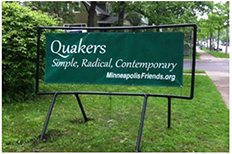
The rest of Simon Best’s presentation goes on to address these questions.
 Through the Flaming Sword