
Mystery
May 22, 2015 § 1 Comment
I woke up this morning with an opening blooming in my mind. I actually had the opening a couple of days ago, and I’ve been circling round it for years, but when my eyes opened this morning, the sun was shining on some petals as they reached toward the light.
At the heart of the liberal Quaker experience lies Mystery.
G*d
My regular readers will know that my operating definition of God is the Mystery Reality behind our spiritual and religious experience—whatever that experience is. This is why I use an asterisk to spell “God”: the asterisk stands in for whatever your experience is. And the asterisk stands in for the Mystery.
We know that our spiritual and religious experience * is real because it has transformed us. Because of it we are healed; we are more whole; we are saved from our sin; we are relieved of some burden or pain or wound; we are inspired; we are more aware; we are more fulfilled; we experience the joy that passes all understanding—something has happened and are we are the better for it.
But it passes understanding. The experience is transcendental—it transcends our normal understanding; or it transcends our five senses; or it transcends the psychic boundaries between people; it transcends normal consciousness. Thus, it is a Mystery. Beyond, or behind, or within what we know and can speak about the experience lies something deeper, something we can only know with the soul, that is, with that part of us that knows this Mystery, that perceives beyond, behind, and within.
That Mystery Reality behind or within our religious experience I call G*d.
Universalism
Part of the genius of liberal Quakerism is that it acknowledges that real religious experience comes in many, many forms, and they are all Real and they are all Mysterious. No one religion or spiritual path has exclusive claim on Truth—and no one is excluded from the Truth. We honor the asterisk.
The truth that every human can commune with the Divine makes the Truth universal without being absolute.
Seeking
Because of the non-absolute universalism of Truth, many liberal Friends describe religion as a journey, as a project of seeking. I have never understood this approach. These Friends would not be Quakers if they had not found something. Ever since George Fox convinced the Seekers on Firbank Fell, Friends have proclaimed what they have found.
But the Mystery remains. We may have found Quakerism and with it a rich tradition that takes weeks to explore just to get through course 101. But still the Mystery draws us forward, seeking—what?
Seeking a name, I think. Seeking an opening into the mystery. Seeking more of the release, joy, and fulfillment that comes from spiritual and religious experience. Seeking deeper immersion in our communion.
Christ Jesus
Fox had a name for what he found—even Christ Jesus.
On the surface, it looks like a huge gap yawns between having a name—especially having that name—and not having a name, any name at all. To someone who knows the Name, whose life is filled by Christ Jesus, it might seem that to experience the Reality and still have a Mystery means that maybe you didn’t experience the Reality after all.
Yet we know that every human can commune with the Divine. That, as mysterious as the religious experience of a Cro-Magnon woman might be to us, nevertheless, Something Was Happening for her that made her more whole.
I think you can make subtle but fairly convincing arguments from Christian scripture for the universal Christ, for why any genuine religious experience could be experience of the Christ. But then you could do the same for Krishna. This is a mystery.
The Bible
Almost all arguments about the nature and the necessity of the Christ come from scripture. Those of us who have experienced Christ personally and directly can speak from our experience, but even these Friends will soon turn to scripture to fill in the details. It is ever so with religious experience. This is one of the roles of a religious tradition, to help its people understand their experience.
The problem with the Bible as authority is that you have to understand it, and everyone takes their own path into it, as is apparently the way with all religious experience. Interpretations abound. I have studied the Bible for decades and I have pretty settled ideas about what a lot of it means. But how do I know I’m right?
The very idea of biblical authority comes from the Bible itself. It’s age, its tone, and its power to transform us confer upon it some real authority. Then there’s 2 Timothy 3:16: “All Scripture is God-breathed and is useful for teaching, rebuking, correcting and training in righteousness, so that the man of God may be thoroughly equipped for every good work.”
So says Paul. But why is Paul an authority? Because he’s in the Bible. The Bible is self-authenticating.
And meanwhile, it’s just wrong about a lot of stuff. And we have changed our minds about some things that it’s pretty clear about, like slavery and the place of women in the church and in the world. And it doesn’t even agree with itself sometimes. And right beside the soaring beauty of its poetry and the healing it can bring, other pages are soaked with blood and horror.
At this point, we remember Margaret Fell’s words:
And so he went on, and said, “That Christ was the Light of the world, and lighteth every man that cometh into the world; and that by this light they might be gathered to God,” &c. I stood up in my pew, and wondered at his doctrine, for I had never heard such before. And then he went on, and opened the scriptures, and said, “The scriptures were the prophets’ words, and Christ’s and the apostles’ words, and what, as they spoke, they enjoyed and possessed, and had it from the Lord”: and said, “Then what had any to do with the scriptures, but as they came to the Spirit that gave them forth? You will say, ‘Christ saith this, and the apostles say this;’ but what canst thou say? Art thou a child of the Light, and hast thou walked in the Light, and what thou speakest, is it inwardly from God?” &c. This opened me so, that it cut me to the heart; and then I saw clearly we were all wrong. So I sat down in my pew again, and cried bitterly: and I cried in my spirit to the Lord, “We are all thieves; we are all thieves; we have taken the scriptures in words, and know nothing of them in ourselves.”
What do we know in ourselves? Are we children of the Light? What is the Light?
These are the real questions, and even when we have answers, mysteries remain.
* “Spiritual” experience. Spiritual experience I define as transcendental experience that transforms us for the better. It transcends normal experience, or normal consciousness, or our normal sensory experience, so that we do not necessarily know where it comes from or even what it means, in its fullness. Yet it is real. We know that it is real because it has changed us in demonstrable ways for the better.
“Religious” experience. Religious experience I define as spiritual experience that takes place in the context of religious community or religious tradition. Either the tradition has led you to the experience, as when you find yourself in a gathered meeting for worship; or you find in a tradition a way to understand your experience, as we do when we speak of that mystery that enables us to commune with G*d directly as the Light.
“Religion”. Religion I define as the spiritual practice of a community. Religion is the things a community does to remember, invoke, and celebrate its communion with its god, the things it does to reconnect with the Mystery Reality that brought it forth as a community of Spirit.
Quaker-pocalypse—Advancement
May 16, 2015 § 2 Comments
In my first post in this series I listed among the signs of Quaker decline the steady decline in our membership. This has been going on for decades. We keep dying off. And most of our kids, though they often retain a Quaker identity (when asked what religion they are, they are likely to answer “Quaker”), most still do not remain active in a Quaker meeting when they become adults. And these two forces consistently outstrip our rates of convincement of new members in many of our meetings.
The intuitive response to this problem is more and better outreach—letting the world know who we are in a way that might encourage seekers to check us out. I like the broader rubric that New York Yearly Meeting uses for this aspect of meeting life—advancement. Advancement includes all efforts to advance Quakerism, and this includes “in-reach” efforts as well as outreach. For, to grow our membership, we have to actually have something valuable waiting for these seekers when they do finally find us.
But, while advancement in this broader sense is important, I don’t think growing our membership ought to be our primary goal. Our goal as meetings should be to bring people to God and to bring God into the world, not so much to bring people to Quakerism and make Quakerism more visible in the world.
Nevertheless, we do have something uniquely spiritually valuable to offer people in this age, for those people anyway who want a shared path, a tradition, a community—a religion—as their way to commune with the divine and channel their desires and efforts to heal the hurts of the world.
So, to do this—to advance Quakerism—we need three things:
- A vital religious life—we need the goods:
- worship that offers true communion with God,
- fellowship that is welcoming and caring, and
- spiritual nurture for individuals and families, including
- recognition of spiritual gifts,
- support for ministry,
- religious education for adults, and
- a First Day School, or readiness to provide some religious education for children on the spot if a family comes.
- A message—we need a clear, truthful, articulate message:
- a confident, simple, but not dumbed-down answer to who we are, what we “believe”, and what we offer; and
- a vision of a world rightly ordered in God’s shalom.
- Vehicles for outreach:
- a decent website (doesn’t have to be great),
- a social media presence, not necessarily very active, but with proper attention having been paid to the social media platform profiles, so that when seekers land there, they can actually find out who and where you are;
- a listing in the web portal(s) for churches in your area;
- a sign at the street, well lit at night, big enough, and readable at the speed limit;
- parking—clear indications on the website and at the street as to where to park;
- witness engagement, as led, in your neighborhood, your municipality, your region;
- a modest, consistent advertising presence.
So the next questions are:
- Have I missed anything?
- Does your meeting have all these elements in place?
- If not, do you agree that you should?
- What about that last one—advertising: do you agree that you should be advertising your meeting, and if so, what media would you use?
In the next post, I plan to unpack each of the items above a little bit with queries.
Quaker-pocalypse—Radical Witness and Real Renewal
April 15, 2015 § 6 Comments
In his message to a consultation on spiritual deepening sponsored by Friends General Conference*, Simon Best challenged the claims made by a slogan that’s fairly common among Friends: “Quakers: Simple. Radical. Contemporary.” Simon claims that we are none of these things. With some qualifications, I agree with Simon Best. But in this post I want to focus on our claim to be radical, and in particular, to be radical in our witness.
I feel that we would be more honest to say “A liberal witness.”
Liberal witness
We organize our social witness into committees organized around a concern. In this we share the fragmented and compartmentalized worldview of the rest of Western Civilization: we tend break our social problems into categories, isolating and analyzing specific social ills and addressing them individually with targeted programs and efforts. Thus we have a peace concerns committee, an earthcare committee, a prisons committee, and so on. This is a classically liberal approach, understood in the broad political-philosophical sense. This is how our schools, our governments, our businesses, our nonprofits—and our liberal religious communities—operate: break down our problems to their parts and deal with them individually.
Continuing this fragmentation of our witness worldview, liberal action for political and social change very often relies on an analysis of a social ill using the tools of the social sciences and the rhetoric of “rights” borrowed from liberal political thinking. Then it formulates solutions for that ill and develops programs to implement the solutions. Thus the majority of witness minutes I see these days coming out of Quaker meetings are almost wholly secular in nature: you could read them and never know that a religious organization had written them, let alone a Quaker one. They may have an ethical argument, but they often do not have a moral argument. It’s all facts, statistics, and reasonable argument.
For liberal social action is reasonable. Quaker liberalism in particular tends not to be confrontational. For a liberal is someone who takes his or her political rhetoric and action up to—but rarely past—the point at which it threatens the liberal’s own status quo. Like approving a minute.
Liberal social action tends to be respectful, too, if not even a bit deferential. The liberal impulse in witness and outreach seeks not to turn away a seeker who might be made uncomfortable by un-reasonable words and actions, or to seem to disrespect the people with whom we disagree.
This is not radical, and I question whether it is the path to renewal. I believe that radical is the path to renewal.
Radical witness
Radical witness is holistic, addressing the roots of social ills. Radical witness is not necessarily reasonable. The radical prophet often speaks before she envisions a solution, envisioning instead the reign of God—the way things should be—and leaving the “program”, the way to get there, in God’s hands. And radical witness entails risk. Radical witness is like the Lamb’s War.
But most important, and like the apocalypse of the Word that drove us in the 1650s, radical Quaker witness is faithful to divine prophetic leading. For this is the real root of faithful Quaker witness—the promptings of the Holy Spirit. And the Pentecostal flame could lead you just about anywhere. It might even lead you through the liberal analysis-solution-program paradigm. But then you would be there because G*d had led you there, not because you had unconsciously adopted the ways of the world, even the valuable ways of secular social justice nonprofits.
Or it might lead you into a new Lamb’s War. In May of 2014, I began a series on the new Lamb’s War (which I have yet to fully develop**), and in the second post, I wrote: “To be meaningful and effective today, Quaker witness must present a real and present danger to the evildoers of the world. Yet the threat must represent a Third Way—not the violence of the oppressor or the violence of the resister, but the emergence of the Truth, meaning a presentation of a truth that is not merely inconvenient but that makes you squirm under its Light, a truth that burns away the shadows, the lies and denials, the fears and the greed that are driving us toward eco-Armaggedon.”
What, today, is our spirit-given radical truth? To which powers would we speak this truth? In what words would we proclaim our truth? In what spirit would we conduct our witness?
It is the Spirit of Love and Truth that will renew Quakerism. But renewing Quakerism isn’t really the goal. The goal is to bring people to God, to the light within them, and to bring God into the world. The world needs a truly prophetic people, not a lukewarm and sometimes pathetically liberal people.
Full disclosure here, though: I am not much of a radical myself. I often feel like the rich ruler in Luke (Matthew 19:16-29) who, when told by Jesus to “Sell all that you own and distribute the money to the poor . . . then come, follow me”, became sad and walked away. I know that I let the constraints I feel upon my life limit my responsiveness to the promptings of the Spirit. Still, I try to embrace our listening spirituality and to be faithful to the degree that I am able.
For I believe that the path to Quaker prophecy lies in the faith and practice of Quaker ministry—in the faith that each one of us can and will be called into service, and the practice of listening for that call and answering it, as individuals, and of listening for that call and supporting it, as meetings. All the “radical” witness for which we like to take credit in our history began with some Friend feeling led to act by the Holy Spirit.
Quaker spirituality is the root of radical Quaker witness.
Thus, I implore Quaker witness committees to look to our spiritual foundation when crafting minutes of conscience, to explain to the audiences of these minutes the religious foundation for our actions, to use the powerful moral arguments we own as a tradition when arguing our case, and not just the thinking and language of social science and secular social justice nonprofits—and to reclaim the social gospel of Jesus.
All of our testimonies arise in human hearts at the prompting of the Holy Spirit, but each of them also has a root in early Friends’ reading of Christian scripture. This is the language of our tradition, of our current culture, and of the false Christian idolators who worship the bombs bursting in air, the bloated feeling of the great god Mammon, and the lust for power over others that characterize the American empire today. But Jesus was a liberationist, an enemy of empire, and his Truth should be our sword.
We should turn toward his light. We should root our radical witness in that Spirit of Love and Truth. We should temper our hearts with divine love—and we should loudly proclaim G*d’s liberating truth.
To do that our meetings need to foster a religious culture in which our members and attenders are turning toward the light within them for the inspiration to change the world, and turning toward meetings that are fully equipped to give these emerging prophets the discernment and support they need. For some part of the world does bend toward justice, and we should be ahead of that curve.
* You can view a pdf of Simon Best’s article “The Religious Society of Friends in Britain: Simple, Contemporary, Radical?” in The Friend; or view the piece published by FGC, “Making Quakerism Available, Teachable, and Experienential”. They are not quite the same. I also mentioned it in my March 14, 2015 post, “Quaker-pocalypse—Making Quakerism Available, Teachable, and Experiential”.
A New Lamb’s War: Here are links to the posts in the New Lamb’s War series:
Quaker-pocalypse: Quaker Spirituality & Renewal—Light & Seed
March 20, 2015 § Leave a comment
I have said a number of times in this blog that I believe the faith and practice of Quaker ministry is the heart or soul of Quaker spirituality—
the faith that we all are called to a direct relationship with G*d, that each one of us can be, and will be, called to serve divine purpose; and
the practice of always listening for that call in holy expectation and submission, seeking always to be open to the promptings of the Holy Spirit, to live a life unencumbered enough to faithfully answer the call when it comes, and then to live our lives as testimony to the truth we have been given.
After reading Doug Gwyn’s A Sustainable Life: Quaker Faith and Practice in the Renewal of Creation (a terrific book I highly recommend), I have discovered that I have been only half right. There really are two vectors, two directions of transformation, in Quaker spirituality, and I have only been focused on the one that begins within and reaches out into the world. I had not paid attention to the one that begins “without”, so to speak, that begins at the surface of our lives and our selves and pierces down into the darkness within us to transform us inwardly, to make of us a new creation. I have always been skittish about salvation.
In A Sustainable Life, Doug Gwyn gives us the two central metaphors for these processes in the writings of Fox and other early Friends: Light and Seed. Each has a classic injunction in early Quaker writings:
Stand still in the Light.
Sink down in the Seed.
Now, I would say that to stand still in the Light is the soul of Quaker spirituality, the path to the transformation—the salvation—of our identity before G*d—our soul. That is, it is the path to our true self as transformed and led by the Holy Spirit.
Now, I would say that to sink down in the Seed is the heart of Quaker spirituality, the path to living rightly (righteously) in the world—of walking cheerfully over the world (that is, so as to uplift it) answering that of God in those around us and in the whole creation. That is, living so as to bring into the world the transformation, the salvation, we have found for ourselves, working to build the kingdom (reign, if you will—this is gender neutral) of G*d on earth.
As Gwyn puts it:
Seed and light are two aspects of the same reality. Seed language is more about being and willing, light is more about knowing and doing. Both light and seed are words for God’s presence with us – in Hebrew, Emmanuel – not only for our own redemption into wholeness/holiness, but also in order that we may become agents of healing wholeness to others, in society and throughout the creation. (p. xxv)
Just as physical light has the qualities of both a particle and a wave, so “that of God” in each of us manifests in these two ways. Quaker faith and practice is lived in the dynamic relationship between light and seed, between knowing and being, between insight and action. What the light reveals to us changes the quality of our being. The seed of a new creation is “raised up” in us. We feel compelled to act differently. Likewise, as we begin to act differently, the light reveals more truth to us. We continue to grow in this dynamic interaction. Meanwhile, this new creation is grounded in the old creation. We embody it in our natural bodies. Coming into the light in a focused way replays the dawn of creation. Light and darkness are separated (Gen. 1:3-4), and the true path forward becomes clear. Likewise, as we live into that truth, a new life with a new will grows in us. (p. 2-3)
Stand still in the light.
So first, in the crucible of Quaker spirituality, one seeks redemption. One stands still in the light.
To “stand still” means not to run. To surrender to its penetrating revelation of your shadow self and its desires, even though your soul wants to hide, to scuttle back into the darkness. This is hard. It is a kind of crucifixion, what Friends used to call a “cross to the will”.
Fox explains how this spirituality works:
Whatever ye are addicted to, the Tempter will come in that thing and when he can trouble you, then he gets advantage over you, and then ye are gone. Stand still in that which is pure, after ye see yourselves, and then mercy comes in. After thou sees thy thoughts, and the temptation, do not think, but submit, and then power comes. Stand still in that which shows and discovers, and there doth strength immediately come. And stand still in the Light, and submit to it, and the other will be hushed and gone; and then content[ment] comes. . . . And earthly reason will tell you what ye shall lose. Hearken not to that, but stand still in the Light, that shows them to you and then strength comes from the Lord, and help, contrary to your expectation. Then ye grow up in peace, and no trouble shall move you. (Gwyn, p. 6; Fox, Works, vol. 7, pp.20-21)
This is the Quaker spirituality of individual transformation, of salvation, of “perfection”, becoming the person we were meant to be. And it comes with a promise: that it works, that with our submission comes the transformation we seek and the strength to see it through.
This is a unique and powerful message that we can offer the world. This is good news indeed. Quaker renewal rests in boldly and prophetically proclaiming this good news.
Of course, we must do it ourselves. And most of us are. Maybe we haven’t articulated it for ourselves in this way. But many Friends instinctively turn toward the light within when troubled. Fox and Gwyn, and now I, have only passed on a vocabulary for this central aspect of Quaker spirituality.
Sink down in the Seed.
As Gwyn points out, the great theologian of the Seed was not Fox but Isaac Penington:
Be no more than God hath made thee. Give over thine own willing; give over thine own running; give over thine own desiring to know or to be any thing, and sink down in the seed which God sows in the heart, and let that grow in thee, and be in thee, and breathe in thee and act in thee, and thou shalt find by sweet experience that the Lord knows that, and loves and owns that, and will lead it to the inheritance of life, which is his portion. And as thou takest up the cross to thyself, and sufferest that to overspread and become a yoke over thee, thou shalt become renewed, and enjoy life, and the everlasting inheritance in that. (Gwyn, p. 8; Penington, “Some Directions to the Panting Soul” in Works, vol. 2, pa. 205)
As Gwyn comments, “. . . language like “cross to thyself” and “a yoke over thee” may make some want to draw back. But it is only the true life within that we are submitting to. It is a cross in that we must abandon our sense of control and self-possession. It is a yoke in that we learn to will and to serve a love that is greater than our own.” (Gwyn, p. 8)
If we do submit, we are bound to receive a call. There is work to do, and Quakerism is, properly practiced, a prophetic religion. That is, it names the wrongs and the evils that Truth has revealed, it speaks truth to power (“and what thou speakest, is it inwardly from God?”), and the motion of love impels us into the world to mend it.
Individual ministers will be called. But so will the community be called. As Doug Gwyn puts it:
“. . . to be drawn into Quaker faith and practice today is to respond at some deep level to a calling into peoplehood. [emphasis is Gwyn’s] Of course, participation in a Friends meeting should satisfy personal needs and desires. But that is not the real goal or meaning of faith and practice. It is the far greater venture of placing one’s own gifts, insights, and worth at the disposal of a group, which in turn places itself at the disposal of divine imponderable purposes in the world. . . . Worship is literally “worth-ship.” . . . Thus, each person’s unique worthiness finds its greatest worth through the group and its consecration to God. (Gwyn, p. 24)
But to be a gathered people under the leadership of the Holy Spirit is to enter into a covenant of Light. Just as the individual must stand still in the Light to be renewed, so the meeting must stand still in the Light to be rightly guided by the Guide. The light will reveal our shadows as a community just as it does for us a individuals. And when it does, we likewise must stand still in that light to be renewed. That is, we must worship. We must let the Light worth-shape us, reshape us in divine purpose.
This is the Quaker spirituality of collective transformation and prophetic action, of becoming the gathered people we were meant to be.
This is a unique and powerful message that we can offer the world. This is good news indeed. Quaker renewal rests in boldly and prophetically proclaiming this good news.
Of course, we must do it ourselves. Our meetings must enter truly into worship and into divine fellowship. We must listen for the call, which will come from our members as they feel called by their own Teacher. And we must be ready to take up the yoke collectively when asked.
Queries
Do we as individuals practice the spirituality of standing still in the Light? Are we ready to be transformed into children of the Light?
Do we as meetings stand still in the Light, seeking divine communion in the gathered meeting?
Do we as individuals practice the spirituality of sinking down in the Seed? Are we ready to be broken open to reveal a new self, one called, equipped, and excited to help heal the world’s wounds?
Do we as meetings stand ready to give our ministers the help with discernment, support, and oversight that they will need in their healing work? Are we in unity as a community about our prophetic calling as Friends?
Quaker-pocalypse—”Making Quakerism Available, Teachable, and Experiential”
March 14, 2015 § 1 Comment
I have just finished reading Simon Best’s fantastic presentation to Friends General Conferences’s consultation on spiritual deepening, and think so highly of it that I want my readers to know about it.
Download the presentation—click this link to download a pdf file of his remarks. You can also visit FGC’s web page on the consultation, but they offer very little more information on the consultation or the presentation. And here is a report of the consultation’s small breakout groups on various topics considered at the consultation.
Right here, I want to include an excerpt that really caught my attention. For one thing, it speaks directly to me as the communications director of New York Yearly Meeting, since his comments below address the very “motto” New York Yearly Meeting uses on its website, albeit slightly altered from the version he refers to used by Minneapolis Friends Meeting. NYYM’s website motto is “A simple faith. A radical witness.” Here’s that excerpt:
Many of you will have seen the slogan that has been used by meetings in both Britain and the US:
When I first saw the posters I thought it was brilliant. A week later I was having a Meeting for Worship with four other Friends, all of us aged about 30, in a basement flat in Bristol and realised that it wasn’t brilliant and it wasn’t even true. Before and since I have become increasingly aware that the Religious Society of Friends is not simple, it is not radical, and it is certainly not contemporary.
We are not simple. We have complex organisations, not just at the centre but at all levels. Meetings are struggling with bureaucracy and as a result placing large demands on the personal time, commitment and energy of members, and drawing this away from growing our meetings spiritually.
We are not contemporary, while I believe strongly that Quakers have a message for today the way it is presented does not fit with the society in which we live.
We are not radical, in a time of global crisis we are not overtly counter cultural in our social action and our engagement in the world.
I acknowledge that, of course, there are exceptions but I’m referring to the overall trend of liberal Quakerism. So what can we do to address this and to make the Quaker way highly available, teachable and experiential?
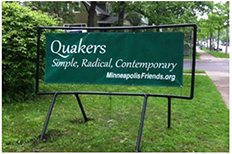
The rest of Simon Best’s presentation goes on to address these questions.
On vocal ministry
March 7, 2015 § 4 Comments
A f/Friend of mine is preparing for a program she will lead in her meeting on vocal ministry and the email she sent me about it evoked a response that I ended up feeling worthy of sharing more broadly. She asked about Afterthoughts as a practice common in many meetings. And then her questions and thoughts got down to the essential thing about vocal ministry: discernment. Here is a revised version my response.
I think Afterthoughts do affect the vocal ministry in a meeting once it has become a settled practice. But one little “study” I found on this practice a while back suggested that it’s really hard to tell what that effect is.
My own feeling, not well cemented, is that it does feed back into worship and tends to lower the bar for vocal ministry. The reason is that one is hard put to tell the difference between messages in worship from messages in Afterthoughts; I rarely see any very noticeable difference in spiritual depth between the best afterthoughts and the average message in meeting.
I think this is subtly confusing to people. I say subtly because I doubt they consciously feel confused. Rather, I suspect that the inability to clearly identify truly spirit-led ministry in either case reinforces the feeling that simply “heart-felt” is enough in meeting for worship, and that “truly spirit-led” is either some mythical condition rarely achieved, or is as common as an inspiring thought.
In other words, I think Afterthoughts are a bad idea. I would make the meeting for worship the crucible for discernment that it is intended to be.
For I agree that the real issue is discernment: how do you tell whether your message is truly spirit-led? It’s not easy.
But I think the negative is, in fact, much easier: I think it’s a lot easier to tell when a message is NOT spirit-led. Here are some indicators that I think raise a flag of caution right away:
- Messages that begin with an allusion or reference to some medium. For instance, “I was reading in the New York Times …” Or “I recently saw the movie American Sniper, and …” “I heard a piece on NPR …”
- Messages that begin with a reference to time: “A few days ago, I was in a drug store when …” “Recently, I’ve been …” “Lately, …”
- Messages that start with “I” and then proceed to recount a personal anecdote: All of the above serve as examples. Or, especially: “I’ve been thinking …”
- Announcements. NEVER as vocal ministry, no matter how important we think it is for others to know about something.
Such messages are always uplifting. But they feel to me like what I call “nuggets I have found on my spiritual journey”. The sharing is good, the message is good. But I often feel that the speaker did not go deep enough to really uncover the truth revealed in the incident, or discipline her or himself enough to deliver just the truth itself without the introductory story. Buried in the outward casing of the anecdote, the truth is left to glimmer weakly somewhere in the inward center. Of course, you can get to the center by starting from the outward. But the self of the speaker and the body, the content, of the story, I believe, tend to draw the listeners upward and outward into the world, rather than inward and downward toward the spiritual depths we each have within us. We follow that story and drift upwards as we do; even the speaker necessarily gets drawn upward and outward and away into the past and the memory of the event as she speaks. Then we get handed a chocolate–only to have to begin deepening again.
I have two other things on my mind regarding vocal ministry. The first is that I would love to recover the sense of calling to what we Friends used to call gospel ministry, back when we recorded ministers. By this I mean, adapted to our modern times, the emergence of a Quaker culture in which some Friends would recognize that they are called to vocal ministry as a ministry; that is, that they feel, not just that they are led in the moment to rise and speak now and then, but that they have been tapped by G*d to follow an ongoing ministry; that they have a sense of mission about vocal ministry. And correspondingly—and this is the culture part—that the meeting feels the same way. That the meeting as a community recognizes that some people really do have a gift for vocal ministry; that the meeting also realizes that such a calling bears a very heavy responsibility, for which the meeting has a responsibility itself. I feel that meetings should do more to help emerging vocal ministers find their feet and then give them ongoing support and—yes—oversight as they mature in their calling.
I feel such a calling myself, and have always longed for a meeting that would be more conscious and deliberate in working with me around whatever gift I have. To be fair, I have asked for such attention only once, but that was not a good experience, and it shied me off. I need to regain some courage there.
The final thing is a deep theological one: where does vocal ministry come from? Most liberal Friends today just are not comfortable thinking that vocal ministry comes from God. First, they’re not sure what we might mean by “God”, but the traditional theistic, supreme being version is a bit hard to deal with. I don’t “believe in” a supreme being myself; it just doesn’t make sense to me and I have no experience of such a thing. I would argue, in fact, that direct experience of a supreme being is by definition impossible.
So if vocal ministry does not come from God—or from Christ, as Friends have claimed for centuries until fairly recently—where does it come from? I think most of us are likely to grope toward that old cliche, “that of God in everyone” as an answer, if we try at all. This has the subtle but extremely powerful effect of individualizing vocal ministry: my message comes from inside me, and I can’t really articulate what the more-than-just-me inside me is, so—well, I guess my messages just come from me. Thus we call them “messages” or “speaking in meeting” instead of “vocal ministry”, that is, service to God and to the meeting through the divine gift of prophecy.
There is a mystery here. Vocal ministry does come from within one’s self. And even if it is truly spirit-led, that is, if it really does come from some kind of higher power greater than myself, whatever that might be, it still comes into me and then out through me. Naming the transcendental source has, for liberal Friends, become nearly impossible.
And maybe we don’t need to name it. But I do believe that we need to acknowledge it. I believe there is a transcendental mystery to truly spirit-led vocal ministry, and immersion in that prophetic mystery and submission to its authority is our goal as vocal ministers. And collectively, I believe that if our meetings took the transcendental, divinely-inspired character of true vocal ministry more seriously, we would enjoy increasingly deep worship.
For myself, as an operating principle I behave as though vocal ministry comes from the spirit of Christ. I have no direct experience of Christ as my guide in this way, so I don’t call myself a Christian. But I find it helpful to sort of assume that leadings come from that spirit of love and truth, because it keeps me on the up and up. It makes me a lot more serious about what I’m doing. And anyway, Friends have been testifying to the truth of Christ as our guide and gatherer in worship for centuries. I have chosen to not just respect but actually embrace their testimony for myself as a tentative article of faith until my own experience clears things up—while remaining clear that I am holding this idea in a rather artificial way. It’s become experimental, but not yet experiential.
Quaker-pocalypse: Spiritual Lukewarmness & Spiritual Formation
March 7, 2015 § 8 Comments
Note: My dear readers, I’ve been away for a while—had a knee replaced and have only just been finding the time to focus clearly on this blog. (I am recovering well.) Thanks for your patience.
Also, this post is very long—too long, really, but I didn’t want to chop it up into pieces. So I’ve made it available as a pdf file, since I hope some Friends and meetings might find it useful in that format. Click the following to download Quaker-pocalypse: Spiritual Lukewarmness & Spiritual Formation.
Spiritual lukewarmness
I know your works; you are neither cold nor hot. I wish that you were either cold or hot. (Revelation 3:15)
In my original post on Quaker-pocalypse, I listed among the signs of our decline, the decline of personal and family devotional life, shallowness in the meeting for worship, and a corresponding infrequency of gathered meetings for worship. In a phrase—spiritual lukewarmness: The meeting feels good; nobody is really unhappy. Nobody is really going anywhere, spiritually, either. No one—or too few—are on fire with the holy spirit. Nobody can remember when the last gathered meeting was. Some Friends aren’t really sure what that even means. But members do enjoy a precious sense of contentment that is hard to find in the world. This certainly is sweet.
However, Quaker renewal needs more. Mere contentment leads to continued decline, if only through the attrition brought on by the passing of our elders. Renewal needs a pentecost, an in-breaking of the holy spirit. And a pentecost needs minds and hearts and souls prepared.
Spiritual formation
In my earlier series on What is Quakerism for? I answered that question with a simple statement: to bring people to God and to bring God into the world. In the context of this series on Quaker decline and renewal, I would say that the way to Quaker renewal is not to focus so much on ourselves and on our problems, but rather to get busy bringing people to God, to the holy—helping make people whole—and by healing the hurts of the world.
So how do we bring people to God? How can our meetings help our members and attenders and our children and the people who come to us as seekers find the holy in their lives and become more whole? What more can we do to invite the pentecost?
The first three prerequisites, I believe, are: prayer, worship, and earnest desire for G*d in our lives, our personal lives and our collective lives as meetings. These are non-programmatic. You just do it. And it works. It worked for George Fox and it worked for those Seekers he convinced at Firbank Fell to jump-start our movement. They just earnestly prayed and worshipped.
However, I do think there is a place for “program”, for programs of “spiritual formation”—programs designed to help members and attenders discover the form or path in which to pursue the life of the spirit as a Friend in a way that speaks to their own condition.
We each have our own past and our own past experiences, our own wounds and our own wonderful milestones, and what I will call our own spiritual temperament. Though we each possess the potential for any spiritual path, most of us specialize. Most of us find ourselves focusing on or getting more out of certain aspects of spirituality. The three temperaments that we Friends readily recognize, I suspect, are the spiritualist/mystic, the social concern activist, and the Friend who seeks the communion of community. I think this idea of spiritual temperament deserves more attention than we can give it here, so I plan to return to the topic of religious temperament in a later post.
What I’m getting at is that no one size or shape of spirituality fits all. Ideally, the spiritual nurturers in the meeting would know the members well enough that it would be relatively clear what kinds of resources to put into a given individual’s hands.
But we don’t worship in ideal meetings. Knowing everyone that well in a large meeting is just impossible. Knowing each other even in small meetings takes effort; you have to do it. It takes time, patience, repetition, and some wisdom for us to get past the superficial and come to know each other “in that which is eternal”, as early Friends liked to put it. So programs have their place.
I imagine that if our meetings had lots of members who were clear about their way to God and were doing something about it, our meetings would also become more whole; the decline we experience would reverse, we would attract more people and grow. Though attracting people and growing are not the goals. Wholeness is the goal; the goal is the holy. Our mission is to bring people to God, not get new members.
So let’s get to it. What else could we be doing?
I imagine that if our meetings were offering our members and attenders, our children and our newcomers opportunities for spiritual sharing, learning, and exploration—programs focused on spiritual nurture—we would find ourselves renewed. Let me be more specific. I propose developing “programs” in our meetings for . . .
Sharing—opportunities to share . . .
- our personal spiritual experiences, especially the ones that have been formative for us, in open discussion groups, in worship sharing, or whatever; and opportunities to share
- our personal spiritual practice—what we do at home, if anything, in our personal devotional life; what we do during our time in meeting for worship; what vocal ministry means to us, and how we test our messages before speaking in meeting.
Learning—religious education programs on . . .
- Quaker ministry—programs on its faith and practice.
- Quaker spirituality—study groups that focus on spiritual classics and Quaker classics, biographies and journals, and Quaker faith and practice in the areas of personal spirituality.
- Quaker corporate religious life—programs on traditional gospel order, the gathered meeting, Quaker dialog, clearness committees, corporate discernment, meeting for worship and vocal ministry, meeting for worship with attention to the life of the meeting, the Advices & Queries, clerking and recording . . . etc.—the full, rich panoply of our peculiar and amazing shared tradition, but with, among other areas, a focus on the unique aspects of Quaker collective spirituality, the spiritual life of the meeting.
Experiencing—hands-on workshops or other opportunities to explore the life of the spirit more directly, as in . . .
- Experiment with Light—many Friends are finding the groups using Rex Ambler’s reconstruction of early Quaker spirituality very rewarding. He’s written several books.
- Traditional spiritual disciplines—especially, prayer, meditation, study, simplicity, solitude, and service, which seem especially suited to Friends practice (but see also Richard Foster’s Celebration of Discipline for good stuff on fasting, confession, spiritual guidance (more about this in a moment), and celebration; Foster was a Friend, after all). That is, study groups using written resources and workshops led by people who have experience in these disciplines, aimed at giving members and attenders exposure to a decent range of spiritual techniques, so that each person might find something that works for them.
- Deepening techniques, from self-hypnosis, yoga (including both meditation techniques and breathing exercises), and especially, centering prayer, since it comes from the Christian tradition, is very easy and very effective, and very compatible with Quaker practice. I recognize that, as Thomas Kelly put it in “The Gathered Meeting”, all that is needed for the authentic religious life is to genuinely turn toward the Light; no special techniques are required for that. However, there is no denying that deepening techniques do enrich the life of the spirit, and a little bit of training—or even just some reading—go a long way toward equipping the faithful with a kind of fast track to the depths within them.
- Healing circles—Does your meeting have any doctors, social workers, or therapists, people who clearly possess the gift of healing, and who have channeled their gifts through the traditional Western healing arts? Or people who practice alternative healing modalities? Or people who just feel called to pastoral care and healing work in general? How can you nurture their gifts as gifts of the spirit? Also, I know from personal experience that healing circles, however they are conducted, can channel healing energy to sometimes miraculous effect, even when the participants do not necessarily feel they have a special gift.
- Proactive Quaker eldership. By this I mean the traditional Quaker calling of some Friends to a ministry of raising up ministers. Some Friends (all Friends, potentially, and any Friend now and again) have a gift for recognizing and nurturing the gifts of others. The person in your meeting who realizes Friend Sally would probably get a lot out of a certain Quaker classic, or who urges someone who is holding back to speak in meeting, or who suggests a certain conference to Friend John . . . or whatever. Is your meeting recognizing and nurturing its elders, in addition to its ministers? Just as strong nonprofits will have a committee dedicated to building up its board of trustees, finding people to serve who have legal or accounting expertise, for instance, so every Quaker meeting should be proactively building up its capacity for spiritual nurture. You can do this with . . .
- Spiritual nurture programs like that which the School of the Spirit and some yearly meetings now offer. In many ways, we live now in a golden age of spiritual nurture among Friends, because there are so many places and resources for it. Meetings should do everything in their power to help members take these courses, which often require real commitment in terms of time, money, and meeting participation. The reward to the meeting of even one person deepening their spiritual life through such an experience is hard to overestimate.
- Spiritual direction and spiritual friends. Resident students at Pendle Hill meet with an advisor once a week and I found this mentoring program extremely rewarding when I was there. The formal pairing of mentor and student for “spiritual direction” is fairly common in many religious traditions and in some seminaries, but far less so among Friends. We have turned instead to spiritual friendships, which are oriented more toward mutual sharing and caring than toward some “vertical” “direction”. Still, spiritual direction as a “movement” has been growing in popularity, I think, and becoming more accessible and ecumenical, if you will, less tied to institutions and traditional definitions. However we do it, our meetings should be encouraging those members who clearly have a thirst for more to get together for mutual encouragement. I imagine this might often work best in the wider network of a quarterly or regional meeting, especially if your own meeting is rather small; more on this at the end.
- Conferences and workshops. The Quaker world is rich these days with conferences, workshops, and consultations that can deepen your spiritual life. Meetings should advertise these opportunities and help our members and attenders and children take advantage of them. I have mentioned Pendle Hill, which is outside of Philadelphia in Pennsylvania. There are also Quaker conference centers in northern New York State, Indiana, California, western Massachusetts, and probably other places I’m not aware of. Yearly Meetings and even local meetings sponsor these events, or have staff that can offer them locally. If not, yearly meeting worship and ministry committees, if they exist, could do the same. Friends General Conference has a lot of resources, not least the annual Gathering.
- Traveling Friends. Do you have a leading to enrich the spiritual lives of Friends or meetings? Is there someone in your meeting who clearly has such a leading—or at least a gift in this area—who has not yet thought of it as a prompting to travel with it to other meetings? Sometimes all that is needed for such a leading to mature is a little nudge, a little encouragement from someone they trust, a simple question: “Hast thee thought of traveling with this gift you have?”
Okay, but . . .
Many meetings will not have the resources to do a lot of the things I’ve described above. They may be too small, or just too lacking in the human resources required. I see two solutions for this problem.
The first is to make it a collective project. My old meeting is doing this with great success, I think. Don’t have somebody who really knows about meditation, or vocal ministry. Ask for a couple of people to volunteer to do some studying. Go to quakerbooks.org and do a search for your topic. Rifle through your meeting’s library—if it doesn’t have what you need, order it. Then, when they are ready, have a gathering and share. Keep doing this and in a while, everybody who attends these gatherings will know more and the Friends who took on the study will know quite a lot.
The second solution is to bring in outside resources. Somebody in your quarter or your yearly meeting probably has the knowledge and experience you are looking for. Finding them might be a little difficult, but every quarter or yearly meeting has some Friends who are natural networkers, who seem to know everybody and to know what’s going on. Those Friends will be easier to find and they might be able to point you in the right direction.
To get practical about all this, here is a condensed version of programs that meetings might try to deepen the spiritual lives of their members, attenders, and children and youth.
Spiritual Nurture Meeting Checklist
Sharing
- Simple gatherings in which you invite a Friend to share their spiritual journey, or their spiritual practice. or
- in which, in worship sharing format, groups of you can share these things.
Learning
- Religious education programs on
- spiritual gifts
- Quaker ministry
- Quaker spirituality
- Quaker corporate religious life
Experiencing
- Experiment with Light groups
- Workshops on
- traditional spiritual disciplines
- deepening techniques
- Healing circles
- Recognize and encourage your elders, and point those appointed to your worship and ministry committee in the direction of more proactive eldership, in the positive sense of spiritual nurture
- Help members attend spiritual nurture programs and conferences
- Encourage spiritual friendships
- Seek out traveling Friends, both within your own meeting (they may only be potential travelers) and those who might travel to you
Quaker-pocalypse—Spiritual Nurture Infrastructure
February 16, 2015 § 1 Comment
I have been looking for a new meeting, now that I’ve moved to Philadelphia, and in the process of “evaluating” the meetings I’ve been visiting, I have been refining my sense of what I’m looking for and refining the questions that I ask of myself and that I ask of people in the meetings I’m visiting.
Meanwhile, here in this blog, I’m thinking and writing about the Quaker-pocalypse, which raises a whole different but related set of questions. Now these two sets of questions are interacting with each other in my brain:
For myself: What do I want from a meeting and can I get it here? What gifts do I have to offer this meeting and does it look like my gifts would be welcome and nurtured here?
Regarding Quaker decline and renewal: Does the meeting seem to be aware of the forces driving our decline and does it seem committed to the kinds of things that invite the Holy Spirit into the lives of its members and into the collective life of the meeting? Is this meeting already in the process of spiritual renewal, or does it at least have enough spiritual resources in place to begin the effort?
I said in my previous post that Central Philadellphia Meeting seems to have several of my desiderata, the things that I desire as essential, in both these regards. The list of things that excited me is rather long, so I’ll have to take them one at a time.
At the top of my list was “a robust infrastructure for spiritual nurture”. What do I mean by “infrastructure for spiritual nurture”? What form does that “infrastructure” take? And how does an “infrastructure for spiritual nurture” serve our need for renewal in the Spirit?
I raise up Central Philadelphia Meeting as an example because I like some of the things they have done, but the specifics are less important than the concrete fact of having done something to nurture the life of the Spirit in its members. So I will use their examples as springboards to talk about what any meeting might do to renew its spiritual life.
So what has Central Philadelphia Meeting done to nurture its members’ spiritual lives? They have some structures in place and they have some processes in place. In terms of structure, we’re talking, of course, about committees.
Structure
The basics—spiritual and pastoral care committees. Like most meetings, Central Philadelphia has a Worship and Ministry Committee, responsible for the right ordering of meeting for worship and for the spiritual nurturing of meeting members and attenders, and a Membership Care Committee, responsible for pastoral care. I don’t know the meeting well enough to know how proactive Worship and Ministry is in the spiritual nurture of the meeting’s members and attenders. But they do have a spiritual journeys and practices series in which members share their spiritual journeys and practices with the rest of the meeting. Programs like this, for sharing our religious lives with each other, are a very effective and non-threatening way to nurture spirituality in the meeting. I don’t know which committee, if any, sponsors that program, but hurray for them, whoever they are.
Adult religious education committee. I believe that adult RE is absolutely essential to a vital Quaker meeting. When you don’t have religious professionals who have been trained in the tradition, a meeting needs a critical mass of people who know the tradition well enough to actually practice it in a faithful way. Learning Quakerism by “osmosis” is a Quaker myth. Newcomers should not be left to figure things out for themselves; they should have frequent and regular opportunities to learn the Quaker way. If people have come to us and stayed for a while, then it seems Quakerism is what they want, so we should give it to them.
And the meeting also needs them to know their Quakerism; we do not need ignorant Quakers. I think this is so important that I would be tempted to require some level of study before giving applicants their membership. All the other faiths have confirmation classes, and they don’t need their members to actually run the religion the way we do. As a Lutheran teenager, I took two years of confirmation classes, even though I was given almost no opportunity to use my knowledge in the service of the congregation; the pastor did almost everything. Members of Lutheran and other churches are actually mostly “consumers” of their faith. You and I are also “consumers” of Quakerism, too, but we are also the “producers” of Quakerism—without us Quakerism doesn’t get produced. And you can’t produce something you don’t know and understand.
Gifts and Leadings Committee. This was the clincher for me. A committee for gifts and leadings—how fantastic! This suggests that the meeting as a whole has an active consciousness of this most essential aspect of the Quaker way: that everyone can and will be called by G*d into service, that each of us has unique gifts to bring to the meeting, to the world, and to the service of G*d, and that the meeting has a vital role to play in nurturing those gifts and raising up those ministries. I am mostly guessing what Central Philadelphia’s committee does, since I have no direct experience of it yet, but I hope it means that some seasoned Friends are trying to be actively alert to the spiritual gifts of the meeting’s members, that they proactively help both the members and the meeting recognize these gifts. Likewise, that they are ready and eager to provide Friends who have leadings with the discernment, support, and oversight they need. Presumably, the existence of such a committee also means that Friends who feel that perhaps they do have a leading know where to go with it. Finally, having such a committee means that the meeting as a whole is focused on gifts, leadings, and ministry, that they enjoy some level of unity in the Spirit about how important these things are, and that they are willing to take responsibility for the role the community should play in the spiritual lives of its members and their ministries.
Process
So structures are in place at Central Philadelphia for nurturing individual Friends’ spiritual gifts and ministries and for facilitating some of the meeting’s roles in that work. However, the meeting also has roles to play that lie outside the purview of these committees in the form of processes that belong to the wider gathered body.
Recording gifts in ministry. I wish I could remember better the details of a conversation I had when I last attended Central Philadelphia Meeting. But I had the impression that the Meeting had in some formal way acknowledged the gifts and/or ministry of one of its members. I don’t know whether it was a “recording” in the elder-days tradition; PhYM’s Faith and Practice does not seem to address the practice of recording ministers and I’m pretty sure that the yearly meeting laid the practice down, maybe in the 1920s. So either my impression is incorrect or perhaps the Meeting has opened a new path and formally recognized that Friends’ gifts in some other innovative way. But stepping aside from Central Philadelphia Meeting as a pattern and example, I’m saying that if your meeting did something as a body to name and raise up the gifts of the spirit that our faith tells us each of us have, your meeting would have turned its face decisively toward renewal in the spirit. It wouldn’t have to be recording ministers in the way of our ancestors; each meeting could find its own way forward in terms of the form. But I think it’s really important to actively identify and nurture the spiritual gifts of our members and attenders.
Clearness committees for discernment. If the Gifts and Leadings Committee is alert to the leadings rising up in the members, then presumably they are conducting clearness committees for discernment to help these emerging ministers confirm that their leadings are of the Spirit and to gain greater clarity about just what the Friend has been called to do.
Minutes of travel, support, and service for ministers. Once the meeting and a Friend with a leading are clear about a Friend’s leading, then the meeting may write and approve a minute in support of the ministry. I believe that Central Philadelphia has done this.
Care committees. The ministry and the minister may also benefit from a care committee, which would provide support and perhaps oversight for the work, and serve as the liaison between the ministry and the meeting. Again, I’m pretty sure that Central Philadelphia Meeting is doing this kind of thing.
Queries
What kind of infrastructure does your meeting have for spiritual formation? Is your meeting actively trying in some way to identify the gifts of the spirit with which your members have been blessed? Does your meeting know and practice the basics of Quaker ministry—discernment of leadings, minutes of travel and/or service, committees of support and oversight for active ministries? If someone in your meeting does have a leading, would they know where to go for the discernment and support the leading requires? Does your meeting offer regular opportunities for members to share their personal faith and practice? Does your meeting offer regular adult religious education that focuses in a meaningful way on Quaker history and tradition, on Quaker biographies, on Quaker faith and practice, on Quaker spirituality and ministry?
Quaker-pocalypse — Whole is the goal
February 2, 2015 § 3 Comments
Whole is the goal—the goal is holy
I’ve been reading an essay by Wendel Berry in which he criticizes our culture’s love of analysis for the way that it does violence to our sense of the whole—just as I have done with my analysis of the causes of our decline, breaking the phenomenon down into its parts, intending to address each cause with a cure, with some kind of program. For analysis often goes hand in hand with program: we analyze a problem, work up a solution, create a program around the solution, and then implement it.
That’s where I was going. I was already laying out programs for one set of cures, programs for what I would call spiritual formation. This has specific meanings in the Christian tradition that don’t really express what I’m interested in here. By spiritual formation I mean
- helping each other discover our own spiritual paths and practices, the faith and the practices that work for us, that make us more whole; and
- helping to equip each other with the tools we need to follow our path, once we’ve found it—opportunities for ideas, learning, and knowledge; techniques and opportunities to practice them; and opportunities to explore, develop, and share our gifts.
And I suspect that I will come back to some of these programs. My analytic-programmatic goal had been to create a kind of master program, or a program buffet, an outline that a meeting could use to strengthen itself in the areas that impede its spiritual vitality and growth. And the ideas I have along those lines have not gone away.
But after reading Berry’s essay, I decided to take his advice and step back a bit and look at our situation more holistically. Whole is the goal. Holy is the goal, for holy is wholeness. So is healing. Heal, whole, and holy all have the same root. We do not seek to be cured of some spiritual disease so much as we seek to become whole.
Then I discovered a meeting that I think is modeling some of the very things I was going to propose.
I have moved into Philadelphia and I’ve been visiting meetings in the city to find a new religious home. Central Philadelphia Meeting has what I want:
- a robust infrastructure for spiritual nurture;
- a collective responsiveness to leadings;
- opportunities for Friends to share with the meeting the ministries they are pursuing outside the meeting;
- a First Day School;
- adult religious education;
- openness to small groups pursuing interests together;
- an active corporate witness;
- a meeting room that is not too big for the worshipping body (just barely) so that Friends do more or less sit together (in my opinion, a major factor in fostering a gathered meeting); and
- an apparent overall culture of spiritual awareness, by which I mean that the way the members talk and the structures they have in place for the life of the spirit, both individual and collective, suggest that they really are trying to live it and that they know how to in the Quaker way; or at least a certain critical mass of Friends do. And that’s really all it takes.
I say “apparent” culture because I’ve only been there twice and while my second impression was quite strong, the first impression wasn’t so much (though it was high summer and there were not very many people there). But I corralled a member to ask some questions after meeting for worship and I liked all the answers. I am sure they have their issues. Every meeting has its issues. But I am eager now to write a letter requesting a transfer of membership.
So in my next post, I want to explore some of these examples in greater depth.
Quaker-pocalypse: Causes of our decline—an overview?
January 30, 2015 § 12 Comments
Note: As soon as I published this post, I started thinking of causes of our decline that I had missed. And I suspect that my readers will be adding more in their comments. So I’m going to try updating this post with additions as they come along, adding some kind of notation that identifies new material, so that people who read the post early on can come back and watch the thing unfold. Click here to go to the beginning of these additions.
A couple of readers have encouraged me to give some kind of overview on this topic, some sense of where I’m going. When I started thinking about that, I realized how huge this undertaking is. There’s a lot of ground to cover, and I’ve thought about it a lot, so I have a lot to say. But my thoughts are not all that well organized. Every time I choose a place to begin, it starts branching out immediately, and folding back, and connecting to other threads of thought. And finally, I’m trying to be more disciplined about writing under the leadership of the Holy Spirit, and the more I succeed the less predictable will be the outcome.
So I think a grand overview isn’t happening. But I can say this much about some of the causes I see for our decline:
Godlessness. In the end and at its root, ours is a spiritual crisis, or, in the vocabulary I have developed for myself, a religious crisis. I’ll explain how I see the difference in a later post. By this I mean that the core problem is that we are loosing touch with G*d. Of course, the very fact that I write G*d with an asterisk means that I’ll have to define God and look more deeply at our relationship with the divine, and that I myself struggle with my own relationship with G*d.
Structures and processes. But other forces are at work, as well. I think the structures for meeting life and what we now call Quaker process often divert us off of our walk with G*d into the ways of the world. We need to rethink some of our modern structures and processes and lay some of them down, and reform some others. And we need to recover some that we’ve lost and adapt them to our modern needs.
Membership and meeting identity. While the essential cause may be religious and the material causes may be structural, the efficient cause, to go a bit Aristotelian here, is our attitudes and practices around membership. Many of our problems walk in the door on two legs. And I don’t mean just problem people, but all of us. And I’m not proposing that we keep some people out, necessarily, but that we be much more intentional about membership. More importantly, as meetings we should redefine, not only what it means to be a member but also what it means to be a meeting. Membership is really about what kind of meeting do we want and most meetings are not even thinking about that question, let alone being clear and united about it. Our meetings need to rethink membership and their own identity.
Quaker culture. Every community has a collective psychology, a more visible personality, a less visible character, a set of habits and neuroses and programmed responses to stimuli, and tribal boundaries—who is us and who is them. These act as an unconscious filter that attracts some people and repels others, that encourages some people to come in and discourages others, and that seeks to maintain the status quo in the face of crisis or change. We need some kind of Jungian collective therapy. The recent energy around examining our own racist tendencies is a very encouraging sign that, at least on that front, we’ve decided to go on the couch.
Ignorance and ignore-ance. Too few of us know the Quaker way well enough to actually practice it with any confidence and many of us seem not to care or even to realize it’s happening. We need a sustained commitment to religious education.
Content and substance. As a result, we’ve let the incredibly rich content of Quaker tradition slip away. We do not know what to say to seekers. We can offer them a set of values and a distinctive process for worship and so on, but we can’t answer the basic questions that religious seekers bring to us, or guide them in their personal spiritual search and practice. We need a sustained commitment to religious education and spiritual formation.
Secularism and individualism. In his recent book, Open for Transformation: Being Quaker, Ben Pink Dandelion identified these two trends as primary drivers of our decline. I agree. These are dominant trends in the wider society and our boundaries are now so porous that these trends have leaked in—well, gushed in, really. We now define Quakerism as a faith in which you can be and do whatever you want and call yourself a Quaker. Reversing that trend will feel like a dangerous veer toward fundamentalism, and many Friends will resist it mightily as an apparent assault on their rights as Quakers. But Quakerism is not about rights. It’s about discipleship. If we mean what we say, that we seek to be led by the Holy Spirit in all that we do, as individuals and as communities, then that means perforce that we submit. This goes beyond just trying to let go of our personal agendas in meeting for business. It means a radical realignment of our individual and collective lives. This is the actual meaning of Islam, I know, and that raises fears. But it is the Quaker way. Or it was. I don’t know how we reclaim the meaning and value of community, some new balance between the community and the individual, without a hue and cry, some anger and some crying, but I think we need it.
[Added 1.30.15] Theological diversity. Friends love our diversity so much that it’s on the verge of becoming one of our idols, like the Silence. It’s proof that we don’t have a creed, which is one of our idols. And, yes, it is one of our great strengths. But I suspect that it also is one of our great weaknesses. How can we pursue unity in the Spirit when we cannot agree on what we’re about in a simple, coherent, and honest way?
I guess I’ll start unpacking some of these ideas in later posts.
 Through the Flaming Sword